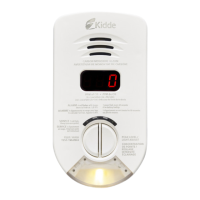
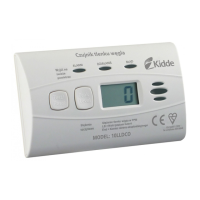
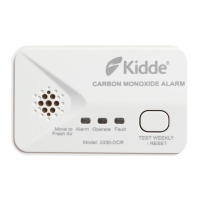
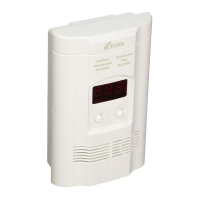
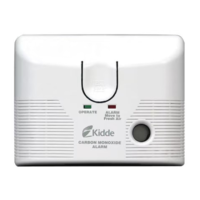
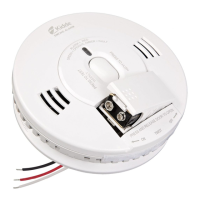
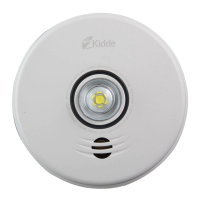
This document is a user guide for the Kidde Model 900-CUAR-VCA Combination Photoelectric Smoke & Carbon Monoxide Alarm with Hardwire Interconnect & Voice.
Function Description
The Kidde 900-CUAR-VCA is a multi-criteria device designed to detect both smoke and carbon monoxide (CO) from any source of combustion in a residential environment. It is a hardwired alarm for 120V AC, and includes two replaceable AA backup batteries to ensure continuous operation during power outages. The alarm features a voice message system and HUSH™ technology for temporarily silencing nuisance alarms. It also incorporates "self-testing" features to ensure proper functionality. The device is designed for use in residential environments and is not intended for recreational vehicles (RV) or boats.
Important Technical Specifications
- Power Source: Hardwired 120VAC, 60 Hz, 42 mA max, with two AA battery backup.
- Sensors: Photoelectric smoke sensor and electrochemical CO sensor.
- Operating Temperature Range: 4.4°C (40°F) to 37.8°C (100°F).
- Humidity Operating Range: 10-95% RH non-condensing.
- Audible Alarm: 85+ dB at 3m (10ft), 3.0 to 3.5 KHz pulsing alarm, with voice messages such as "Fire! Feu!" and "Warning! Carbon monoxide, Monoxyde de carbone!"
- Interconnect: Hardwire interconnectable to other compatible alarms. A maximum of 24 Kidde Safety devices may be interconnected in a multiple station arrangement. The interconnect system should not exceed the NFPA interconnect limit of 12 smoke alarms and/or 18 alarms total (smoke, CO, Smoke/CO Combination, heat, etc.). With 18 alarms interconnected, it is still possible to interconnect up to a total of 6 remote signaling devices and/or relay modules.
- Self-Testing: Includes self-testing features (see Section 10).
- Compliance: This Class B digital apparatus complies with Canadian ICES-003. It also complies with Industry Canada licence-exempt RSS standard(s).
Usage Features
Alarm Indications:
- Normal (standby): Green LED on continuously. DC power: Green LED blinks approximately every 60 seconds.
- Smoke Alarm: Three long beeps with voice "Fire! Feu!," a 1.5 second pause, and three long beeps repeating. Red LED blinks in time with the alarm pattern.
- Carbon Monoxide Alarm: Four quick beeps with voice "Warning! Carbon monoxide. Monoxyde de carbone!" repeating every 5 seconds. Red LED blinks in time with the alarm pattern. On DC power, after 4 minutes in CO alarm the alarm pattern will only occur every 60s.
- Other Alarm Visual and Audible Indicators:
- Test (button press when no alarm condition is present): Red LED blinks in time with alarm pattern. Single beep. 3 long beeps, voice "Fire! Feu!," 3 long beeps, 4 quick beeps, voice "Warning! Carbon monoxide, Monoxyde de carbone!" 4 quick beeps. Performs button press once a week to verify proper alarm operation.
- Smoke or CO Alarm Memory (unit has experienced a smoke or CO alarm event, or has detected 100ppm CO or greater): Smoke: Red LED blinks every 15 sec. CO: 2 red LED blinks every 15 sec. After button push, voice "Caution, carbon monoxide previously detected. Attention, niveau de monoxyde de carbone précédemment détecté." (if CO was detected). No voice for smoke alarm memory. Push button to clear Alarm Memory.
- Smoke Alarm Hush™ Mode: Red LED blinks every 2 sec. After button push, voice "Hush mode activated, Mode hush activé." Smoke alarm pattern stops. (If there is too much smoke to allow Hush™, smoke alarm pattern continues.) Voice "Hush mode cancelled, Mode hush annulé." if button pushed again during Hush™. Push button during Hush™ to clear Hush™ and perform a test.
- CO Alarm Reset: None. After button push: CO alarm pattern stops. Unit is confirming if CO is present or if it experienced a nuisance situation. Re-alarm means danger. Move to fresh air and call 911.
- Initiating Alarm (multiple alarms in an interconnected system): Red LED blinks in time with alarm pattern indicating that this is the unit initiating the alarm in an interconnected, multiple alarm, system. Unit in either Smoke or CO alarm mode.
Troubleshooting Guide:
- False Low Battery (AC power connected before backup batteries activated): Amber LED blinks every 60 sec. Chirp every 60 sec. Pull the battery pull tab to activate the backup batteries.
- Low Battery: Amber LED blinks every 60 sec. Chirp and voice "Low Battery. Pile faible" every 60 sec. (After 1 hour, voice occurs only once every 15 mins). Push button once to silence for 24 hrs. (Pushbutton again to clear Hush™ and perform a test). Note: 7 days after Low Battery begins, the notifications cannot be silenced. Replace batteries as soon as possible.
- Photo Fault: Amber LED blinks every 60 sec. 3 chirps every 60 sec. See Cleaning Your Alarm section. Push button once to attempt to reset the unit. If error continues, remove alarm, dispose unit, and replace as soon as possible.
- CO Fault: Amber LED blinks 2 times every 60 sec. 3 chirps every 60 sec. Push button once to attempt to reset the unit. If error continues, remove alarm, dispose unit, and replace as soon as possible.
- Memory Fault: Amber LED blinks 3 times every 60 sec. 3 chirps every 60 sec. Push button once to attempt to reset the unit. If error continues, remove alarm, dispose unit, and replace as soon as possible.
- End of Unit Life: Amber LED blinks 2 times every 60 sec. 2 chirps every 60 sec. Voice "Hush mode activated, Mode hush activé" after button push (first 7 days only). Push button once to silence for 24 hrs. (Push button again to clear Hush™ and perform a test). Note: 7 days after End of Unit Life begins, the notifications cannot be silenced. Remove alarm, dispose unit, and replace as soon as possible.
- MCU Failure: None. Constant Tone. Remove alarm, dispose unit, and replace as soon as possible.
- Stuck Button: Amber LED blinks 4 times every 60 sec. 3 chirps every 60 sec. Push button to dislodge it from being stuck. If button cannot be unstuck, remove alarm, dispose unit, and replace as soon as possible.
Installation and Activation:
- A dust cover is provided with this alarm. Install the dust cover over the alarm if construction projects are ongoing. Do not remove the dust cover until all construction has been completed for at least 24 hours (drywall, painting, varnishing, mounting plate install, etc.). Construction dust and chemicals can cause contamination and false alarms.
- Wiring Requirements: This alarm should be installed on a CSA-Listed or recognized junction box. All connections should be made by a qualified electrician and all wiring used shall be in accordance with codes having jurisdiction in your area. The multiple station interconnect wiring to the alarms must be run in the same raceway or cable as the AC power wiring. In addition, the resistance of the interconnect wiring shall be a maximum of 10 ohms. The maximum wire run distance between the first and last unit in an interconnected system is 305 m (1000 ft). The appropriate power source is 120 Volt AC Single Phase supplied from a non-switchable circuit. Smoke alarms are not to be used with detector guards unless the combination (alarm and detector guard) has been evaluated and found suitable for that purpose. Kidde alarms are not designed, agency tested or certified for recessed mounting and should not be installed in this manner. Recessed mounting impedes smoke entry into the smoke chamber, which may prevent the alarm from sounding in a timely manner. This could endanger the lives of occupants in the residence. Kidde alarms are designed, tested and certified for wall (if applicable) and ceiling surface mount only.
- AC Quick Connector Harness: The harness connects to the alarm via a slot. The black wire is hot side of AC line, white is neutral side of AC line, and red is interconnect lines.
- Battery Activation: To avoid false low battery chirping, pull out the battery pull tab first to activate the backup batteries. Battery activation is confirmed with a beep and voice "Push test button, Appuyer sur le bouton d'essai." If the beep and voice do not occur when the battery pull tab is removed, remove the batteries and reinstall them. Confirm the battery activation beep and voice.
Operation and Testing:
- The alarm is operating once it is activated and testing is complete (see "TESTING" below). When products of combustion (smoke or CO) are sensed, the unit sounds a loud alarm with voice messages.
- Testing: Retail canned smoke products vary by manufacturer and produce inconsistent results. If the unit does not alarm when canned smoke is applied, conduct a push-to-test to verify proper operation. Over-application of canned smoke can permanently damage the alarm.
- Self-Testing: This model is equipped with internal, self-testing components that are always checking to ensure the device is operating as expected. (Weekly manual testing is still required).
- Manual Testing: Test your alarm weekly by pressing and releasing the button quickly. A quick beep will confirm the button has been pushed followed by the test sequence. See Other Alarm Visual and Audible Indicators table. The alarm and voice (and any interconnected units) will sound if the electronic circuitry, horn, speaker, and batteries are working. If the alarm or voice does not sound, or gives erratic or low volume sound, the unit must be replaced.
- CO Alarm Response Times: At 70 PPM, the unit must alarm within 60-240 minutes. At 150 PPM, the unit must alarm within 10-50 minutes. At 400 PPM, the unit must alarm within 4-15 minutes.
Recognizing Nuisance Alarms:
- Smoke Nuisance: HUSH™: If you know why the alarm is sounding, and you can verify that it is not a life threatening situation, you can push the button on the initiating unit to silence the alarm for 8-10 minutes. If the smoke is not too dense, that unit, and all interconnected units will silence. After the Hush™ period, the smoke alarm will automatically reset and sound the alarm if particles of combustion are still present. You can use Hush™ repeatedly until the air has been cleared of the condition causing the alarm. Dense smoke will override Hush™ and sound a continuous alarm. If no fire is present, check to see if one of the reasons listed in "Locations to avoid" may have caused the alarm. If a fire is discovered, get out and call the fire department or 911. This alarm is designed to minimize nuisance alarms. Cigarette smoke will not normally cause the unit to alarm, unless the smoke is blown directly into the alarm. Combustion particles from cooking may set off the alarm if it is located too close to a cooking appliance. Large quantities of combustible particles are generated from spills or when broiling. Using the fan on a range hood which vents to the outside (non-recirculating type) will also help prevent nuisance alarms from occurring by removing these combustible products from the kitchen.
- Carbon Monoxide (CO) Nuisance: RESET: Pushing the button during CO alarm allows the unit to reset calculations and double check for the presence of CO. If the unit re-alarms within 6 minutes, it is sensing high levels of CO which can quickly become a dangerous situation. Move to fresh air and call 911.
Maintenance Features
Battery Backup:
- This alarm is powered with AC power, but also contains two replaceable AA backup batteries.
- To access the battery compartment, the wiring harness needs to be removed. To release the wiring harness, press down on the tab as shown in Figure 12-A.
- Low Battery: This alarm is equipped with a low battery monitor circuit. If the battery capacity is nearing the point where it can no longer provide adequate power for all alarm functions, the low battery condition will occur. See Troubleshooting Guide. The batteries must be replaced within 7 days of the first occurrence of the "Low Battery Warning" to provide continuous alarm detection.
- Replace batteries with one of the following approved brands: Energizer E91, Gold Peak 15A or Golden Power GLR6A. These batteries can be purchased at your local retailer.
- WARNING: Use only the batteries specified. Use of different batteries may have a detrimental effect on the alarm. Do not mix old and new batteries. Do not mix alkaline, standard, or rechargeable batteries. Do not use lithium batteries in this unit. A good safety measure is to replace the batteries at least once a year, or at the same time you change your clocks for daylight saving time. Loss of AC power and a missing or improperly installed battery will render the unit inoperable.
Cleaning Your Alarm:
- Your alarm should be cleaned at least once a year.
- You can clean the interior of your alarm (sensing chamber) by using compressed air or a vacuum cleaner hose and blowing or vacuuming through the openings around the perimeter of the alarm. The outside of the alarm can be wiped with a damp cloth. Use only water to dampen the cloth, use of detergents or cleaners could damage the alarm.
- If the alarm is in Fault mode, the alarm may be in need of cleaning. After cleaning, press the button. If the fault does not clear, the alarm needs to be replaced.
- Never use detergent or other solvents to clean the unit.
- Avoid spraying air freshener, hair spray, or other aerosols near the alarm.
- Do not use a hair dryer to clean the alarm, as it may damage the alarm and impact performance.
- Do not paint the unit. Paint will seal the vents and interfere with the sensor's ability to detect smoke and CO.
- Never attempt to disassemble the unit to clean inside. This action will void your warranty.
- The following substances can affect the CO sensor and may cause false readings and damage to the sensor: Methane, propane, isobutane, iso-propanol, ethyl acetate, hydrogen sulfide, sulfide dioxides, alcohol based products, paints, thinner, solvents, adhesives, hair spray, aftershave, perfume, and some cleaning agents.
- Move the Alarm and place in another location prior to performing any of the following: Staining or stripping wood floors or furniture, Painting, Wall papering, Using adhesives.
- Storing the unit in a plastic bag during any of the above projects will protect the sensors from damage. When household cleaning supplies or similar contaminants are used, the area must be well ventilated.
Service and Warranty:
- Ten-Year Limited Warranty: Kidde warrants that the enclosed alarm will be free from defects in material and workmanship or design under normal use and service for a period of ten years from the date of purchase.
- This warranty shall not apply to the alarm if it has been damaged, modified, abused or altered after the date of purchase or if it fails to operate due to improper maintenance or inadequate power.
- The manufacturer shall have no liability for any personal injury, property damage or any special, incidental, contingent or consequential damage of any kind resulting from gas leakage, smoke, fire or explosion.
- The above warranty may not be altered except in writing signed by both parties hereto. Your Kidde Alarm is not a substitute for property, fire, disability, life or other insurance of any kind. Appropriate insurance coverage is your responsibility. Notify your local fire department and insurance company of your alarm installation. Opening the unit will void the warranty.

 Need help?
 General

 To Next Page