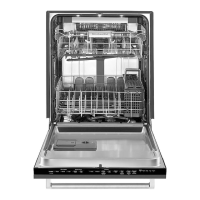
This document describes the KitchenAid Built-In Dishwasher, models KUDM220T, KUDM22GT, and KUDM22HT. It serves as a Use and Care Guide, providing essential information for installation, operation, and maintenance.
Function Description:
The KitchenAid Built-In Dishwasher is designed to wash and dry dishware automatically. It features a "Sure-Scrub™ Wash System" which continuously filters wash water through a triple filtration and soil collector system to prevent food particles from redepositing on clean dishes. The system includes a removable filter, an ultrafine filter, and a removable coarse strainer. The dishwasher also incorporates a 4-Way Hydro Sweep Wash Arm with a single spray nozzle and nine water jets for thorough cleaning. An "Overflow Protection Float" prevents the dishwasher from overflowing. The appliance offers automatic water heating to ensure optimal wash temperatures of at least 120°F (49°C).
Important Technical Specifications:
- Electrical Requirements: Operates on 115 volts, 60 hertz A.C. house current. Cannot be converted to 220 volts, 50 or 60 hertz.
- Water Pressure: Home water pressure should be 20 to 120 psi for proper dishwasher fill.
- Water Temperature: Incoming water temperature should be at least 120°F (49°C) for best results.
- Rinse Agent Dispenser: Holds 7 fluid ounces of liquid rinse agent, sufficient for several months.
- Detergent: Requires automatic dishwashing detergents only. Amount varies based on water hardness and soil level.
- Custom Panels: The stainless front trim can accommodate a custom wood front or a decorative panel insert, 1/4 inch thick. Heavy panels may require heavy-duty door springs (available as a service item).
Usage Features:
- Loading: Designed with ample loading space. Glasses, mugs, saucers, and saucepans can be loaded in either the upper or lower rack. Dishware should be loaded with soiled surfaces facing the rotating wash arm. Sharp items should be located to avoid damaging the door seal, and sharp knives loaded with handles up. Silverware should be loaded to prevent nesting, with slim-handled items handles up.
- Pre-treatment: No hand rinsing is necessary; just scrape leftover food, bones, toothpicks, and other hard items. For hard-to-remove foods that may dry, a "RINSE & HOLD CYCLE" can be used. Do not prewash with hand dishwashing detergent to avoid sudsing.
- Cycles:
- Pots/Pans Cycle: For heavily soiled pots, pans, casseroles, and regular tableware. Involves two wash periods, three rinses, and a heated dry. Total time: 88 minutes, uses 13 gallons of water.
- Normal Wash Cycle: For daily loads with moderate food soil. Involves two wash periods, two rinses, and a heated dry. Total time: 78.5 minutes, uses 10.75 gallons of water.
- Light/China Wash Cycle: For daily loads with light food soil. Uses less water and time. Involves two wash periods, one rinse, and a heated dry. Total time: 63 minutes, uses 7.5 gallons of water.
- Rinse & Hold Cycle: For rinsing partial loads until a full load accumulates. No detergent is used. Provides one rinse. Total time: 13 minutes, uses 2.25 gallons of water.
- Drying Options: "ENERGY SAVER-DRY" option eliminates heat during drying, allowing dishes to air dry naturally. Flash drying (unlatching door after final rinse) can also be used, but may increase spotting in hard water areas.
- Adding Dishware: Items can be added before the main detergent wash portion of the cycle by unlatching the door.
- Canceling a Cycle: The "Cycle Selection Dial" can be advanced to the drain portion (if water is present) or to the "Pots/Pans Cycle" (if water is absent) to cancel.
- Detergent Dispenser: Has compartments for Prewash and Main Wash. Detergent should be added immediately before starting a cycle.
- Rinse Agent: A liquid rinse agent should be used to reduce water spots and speed drying. The dispenser is located to the left of the detergent dispenser.
- Energy Saving Tips: Run with a full load, do not rinse dishware before loading, use only necessary cycles/options, and consider running at night during summer.
Maintenance Features:
- General Cleaning: The porcelain enamel interior seldom needs cleaning, but mineral deposits can be cleaned with a mild scouring powder or by following spot/film removal instructions. Do not use foaming cleansers. The control panel can be wiped with a damp cloth. Enamel or wood fronts can be cleaned with a soft cloth and mild soap.
- Filter Cleaning: The removable filter should be scrubbed with a stiff brush under running water. The 4-Way Hydro Sweep Wash Arm and coarse strainer can also be removed and cleaned if necessary. Check the spray nozzle and water jets for blockages.
- Drain Air Gap: Periodically clean the drain air gap (if installed) to ensure proper drainage.
- Spot and Film Removal: For spots and film on dishware/glasses or hard water film in the dishwasher, stripping products or a vinegar procedure can be used. The vinegar procedure involves loading clean dishes (no silverware/metals), running a "LIGHT/CHINA WASH CYCLE" without detergent, adding 2 cups of vinegar after the main wash fill, and then canceling the cycle after the final rinse. A non-precipitating water conditioner can be used for a final polish.
- Seasonal Storage:
- Summer: Turn off water and electricity supply.
- Winter (Freezing Temperatures): Close and latch door, turn off electricity and water, disconnect fill valve and drain valve to drain water, and leave them disconnected. Reconnect and run a "LIGHT/CHINA WASH CYCLE" to restore service.
- Front Panel Replacement: The dishwasher comes with reversible black/white panels. Instructions are provided for changing panels, with two options depending on whether the dishwasher front is flush with cabinets. This involves disconnecting electrical power, removing trim screws, sliding out the panel, reversing it, and reassembling.

 Need help?
 General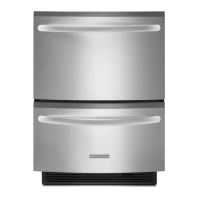


 To Next Page