EasyManua.ls Logo

KitchenAid KUDM220T - Problem, Cause, Solution Chart.18-19

KitchenAid KUDM220T
24 pages
Print Icon
To Next Page IconTo Next Page
To Previous Page IconTo Previous Page
Loading...
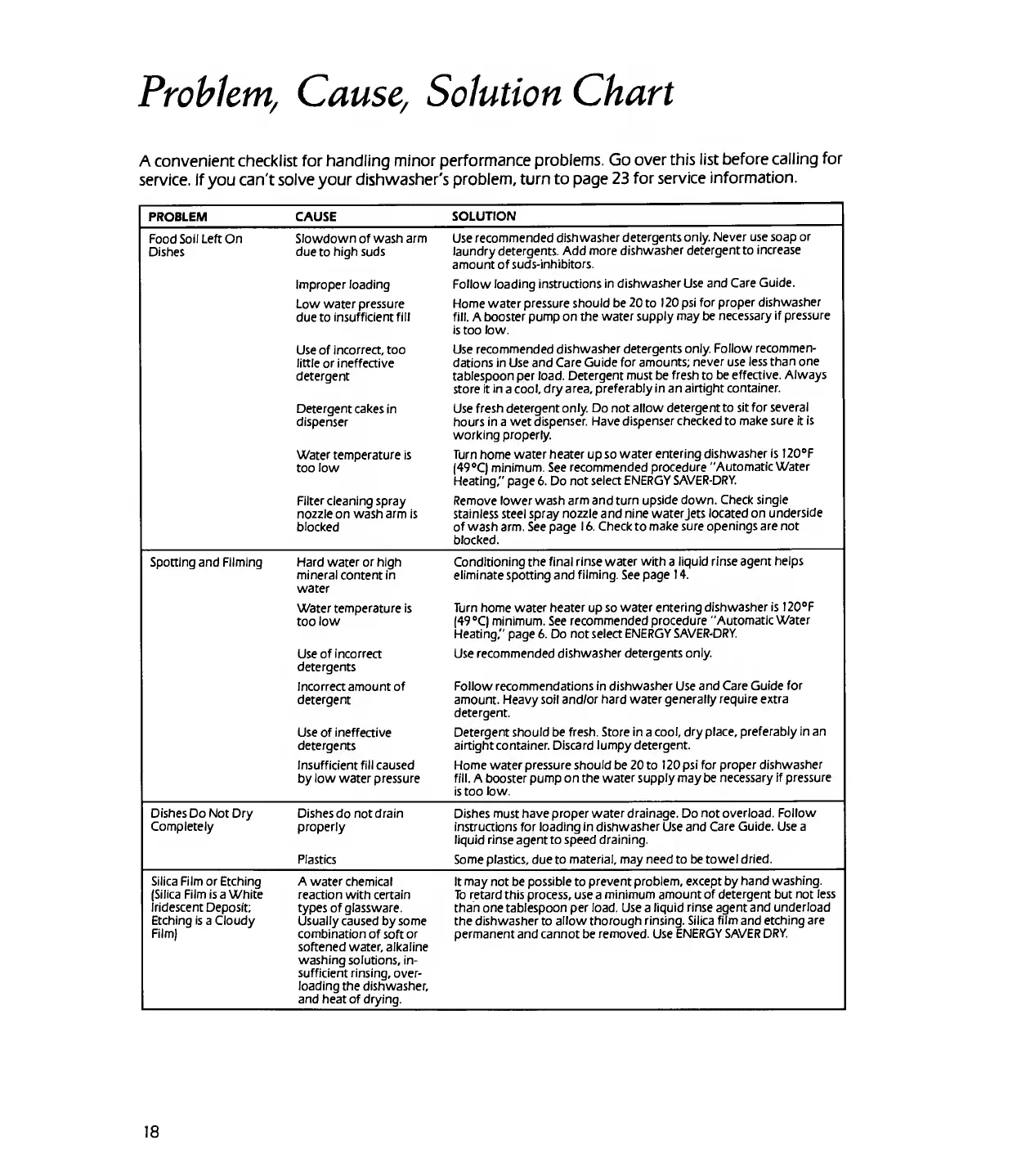
Problem,
Cause,
Solution
Chart
A
convenient
checklist
for
handling
minor
performance
problems.
Go
over
this
list
before
calling
for
service.
If
you
can't
solve
your
dishwasher's
problem,
turn
to
page
23
for
service
information.
PROBLEM
CAUSE
SOLUTION
Food
Soil
Left
On
Dishes
Slowdown
of
wash
arm
due
to
high
suds
Use
recommended
dishwasher
detergents
only.
Never
use
soap
or
laundry
detergents.
Add
more
dishwasher
detergent
to
increase
amount
of
suds-inhibitors.
Improper
loading
Follow
loading
instructions
in
dishwasher
Use
and
Care
Guide.
Low
water
pressure
due
to
insufficient
fill
Home
water
pressure
should
be
20
to
120
psi
for
proper
dishwasher
fill.
A
booster
pump
on
the
water
supply
may
be
necessary
if
pressure
is
too
low.
Use
of
incorrect,
too
little
or
ineffective
detergent
Use
recommended
dishwasher
detergents
only.
Follow
recommen¬
dations
in
Use
and
Care
Guide
for
amounts;
never
use
less
than
one
tablespoon
per
load.
Detergent
must
be
fresh
to
be
effective.
Always
store
it
in
a
cool,
dry
area,
preferably
in
an
airtight
container.
Detergent
cakes
in
dispenser
Use
fresh
detergent
only.
Do
not
allow
detergent
to
sit
for
several
hours
in
a
wet
dispenser.
Have
dispenser
checked
to
make
sure
it
is
working
properly.
Water
temperature
is
too
low
Turn
home
water
heater
up
so
water
entering
dishwasher
is
120°F
(49°C)
minimum.
See
recommended
procedure
"Automatic
Water
Heating,"
page
6.
Do
not
select
ENERGY
SAVER-DRY.
Filter
cleaning
spray
nozzle
on
wash
arm
is
blocked
Remove
lower
wash
arm
and
turn
upside
down.
Check
single
stainless
steel
spray
nozzle
and
nine
water
jets
located
on
underside
of
wash
arm.
See
page
16.
Check
to
make
sure
openings
are
not
blocked.
Spotting
and
Filming
Hard
water
or
high
mineral
content
in
water
Conditioning
the
final
rinse
water
with
a
liquid
rinse
agent
helps
eliminate
spotting
and
filming.
See
page
14.
Water
temperature
is
too
low
Turn
home
water
heater
up
so
water
entering
dishwasher
is
120°F
(49°C)
minimum.
See
recommended
procedure
"Automatic
Water
Heating,"
page
6.
Do
not
select
ENERGY
SAVER-DRY.
Use
of
incorrect
detergents
Use
recommended
dishwasher
detergents
only.
Incorrect
amount
of
detergent
Follow
recommendations
in
dishwasher
Use
and
Care
Guide
for
amount.
Heavy
soil
and/or
hard
water
generally
require
extra
detergent.
Use
of
ineffective
detergents
Detergent
should
be
fresh.
Store
in
a
cool,
dry
place,
preferably
in
an
airtight
container.
Discard
lumpy
detergent.
Insufficient
fill
caused
by
low
water
pressure
Home
water
pressure
should
be
20
to
120
psi
for
proper
dishwasher
fill.
A
booster
pump
on
the
water
supply
may
be
necessary
if
pressure
is
too
low.
Dishes
Do
Not
Dry
Completely
Dishes
do
not
drain
properly
Dishes
must
have
proper
water
drainage.
Do
not
overload.
Follow
instructions
for
loading
in
dishwasher
Use
and
Care
Guide.
Use
a
liquid
rinse
agent
to
speed
draining.
Plastics
Some
plastics,
due
to
material,
may
need
to
be
towel
dried.
Silica
Film
or
Etching
(Silica
Film
is
a
White
Iridescent
Deposit;
Etching
is
a
Cloudy
Film)
A
water
chemical
reaction
with
certain
types
of
glassware.
Usually
caused
by
some
combination
of
soft
or
softened
water,
alkaline
washing
solutions,
in¬
sufficient
rinsing,
over¬
loading
the
dishwasher,
and
heat
of
drying.
It
may
not
be
possible
to
prevent
problem,
except
by
hand
washing.
To
retard
this
process,
use
a
minimum
amount
of
detergent
but
not
less
than
one
tablespoon
per
load.
Use
a
liquid
rinse
agent
and
underload
the
dishwasher
to
allow
thorough
rinsing.
Silica
film
and
etching
are
permanent
and
cannot
be
removed.
Use
ENERGY
SAVER
DRY.
18

Related product manuals