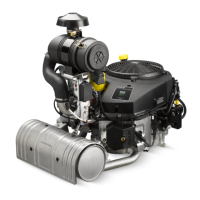
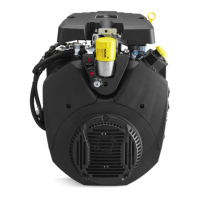
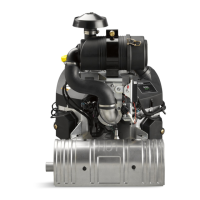
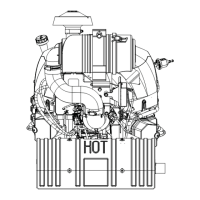
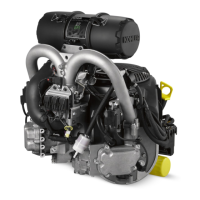
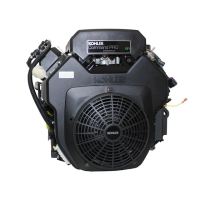
EFI SYSTEM-ECH WITHOUT OXYGEN SENSOR
96
24 690 01 Rev. SKohlerEngines.com
Temperature/Manifold Absolute Pressure (TMAP)
sensor is an integrated sensor that checks both intake
air temperature (IAT) and manifold absolute pressure
(MAP).
Intake Air Temperature control is a thermally sensitive
resistor that exhibits a change in electrical resistance
with a change in its temperature. When sensor is cold,
resistance of sensor is high. As sensor warms up,
resistance drops and voltage signal increases. From
voltage signal, ECU can determine temperature of intake
air.
Purpose of sensing air temperature is to help ECU
calculate air density. Higher air temperature less dense
air becomes. As air becomes less dense ECU knows
that it needs to lessen fuel fl ow to achieve correct air/fuel
ratio. If fuel ratio was not changed engine would become
rich, possibly losing power and consuming more fuel.
Manifold absolute pressure check provides immediate
manifold pressure information to ECU. TMAP sensor
measures diff erence in pressure between outside
atmosphere and vacuum level inside intake passage
and monitors pressure in passage as primary means
of detecting load. Data is used to calculate air density
and determine engine's mass air fl ow rate, which in turn
determines required ideal fueling. TMAP also stores
instant barometric pressure reading when key is turned
ON.
Fuel injectors mount into intake manifold, and high
pressure fuel line attaches to them at top end.
Replaceable O-rings on both ends of injector prevent
external fuel leakage and also insulate it from heat and
vibration. A special clip connects each injector to high
pressure fuel line and holds it in place. O-rings and
retaining clip must be replaced any time fuel injector is
separated from its normal mounting position.
When key switch is on, fuel pump module will pressurize
high pressure fuel line to 39 psi, and voltage is present
at injector. At proper instant, ECU completes ground
circuit, energizing injector. Valve needle in injector
is opened electromagnetically, and pressure in high
pressure fuel line forces fuel down through inside.
Director plate at tip of injector contains a series of
calibrated openings which directs fuel into manifold in a
cone-shaped spray pattern.
Injectors have sequential fueling that open and close
once every other crankshaft revolution. Amount of fuel
injected is controlled by ECU and determined by length
of time valve needle is held open, also referred to as
injection duration or pulse width. Time injector is open
(milliseconds) may vary in duration depending on speed
and load requirements of engine.
A high-voltage, solid-state, battery ignition system is
used with EFI system. ECU controls ignition output and
timing through transistorized control of primary current
delivered to coils. Based on input from crankshaft
position sensor, ECU determines correct fi ring point
for speed at which engine is running. At proper instant,
it interrupts fl ow of primary current in coil, causing
electromagnetic fl ux fi eld to collapse. Flux collapse
induces an instantaneous high voltage in coil secondary
which is strong enough to bridge gap on spark plug.
Each coil fi res every other revolution.
EFI engines are equipped with either a 20 or 25 amp
charging system to accommodate combined electrical
demands of ignition system and specifi c application.
Charging system troubleshooting information is provided
in Electrical System.
An electric fuel pump module and a lift pump (two types)
are used to transfer fuel in EFI system. Types of lift
pumps are: a pulse fuel pump, a mechanical fuel pump,
or a low pressure electric fuel pump. Pumping action
is created by either oscillation of positive and negative
pressures within crankcase through a hose, or by direct
lever/pump actuation off rocker arm movement. Pumping
action causes diaphragm on inside of pump to pull fuel
in on its downward stroke and to push it into fuel pump
module on its upward stroke. Internal check valves
prevent fuel from going backward through pump. Fuel
pump module receives fuel from lift pump, increases and
regulates pressure for fuel injectors.
Fuel pump module is rated for a minimum output of 13.5
liters per hour and regulated at 270 kilopascals (39 psi).
When key switch is turned ON and all safety switch
requirements are met, ECU activates fuel pump module
for about six seconds, which pressurizes system for
start-up. If key switch is not promptly turned to start
position, engine fails to start, or engine is stopped with
key switch ON (as in case of an accident), ECU switches
off pump preventing continued delivery of fuel. In this
situation, MIL will go on, but it will go back off after 4
cranking revolutions if system function is OK. Once
engine is running, fuel pump remains on.
Precision components inside fuel pump module are not
serviceable. DO NOT attempt to open fuel pump module.
Damage to components will result and warranty will be
void. Because fuel pump module is not serviceable,
engines are equipped with a special 10-micron EFI fuel
fi lter to prevent harmful contamination from entering
module.
If there are two fi lters in system, one before lift pump
will be a standard 51-75 micron fi lter, and one after lift
pump will be special 10-micron fi lter. Be sure to use an
approved 10-micron fi lter for replacement.


 To Next Page
 Loading...