7
WARNING
Accidental Starts can cause severe injury or death.
Disconnect and ground spark plug leads before servicing.
Disabling engine. Accidental starting can cause severe injury or death. Before working on the engine or equipment, disable the
engine as follows: 1) Disconnect the spark plug lead(s). 2) Disconnect negative (-) baery cable from baery.
Maintenance Schedule
These required maintenance procedures should be performed at the frequency stated in the table below. They
should also be included as part of any seasonal tune-up.
Frequency Maintenance Required
Daily or Before
Starting Engine
• Check oil level.
• Fill fuel tank.
• Check air cleaner for dirty
1
, loose, or damaged parts.
• Check air intake and cooling areas, clean as necessary.
1
Every 25 Hours
• Clean or replace precleaner (if equipped) clean as necessary.
1,3
Every 100 Hours
• Replace element
1
(low-prole air cleaner models).
• Remove and clean shrouds and cooling areas.
1
• Change oil. (More frequently under severe conditions).
• Check oil cooler ns, clean as necessary (if equipped).
Weekly or Every 150
Hours
• Check lter minder.
4
• Inspect air lter paper element and inlet screen area.
4
Every 200 Hours
• Replace fuel lter.
1
• Clean, set gap or replace spark plug, and set gap.
• Change oil lter.
Annually or
Every 300 Hours
• Replace heavy-duty air cleaner element and check inner element.
1
Annually or
Every 500 Hours
• Have starter serviced.
2
¹Perform these maintenance procedures more frequently under extremely dusty, dirty conditions.
²Have a Kohler Engine Service Dealer perform this service.
3
Low-prole air cleaner.
4
Heavy-duty air cleaner.
Check Oil Level
The importance of checking and maintaining
the proper oil level in the crankcase cannot be
overemphasized. Check oil BEFORE EACH USE as
follows:
1. Make sure the engine is stopped, level, and is cool
so the oil has had time to drain into the sump.
2. Clean the area around and beneath the oil ll cap/
dipstick before removing it. This will help keep
dirt, debris, and other foreign maer out of the
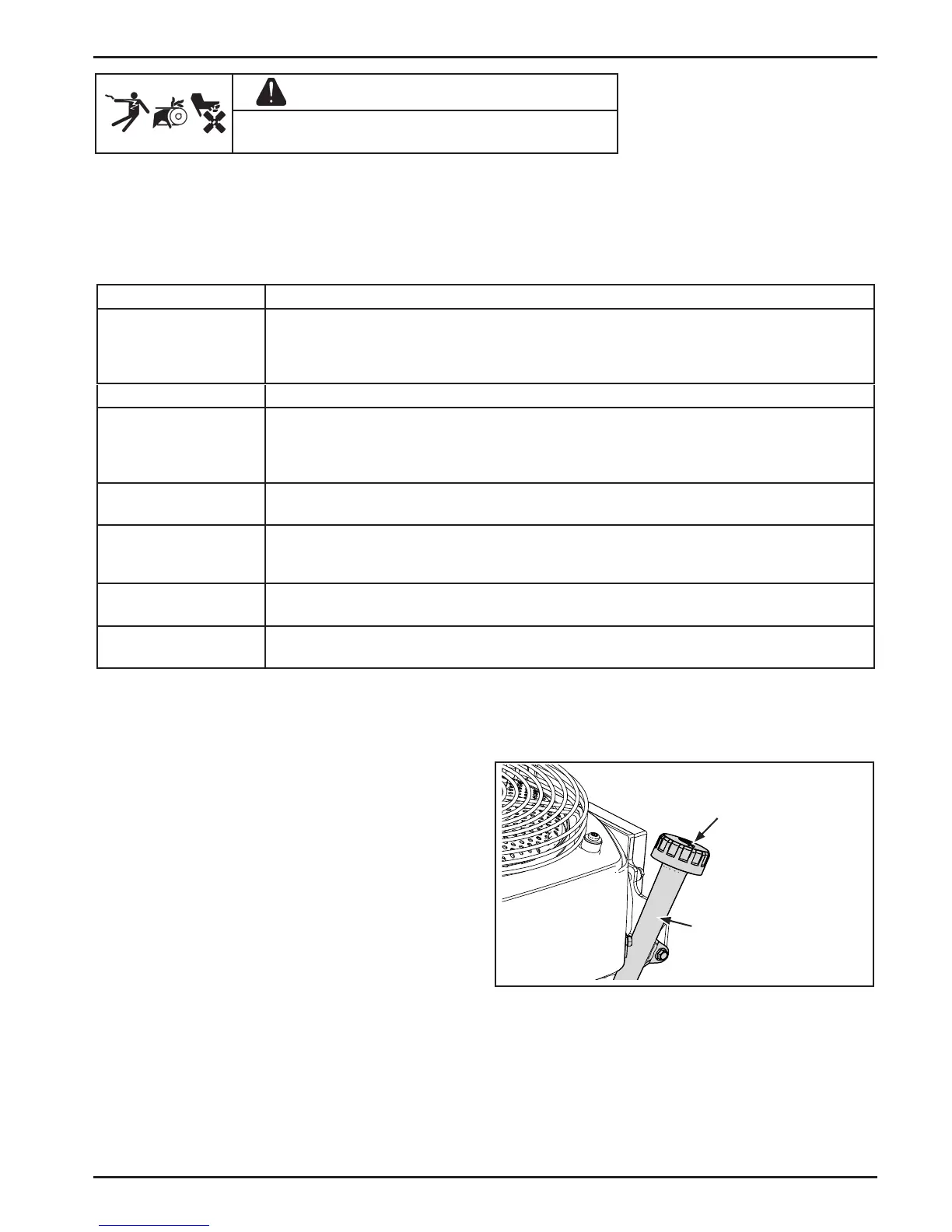
engine. See Figure 3.
Oil Fill
Tube
Oil Fill Cap/
Dipstick
Figure 3. Oil Fill Cap/Dipstick and Oil Fill Tube.




 To Next Page