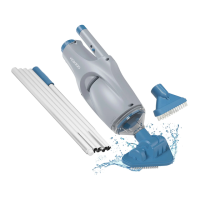
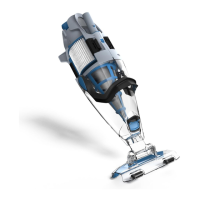
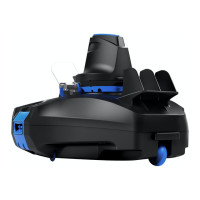
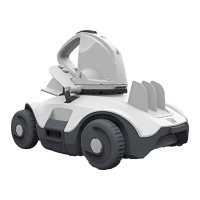
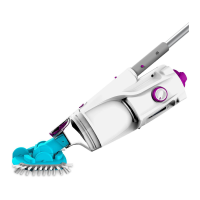
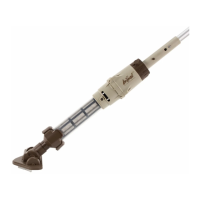
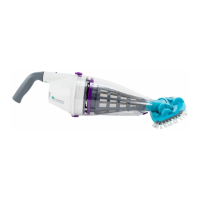
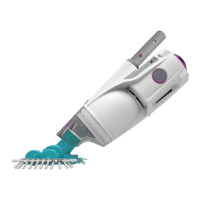
The Kokido Xtovac 200 is a pool vacuum cleaner designed for underwater use only, specifically for cleaning pools. It is not an all-purpose vacuum cleaner and should not be used to clean anything other than a pool. This device is equipped with a rechargeable lithium-ion battery pack and is intended for safe and efficient pool maintenance.
Function Description
The Xtovac 200 operates by generating suction to collect debris from the pool floor. It is designed to be fully immersed in water before operation, with a minimum water level covering the entire unit to prevent damage and voiding of the warranty. The vacuum collects debris from the front, side, and back, filling an internal filter bag. When the impeller becomes clogged with excessive dirt or debris, it automatically stops for 3 seconds to release the larger debris, then resumes operation. The device is powered by a rechargeable lithium-ion battery, which provides a typical operating time of up to 30 minutes on a full charge. The battery's lifespan is limited and its capacity will gradually reduce over time with repeated charging and discharging.
Usage Features
To begin using the Xtovac 200, it must first be fully charged for approximately 6 hours. The charging process involves connecting the provided USB charging cable and USB charger to the unit and a power source. A red indicator light signifies charging, which turns green when fully charged. It is crucial to ensure the pool vacuum and charging port are clean and dry before charging.
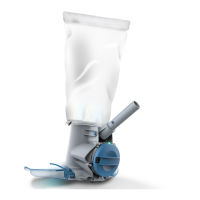
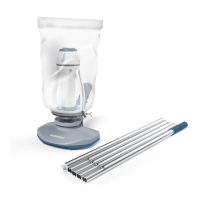
Once charged, the pool vacuum is assembled by aligning and inserting the main body's nozzle into the vacuum head's hole, ensuring it is securely locked. The filter bag is then spread over the main body, with its cord placed under the flange and secured by a cord fastener. For extended reach, a telescopic pole (not provided) can be attached to the pole connector. Brushes can also be inserted into cavities underneath the tab on the vacuum head for enhanced cleaning.
Before deployment, ensure the pool vacuum's on/off switching knob is turned anticlockwise until it clicks and the power indicator lights up. The charging cable must be detached, and the charging port plugged with its protective cap. The vacuum should be fully immersed in water. To effectively vacuum, the unit should be laid flat on the pool floor and steered back and forth in a regular motion over debris patches. The power indicator light will flash when approximately 5-10 minutes of working time remain. If the impeller clogs, the light will turn red for 3 seconds before resuming green. If clogging persists, the vacuum should be removed from the pool and turned off for manual unclogging and filter bag emptying.
When retrieving the pool vacuum, bring it poolside and flip it upside down before lifting to prevent debris from scattering back into the pool and to avoid bending the pole. The device can also be used for vacuuming the sunken compartment of automatic slatted covers, provided safety warnings for the cover are observed. The minimum immersion distance for this operation is 24cm (9.5in).
Maintenance Features
Regular maintenance is essential for optimal performance and longevity of the Xtovac 200. After each use, the pool vacuum should be rinsed with fresh water; aggressive detergents should not be used. The charging port and pins must be thoroughly dried, ideally with a cotton bud, to prevent stains from chemical reactions between water and electric currents. These stains, if they occur, can be removed by light scrubbing with a cotton bud soaked in lemon juice or vinegar.
The filter bag should be emptied and washed regularly to maintain good suction and contact with the pool floor. It is recommended to wash the filter bag with a water jet after each cleaning cycle. For stubborn dirt, the filter bag can be washed in a washing machine at 30°C (86°F). If brushing is necessary, only a soft brush should be used gently to avoid damage.
For storage, the pool vacuum should be detached from the charging cable, cleaned, and dried. It should be stored in a well-ventilated area, away from sunlight, heat, ignition sources, pool chemicals, and children. The ideal storage temperature is 10°C – 25°C (50°F – 77°F). Before storing for an extended period, the battery should be charged to about 30% to 50% of its capacity. The battery must be recharged at least once every three months when not in use to prevent deep discharge.
The rechargeable lithium-ion battery is a consumable item with a limited life. If the battery does not charge fully or its operating time is noticeably reduced, it may need replacement. Battery replacement, along with any disassembly of the main unit (such as for battery disposal), must only be carried out by an authorized technician. Users should never attempt to disassemble the pool vacuum or replace the impeller, motor, or battery themselves, as this can void the warranty and pose safety risks.
Wheel replacement is also a maintenance task. If a wheel is damaged, it should be replaced with a new one. This involves unfastening screws, lifting the cover, removing the damaged wheel, and installing a new one, then reassembling the cover. Similarly, the protective plug can be replaced by unfastening screws, lifting the round cover, removing the old plug, and inserting a new one, ensuring the hinge is fully inserted into the chamber before re-fastening the cover. Always switch off the pool vacuum before replacing the protective plug.
For battery disposal, the pool vacuum must be disconnected from the supply mains. The battery pack, which is maintenance-free, must be disposed of properly through recycling. This process, including removal of the battery pack, should be carried out by an authorized technician using appropriate tools like a screwdriver. During battery removal, personal items like rings, bracelets, necklaces, and watches should be removed to prevent short circuits. Complete eye protection, gloves, and protective clothing are recommended. Contact with wires and metal items should be avoided to prevent sparking or short circuits. Smoking, sparks, or flames should be kept away from the battery and vacuum. The battery should not be exposed to fire or intense heat to prevent explosion. In case of a battery leak, contact with fluids should be avoided, and the damaged battery placed in a plastic bag. If contact occurs, skin and clothing should be washed immediately with soap and water, and eyes flushed with cool running water for at least 15 minutes, seeking medical attention if necessary.


 To Next Page

 General