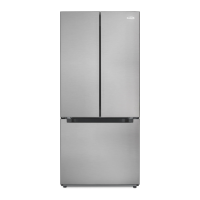
This document serves as a comprehensive user manual for the KoolMore RERFDSS-22C refrigerator, providing essential information on safety, proper usage, structure, functions, and maintenance. It is designed to ensure safe and efficient operation of the appliance, emphasizing the importance of adhering to guidelines for optimal performance and longevity.
The refrigerator is primarily intended for household use and similar applications, such as staff kitchen areas in shops, offices, and other working environments, farmhouses, hotels, motels, and bed and breakfast establishments, as well as catering and similar non-retail applications. It is crucial to understand that this appliance is not designed for storing blood, drugs, or biological products.
Safety Warnings
Safety is paramount when operating this refrigerator. The manual highlights several critical warnings, categorized by symbols:
- Prohibition Symbol: Indicates actions that are strictly forbidden, as non-compliance can lead to product damage or personal injury. For instance, users are prohibited from arbitrarily disassembling or reconstructing the refrigerator, or damaging the refrigerant circuit. Maintenance must only be conducted by a specialist.
- Warning Symbol: Denotes instructions that must be strictly observed to prevent product damage or personal injury. This includes warnings about flammable materials, ensuring ventilation openings are clear, and not using mechanical devices to accelerate defrosting other than those recommended by the manufacturer.
- Cautioning Symbol: Advises special caution, as insufficient attention may result in slight or moderate injury or product damage.
Key electricity-related warnings include:
- Always firmly grasp the power plug when pulling it out from the socket; never pull the power cord.
- Do not damage or use a damaged power cord.
- Use a dedicated power socket and ensure it is properly grounded. Sharing a socket with other appliances can lead to fire hazards.
- In case of gas leakage, turn off the gas valve, open doors and windows, and avoid unplugging electrical appliances to prevent sparks.
- Do not use electrical appliances on top of the refrigerator unless they are specifically recommended by the manufacturer.
Warnings for using the appliance emphasize:
- Do not store explosive or flammable substances like aerosol cans with flammable propellants.
- Unplug the appliance before any user maintenance.
- Keep ventilation openings clear.
- Do not damage the refrigerant circuit.
- Avoid using electrical appliances inside food storage compartments unless recommended.
- Dispose of the refrigerator according to local regulations, as it uses flammable blowing gas and refrigerant. It must be kept away from fire sources and recovered by a specialized company.
- Ensure the supply cord is not trapped or damaged when positioning the appliance.
- Do not use multiple portable socket-outlets or power supplies at the rear.
- Avoid extension cords or ungrounded adapters.
- Child Safety: Before disposing of an old refrigerator, remove the doors and leave shelves in place to prevent children from climbing inside and becoming entrapped. Children should always be supervised to prevent them from playing with the appliance.
Warnings for item placement include:
- Do not place flammable, explosive, volatile, or highly corrosive items in the refrigerator to prevent damage or fire.
- Keep flammable items away from the refrigerator.
- Do not store beer, beverages, or other fluids in bottles or enclosed containers in the freezing chamber, as they may crack due to freezing.
- Avoid placing heavy objects on top of the refrigerator, as they may fall and cause injury when the door is opened or closed.
- Unplug the refrigerator during power failure or cleaning. Wait at least five minutes before reconnecting to prevent compressor damage from successive starts.
Proper Use of the Refrigerator
To ensure proper functioning and stability, the refrigerator needs to be leveled correctly.
- Levelling Feet: Before adjusting, ensure the refrigerator is disconnected from power to prevent personal injury. The feet can be turned clockwise to raise the refrigerator and counterclockwise to lower it. Adjust both the right and left feet until the appliance is horizontal.
- Levelling Door: If the doors are not level, raise the lower door to match the higher door. Insert supplied fastener-rings using pliers into the gap between the hinge-grommet and the lower hinge. The number of rings depends on the gap size.
- Changing the Light: Any replacement or maintenance of LED lamps must be performed by the manufacturer, its service agent, or a similarly qualified person.
- Starting: After initial setup, let the refrigerator stand still for two hours before connecting it to power. Before placing any fresh or frozen foods, allow the refrigerator to run for 2-3 hours, or over 4 hours in summer when ambient temperatures are high. Ensure enough space for convenient opening of doors and drawers.
Energy Saving Tips:
- Place the appliance in the coolest area of the room, away from heat sources and direct sunlight.
- Allow hot foods to cool to room temperature before placing them in the refrigerator. Overloading the appliance forces the compressor to run longer, potentially spoiling food.
- Wrap foods properly and wipe containers dry to reduce frost buildup.
- Avoid lining storage bins with aluminum foil, wax paper, or paper toweling, as this interferes with cold air circulation.
- Organize and label food to minimize door openings and extended searches. Remove multiple items at once and close the door promptly.
Placement:
- Remove all packing materials, including cushions, foam pads, and tapes, and tear off protective films from doors and the body before use.
- Keep the refrigerator away from heat and direct sunlight. Avoid moist or watery places to prevent rust or reduced insulation.
- Do not spray or wash the refrigerator with water, especially in moist areas, to prevent affecting electrical insulation.
- Place the refrigerator in a well-ventilated indoor area on a flat, sturdy ground. Adjust the adjustable legs for stability.
- Ensure at least 30cm of space above the refrigerator and more than 10cm from the wall to facilitate heat dissipation.
- Before installation or adjusting accessories, disconnect the refrigerator from power. Take precautions to prevent handles from falling and causing injury.
Structure and Functions
The refrigerator consists of a refrigerating chamber and a freezing chamber.
- Refrigerating Chamber: Suitable for storing fruits, vegetables, beverages, and other short-term consumables. Cooked foods should be cooled to room temperature before storage and preferably sealed. Glass shelves are adjustable for flexible storage.
- Freezing Chamber: Designed for long-term storage of frozen foods and ice making. It is suitable for meat, fish, rice balls, and other items not consumed immediately. Meat chunks should be divided into smaller pieces for easier access. Food should be consumed within its shelf life.
- Note: Storing too much food after initial power connection can adversely affect freezing. Food should not block the air outlet.
Control and Display Panel:
The display panel features several buttons:
- Ice-making button
- Super cool button
- Temperature adjusting button for the refrigerator room
- Temperature adjusting button for the freezer room
- Super freeze button
- Lock/unlock button
Display Operation:
- Upon electrification, the screen displays for 3 seconds with a bell sound, then enters normal operation. Default temperatures are 41°F for the refrigerator and 0°F for the freezer.
- It displays set temperatures for both chambers when no fault is present.
- Under normal conditions, the display light turns off after 30 seconds in lock state. Button operation or opening a door wakes the screen. If a fault code is visible, the screen lights up for 30 seconds.
Lock/Unlock Function:
- In unlock state, press and hold the lock/unlock button for 3 seconds to enter lock state, accompanied by a buzzer sound.
- In lock state, press and hold the lock button for 3 seconds to unlock, with a buzzer sound.
- The system automatically enters lock state if there's no door opening or button operation within 30 seconds.
- The alarm sound can be stopped by pressing any button in lock state, but other operations require unlocking. An error beep will sound if an operation is attempted in lock state.
Temperature Setting:
- Refrigerator: Click the temperature adjusting button to change the set temperature. Each click decreases the temperature by 1°F. Once 34°F is reached, the next click sets it to 44°F. Settings take effect after the display panel locks.
- Freezer: Click the temperature adjusting button to change the set temperature. Each click decreases the temperature by 1°F. Once -7°F is reached, the next click sets it to 7°F. Settings take effect after the display panel locks.
Mode Setting:
- Super Cool: Press the SUPER COOL button. The refrigerator room automatically sets to 34°F, and the SUPER COOL icon shines. Exiting this mode returns the refrigerator to its previous set temperature.
- Super Freeze: Press the SUPER FRZ button. The freezer room automatically sets to -7°F, and the SUPER FRZ icon shines. Exiting this mode returns the freezer to its previous set temperature.
- Ice Making: Press the ICE MAKER button to toggle the ice-making function on/off. When the ICE MAKER icon is on, ice making is activated.
Error Codes:
The display screen may show error codes indicating problems. While the refrigerator may still provide cooling/freezing functions, users should contact maintenance personnel for resolution.
- E1: Temperature sensor failure of refrigerator room
- E2: Temperature sensor failure of freezer room
- E5: Defrost sensor error of freezer room
- E6: Communication error
- E7: Ambient temperature sensor error
- EH: Humidity sensor error
- Eo: Ice maker error
Maintenance and Care of the Refrigerator
Regular maintenance ensures optimal performance and hygiene.
Defrosting:
- The refrigerator uses an air-cooling principle for automatic defrosting.
- Any frost formed due to seasonal changes or temperature fluctuations can be manually removed by disconnecting the appliance from power or wiping with a dry towel.
Out of Operation:
- Power Failure: In case of power failure, food inside the appliance can remain preserved for several hours, even in summer. Reduce door openings and avoid adding fresh food.
- Long-time Nonuse: Unplug and clean the appliance, then leave the doors open to prevent odors.
- Moving: Before moving, remove all objects, fix glass partitions, vegetable holders, and freezer drawers with tape. Tighten leveling feet. Close and tape the doors. During movement, do not lay the appliance upside down or horizontally, avoid vibration, and ensure the inclination is no more than 45°.
- The appliance should run continuously once started. Interrupting its operation can impair its service life.
Troubleshooting
The manual provides a list of common problems and their solutions. If these steps do not resolve the issue, contact the after-sales department.
- Failed Operation: Check power connection, voltage, and for power failure or tripped circuits.
- Odor: Ensure odorous foods are tightly wrapped, check for rotten food, and clean the interior.
- Long-time Compressor Operation: Normal in summer with high ambient temperatures. Avoid overloading, cool food before placing it, and reduce frequent door openings.
- Light Failure: Check power supply and if the illuminating light is damaged.
- Doors Not Closing Properly: Check for food packages obstructing the door or if the refrigerator is tilted.
- Loud Noise: Ensure the floor is level and the refrigerator is stable. Check if accessories are placed correctly.
- Door Seal Not Tight: Remove foreign matters. Heat the door seal and cool it for restoration (e.g., with an electrical dryer or hot towel).
- Water Pan Overflows: Too much food or water in the chamber can lead to heavy defrosting. Improperly closed doors can cause frosting due to air entry.
- Hot Housing: Normal heat dissipation from the built-in condenser. Provide good ventilation if housing becomes hot due to high ambient temperature or too much food.
- Surface Condensation: Normal when ambient humidity is high; wipe with a clean towel.
- Abnormal Noise: Buzzing from the compressor (especially at start/stop) and creaking from refrigerant flow are normal.
Door Handle Installation
Precautions must be taken to prevent the handle from falling and causing personal injury.
- Tools: Cross screwdriver.
- Procedure:
- Take bolt (1) from the accessory bag and use a cross screwdriver to fix it into the bolt hole (2) of the refrigerator doors.
- Place the handle on the door through bolt (1), ensuring it contacts the door surface closely.
- Fix the handle by rotating handle screw (3) to the end. Shake the handle to verify tightness.
- Put the cap (4) on the handle screw hole to complete installation.
Installing the Waterline
Water line installation kits are available as an additional accessory from dealers or hardware stores.
- Connecting to the Water Supply Line:
- Shut off the main water supply line and turn off the ice maker.
- Locate the nearest cold water supply valve.
- After connecting the water supply to the water valve, turn the main supply back on and flush several gallons of water to clear the line.
- Connecting the Water Line to the Refrigerator:
- Insert water tubes (supplied) into the corresponding hole of the water connector (supplied).
- Insert the water line installation kit (not included) into another hole of the water connector (supplied).
- Turn the water valve on and check for any leakage.
- Connecting to a Drinkable Water Source: If the water line is not drinkable, add an external water filter.
- Repair/Disassembly: If repairing or disassembling the water line, cut off the plastic tubing to ensure a snug, leak-free connection.
This manual provides a comprehensive guide for users to effectively operate and maintain their KoolMore RERFDSS-22C refrigerator, ensuring safety, efficiency, and prolonged product life.

 Need help?
 General

 To Next Page