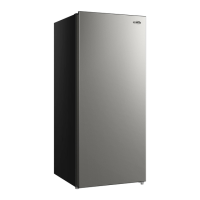
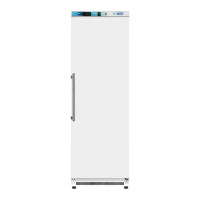
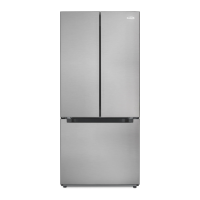
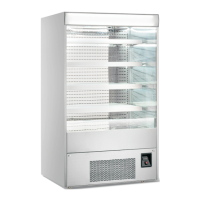
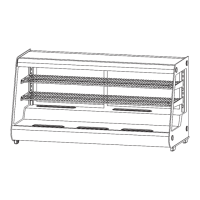
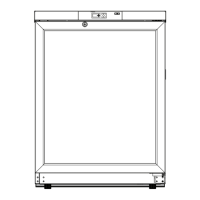
This document serves as the user's manual for a series of commercial reach-in refrigerators and freezers. It provides essential information regarding installation, safety, operation, maintenance, and troubleshooting for these units.
Function Description:
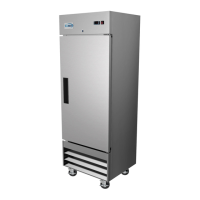
The devices covered by this manual are commercial reach-in refrigerators and freezers. These units are designed for professional use, likely in kitchens, restaurants, or other food service establishments, to store perishable goods at controlled temperatures. The "reach-in" designation implies that users access the stored items by opening a door and reaching inside, as opposed to walk-in units. The models listed include both stainless steel (SS) and glass door (GD) options, indicating versatility in application, where glass doors might be preferred for display or quick inventory checks.
Important Technical Specifications:
The manual lists specific model numbers for both refrigerators and freezers:
- Refrigerator Models: RIR-1D-SS-19C, RIR-1D-SS, RIR-2D-SS, RIR-3D-SS, RIR-1D-GD, RIR-2D-GD, RIR-3D-GD. The "1D," "2D," and "3D" likely refer to the number of doors (one, two, or three-door units), while "SS" denotes stainless steel and "GD" denotes glass door. "19C" might indicate a specific capacity or configuration.
- Freezer Models: RIF-1D-SS-19C, RIF-1D--SS, RIF-2D--SS, RIF-3D-SS. Similar to the refrigerators, these likely represent one, two, and three-door stainless steel freezer units.
While specific dimensions, capacities, or refrigerant types are not detailed on the provided pages, the safety warnings mention "Flammable refrigerant used," indicating that the units utilize refrigerants like R290 (propane) or R600a (isobutane), which are common in modern commercial refrigeration for their lower environmental impact but require specific handling precautions. The electrical section emphasizes the need for a "grounded and properly-sized electrical outlet" and appropriate overcurrent protection, with voltage requirements to be found on the unit's nameplate.
Usage Features:
The manual stresses proper setup and operation for optimal performance and longevity. Key usage features and recommendations include:
- Initial Setup: After transport, the unit should stand still for a minimum of 24 hours before plugging in to allow refrigerants and oils to settle. It's crucial to wait for the unit to reach the desired temperature before loading products.
- Loading: Avoid placing excessive amounts of warm product into the cabinet at once, as this can cause the condensing unit to run for prolonged periods.
- Door Management: Keep doors closed when not in use and avoid prolonged door openings to maintain internal temperature and efficiency.
- Thermostat Control: Users can adjust the thermostat to control the internal temperature. If the cabinet is too warm, the thermostat may be set too high.
- Airflow: Ensure proper airflow inside the cabinet by arranging products to allow at least four inches of clearance from the evaporator.
- Ventilation: The unit requires proper ventilation, with a minimum clearance of 20 cm (or 4 inches in another section) from the cabinet to the wall, and should not be sealed completely at the back. It must be installed in a well-ventilated indoor area. Outdoor use is discouraged.
- Stability: The unit should be installed on strong and leveled surfaces to prevent unpleasant noises and malfunction.
- Electrical Connection: A dedicated, grounded, single-phase electrical socket with appropriate overcurrent protection is required. Extension cords are strictly prohibited.
- Safety: The manual explicitly prohibits storing flammable and volatile chemicals or explosive gases/liquids inside the unit. Users are warned not to hang on the doors.
Maintenance Features:
Regular maintenance is crucial for the efficient operation and longevity of these commercial units. The manual outlines several key maintenance procedures:
- Condenser Coil Cleaning: This is highlighted as very important for efficient operation. The condenser surface should be kept free of dust, dirt, and lint. Cleaning is recommended at least once per month using a commercial condenser coil cleaner and a brush (top to bottom). Bent fins should be straightened with a fin comb.
- Fan Blade and Motor Cleaning: If necessary, fan blades and the motor should be cleaned with a soft cloth. If washing the blades, the fan motor must be covered to prevent moisture damage.
- Interior Cleaning: The cabinet interior should be cleaned using warm water and mild soap. Abrasive cleaners, steel wool, caustic soap, or bleach are prohibited as they can damage the stainless steel surface.
- Door Gasket Maintenance: Door gaskets should be washed regularly (preferably weekly). They can be removed, soaked in warm water and soap for 30 minutes, dried with a soft cloth, and then replaced. After replacement, their proper seal should be checked.
- Shelf and Pilaster Cleaning: Shelves and pilasters should be periodically removed and cleaned with mild soap and warm water. Pilasters are removed by first taking out shelves and shelf brackets, then lifting the pilaster up and out.
- Defrosting: The manual mentions a "defrost cycle" and advises unplugging the unit to allow the evaporator coil to defrost if it's iced over. Mechanical devices should not be used for defrosting.
- Pre-Maintenance Safety: A critical warning states to "Disconnect power cord before cleaning any parts of the unit."
Troubleshooting:
The manual includes a troubleshooting section to help users identify and resolve common issues before calling for service. It provides a table linking symptoms to possible causes and corrective actions. Examples include:
- Compressor not running: Possible causes include a blown fuse/tripped circuit breaker, unplugged power cord, or thermostat set too high. Corrective actions involve checking and resetting electrical components, plugging in the cord, or adjusting the thermostat.
- Condensing unit runs for long periods: This could be due to excessive warm product, prolonged door opening, improperly sealing door gaskets, a dirty condenser coil, or an iced-over evaporator coil. Solutions range from allowing product to cool, ensuring doors are closed and gaskets sealed/cleaned/replaced, to cleaning the condenser coil or defrosting the evaporator.
- Cabinet temperature too warm: Possible causes include a thermostat set too warm, blocked airflow, excessive warm product, a blown fuse/tripped circuit breaker, a dirty condenser coil, or prolonged door opening. Corrective actions involve adjusting the thermostat, rearranging products for airflow, checking electrical components, cleaning the condenser, or ensuring doors are closed.
- Cabinet is noisy: This could be due to loose parts or tubing vibration. Corrective actions involve locating and tightening loose parts or ensuring tubing is free from contact with other components.
The manual strongly advises against attempting to solve problems independently if they persist, recommending that users refer to a certified technician. It also emphasizes that servicing should be done by factory-authorized personnel to minimize risks associated with incorrect parts or improper service.


 To Next Page
 General