Need help?
Do you have a question about the Koso Mini3 and is the answer not in the manual?
Displays the current fuel level in 10 discrete steps or 0-100% numerically.
Configures the meter to match the vehicle's fuel sender resistance.
Sets the fuel level threshold for the warning indicator.
Includes operating voltage, temperature range, meter standard, size, and weight.
Guides users through selecting the correct resistance value for their vehicle's fuel sender.
Details the procedure to set the low fuel warning level.
Explains how to calibrate the meter for empty and full fuel tank positions.
Covers checks for power supply, wiring, and fuses for meter activation issues.
Addresses issues with fuel level display, checking fuel, wiring, and settings.
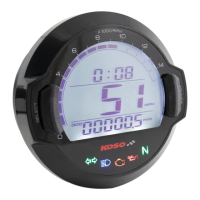
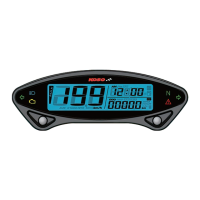
The KOSO Fuel Meter is a digital instrument designed to provide accurate and real-time fuel level information for vehicles operating on a DC 12V electrical system. This device is an essential tool for drivers who need to monitor their fuel consumption and avoid unexpected fuel shortages. The meter features a clear LCD display that shows the fuel level in two distinct ways: a 10-level graphical representation and a precise percentage display. This dual display ensures that users can quickly grasp their fuel status at a glance, whether they prefer a visual indicator or a numerical value.
The primary function of the KOSO Fuel Meter is to measure and display the fuel level in a vehicle's tank. It achieves this by connecting to the vehicle's original fuel level signal wire, interpreting the electrical resistance changes from the fuel sender unit, and converting this data into an easily understandable format on its LCD screen. The meter is designed to be highly adaptable, offering a "Fuel Gauge Resistance Setting" that allows it to be calibrated to a wide range of fuel sender units found in various motorcycle and scooter models. This adaptability is crucial for ensuring compatibility across different vehicle manufacturers and models, making it a versatile aftermarket accessory.
Beyond simple fuel level display, the KOSO Fuel Meter incorporates a "Fuel Warning Setting." This feature allows the user to define a specific low fuel threshold, expressed as a percentage, at which the meter will activate a warning. This proactive alert system is invaluable for preventing situations where a driver might unknowingly run out of fuel, providing ample time to locate a refueling station. The warning threshold is customizable, enabling users to set it according to their preferences and typical driving habits, ranging from 0% to 25% of the tank's capacity.
A unique and advanced feature of the KOSO Fuel Meter is its "Fuel Learning Setting." This mode is particularly useful when the exact resistance values of the vehicle's fuel sender unit are unknown or when a more precise calibration is desired. In this learning mode, the meter can be taught the "empty" and "full" fuel levels by having the user physically adjust the fuel in the tank to these states and then confirming them on the meter. This self-calibration capability ensures a highly accurate fuel reading tailored specifically to the individual vehicle's fuel system, overcoming potential discrepancies that might arise from generic resistance settings.
The meter's interface is designed for simplicity and ease of use, primarily relying on a single button for navigation and setting adjustments. A short press of the button is used for changing values or confirming selections, while a long press (3 seconds) is typically used to enter or exit setting menus. This intuitive control scheme minimizes complexity, allowing users to configure the meter without extensive technical knowledge.
Installation of the KOSO Fuel Meter is designed to be straightforward, although it requires careful attention to wiring connections. The meter comes with essential accessories, including the LCD meter unit, mid-way connectors, and Velcro for mounting. The Velcro allows for flexible placement of the meter on the dashboard or any desired surface, ensuring it is easily visible to the driver.
The wiring process involves connecting the meter to three main points: the DC 12V main power switch (for power), the vehicle's ground (for electrical return), and the original fuel level signal wire (for fuel level data). The manual provides clear color-coded wiring references for common motorcycle brands like Yamaha, Honda, Suzuki, Kawasaki, Kymco, SYM, and PGO, simplifying the identification of the correct wires. This detailed guidance is critical for a successful installation and to prevent damage to the meter or the vehicle's electrical system.
Once installed, the meter's setup involves configuring the fuel gauge resistance. The manual provides a comprehensive reference table listing resistance values for numerous motorcycle and scooter models, which users can select from. If a specific model is not listed, or for enhanced accuracy, the "USER" mode can be selected, leading to the "Fuel Learning Setting" for a custom calibration. This flexibility ensures that the meter can be adapted to a wide array of vehicles, making it a universal solution for fuel monitoring.
The "Fuel Warning Setting" is a practical usage feature that enhances safety and convenience. By setting a personalized low fuel alert, drivers can avoid the stress and inconvenience of running out of fuel unexpectedly. The meter's ability to display both a graphical fuel bar and a percentage allows drivers to choose their preferred method of monitoring, catering to different visual preferences.
The compact size and lightweight design of the KOSO Fuel Meter make it unobtrusive and easy to integrate into a vehicle's cockpit. Its robust construction is designed to withstand typical operating temperatures, ensuring reliable performance in various environmental conditions.
The KOSO Fuel Meter is designed for durability and minimal maintenance. However, proper installation is key to its longevity and accurate operation. The manual explicitly warns against breaking or modifying wire terminals and advises against pulling wires during installation to prevent short circuits. These precautions are essential "maintenance" steps during the initial setup phase to ensure the device functions correctly from the start.
The troubleshooting section of the manual serves as a primary maintenance guide for common issues. It addresses scenarios such as the meter not powering on or the fuel gauge displaying incorrectly. For power issues, it directs users to check wiring connections, fuses, and the battery's condition, emphasizing that a weak or broken battery might not supply sufficient DC 12V power. For incorrect fuel readings, it advises checking the fuel tank for actual fuel content, verifying wiring connections to the fuel sender, and confirming the meter's resistance settings. This systematic approach allows users to diagnose and resolve minor problems without professional assistance.
The manual also highlights the importance of correct wiring for the fuel signal, specifically cautioning against parallel connections with the original fuel sensor if it is an electronic type. Incorrect wiring in this area can lead to the fuel gauge not displaying correctly or even damage to the meter. This specific warning underscores a critical "maintenance" aspect related to installation integrity.
The device is not designed for user disassembly or modification beyond the described installation and setting procedures. Any internal examination or maintenance is explicitly stated to be performed by professionals. This ensures the integrity of the device and prevents potential damage from untrained handling.
In essence, the maintenance of the KOSO Fuel Meter primarily revolves around ensuring a correct initial installation, adhering to the specified wiring guidelines, and utilizing the provided troubleshooting steps for any operational anomalies. Its robust design and clear instructions aim to provide a reliable and long-lasting fuel monitoring solution with minimal ongoing user intervention.
 General
| Display Type | LCD |
|---|---|
| Weight | 50g |
| Resolution | 0.1 km/h |
| Accuracy | ±1 km/h |
| Temperature Range | -10°C to 60°C |
| Measurement Range | 0 to 360 km/h |
| Display | Digital |

 To Next Page