EasyManua.ls Logo

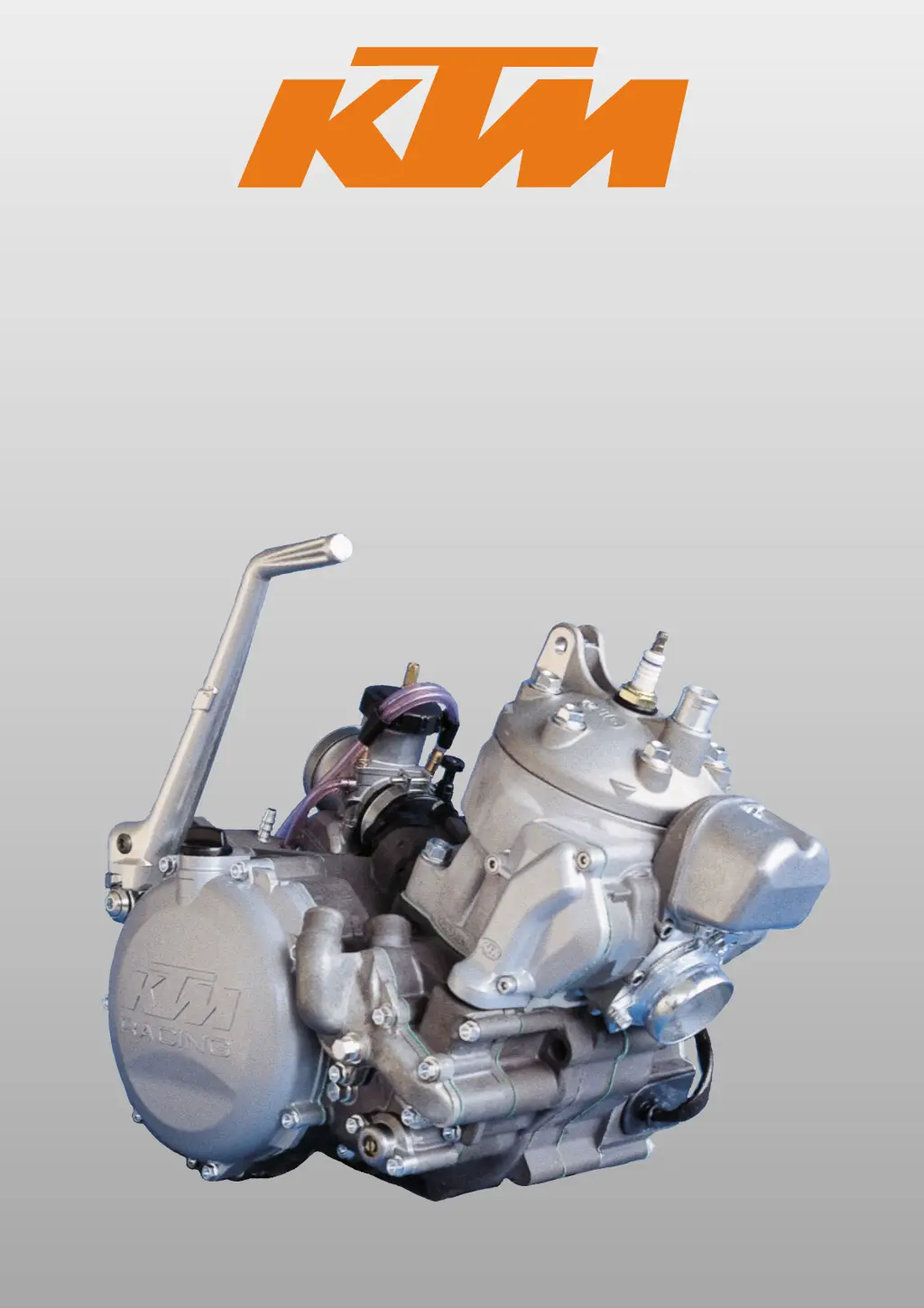
KTM 250 1998 - User Manual

KTM 250 1998
59 pages
Print Icon
To Next Page IconTo Next Page
Loading...
‘98
7. 97 ART. NR. 3.205.20
250 / 300 / 380
REPARATURANLEITUNG MOTOR
REPAIR MANUAL ENGINE
MANUALE DI RIPARAZIONE MOTORE
MANUEL DE RÉPARATION MOTEUR
MANUAL DE REPARACIÓN MOTOR

Table of Contents

Questions and Answers

  • K
    Kelly BellAug 19, 2025
    Why KTM 250 1998 Engine has not enough power?
    • A
      Angela ClayAug 19, 2025
      Your KTM Engine might lack power due to several reasons: * **Exhaust System**: Charred glass fiber yarn in the silencer (renew filling) or a damaged exhaust system (check for damage). * **Fuel and Air Supply**: An obstructed air filter (clean or renew it) or a partly interrupted/blocked fuel supply (blow through the fuel pipe and clean the carburetor). * **Mechanical Issues**: A control flap that doesn't work (check the control flap, joint rod, and centrifugal timer), loss of compression through a loose spark plug (tighten the spark plug), or insufficient preignition (check and adjust the ignition).
  • B
    Bobby SmithAug 22, 2025
    How to fix KTM 250 1998 overheating?
    • J
      Joshua GomezAug 22, 2025
      If your KTM Engine is overheating, consider these potential causes and solutions: * **Coolant Issues**: Insufficient coolant (top up and bleed the system), a cooling system that isn't properly bled (bleed it), or frothing in the cooling system (renew the coolant with a branded anti-freeze/anti-corrosive). * **Radiator**: Clogged radiator fins (clean them with a water jet). * **Hoses**: Pinched or kinked water hoses (replace them with correctly routed hoses). * **Timing**: Incorrect ignition timing due to loose stator screws (readjust timing and secure screws with Loctite 242), or an incorrect dimension "X" (measure and adjust to the correct specification).
  • L
    Laura JohnsonAug 26, 2025
    What to do if KTM 250 1998 ignition wire or spark plug connector damaged?
    • U
      uevansAug 26, 2025
      If the ignition wire or spark plug connector is damaged on your KTM Engine, dismount the spark plug, connect the ignition cable, hold it to ground, and actuate the kickstarter. A strong spark must be produced at the spark plug. If no spark is produced, loosen the spark plug cap from the ignition cable, hold it about 5 mm from the ground, and actuate the kickstarter. If a spark now occurs, replace the spark plug cap. If no spark is produced, control the ignition system.
  • B
    Brenda VanceAug 27, 2025
    What causes KTM Engine to sputter into the carburetor?
    • A
      Allison StewartAug 28, 2025
      If your KTM Engine sputters into the carburetor, it could be due to: * **Fuel Issues**: Lack of fuel (clean fuel pipes, examine tank aeration and clean). * **Incorrect Parts**: Spark plug with incorrect heat value (fit correct spark plug). * **Air Leaks**: Engine taking air out of control (check intake flange and carburetor if firmly setted).
  • B
    Bruce HansenAug 30, 2025
    How to resolve KTM 250 1998 Engine without idle running?
    • A
      Abigail JohnsonAug 30, 2025
      If your KTM Engine won't idle, the possible causes include: * **Adjustment Issues**: Idle adjusting screw out of adjustment (readjust idle running or replace idle adjusting screw). * **System Damage**: Ignition system damaged (examine ignition system). * **Wear**: Wear (overhaul engine).
  • W
    William SmithSep 2, 2025
    Why KTM 250 1998 Engine experiences high rpm misfiring?
    • D
      Danielle JonesSep 2, 2025
      High RPM misfiring in your KTM Engine can be caused by: * **Spark Plug Issues**: Incorrect heat range or low-quality spark plug (refer to the technical data section). * **Connector Problems**: Incorrect or faulty spark plug connector (test and/or replace with the correct type). * **Socket Connection**: Loose, corroded, or non-conductive ignition socket connector (check and seal with silicon).
  • L
    lisamooreSep 5, 2025
    Why KTM 250 1998 Engine revs not high and running with four stroke cycle?
    • J
      Jacob LindseySep 5, 2025
      If your KTM Engine revs are not high and it's running with a four-stroke cycle, the issues might be: * **Carburetor Problems**: Carburetor overflows if the level adjust is too high, or the float needle seating is dirty or enlarged (clean carburetor, if necessary replace float needle and adjust level). * **Loose Components**: Loose carburetor jets (tighten jets).
  • W
    Whitney HarrisSep 7, 2025
    Why excessive oil escapes from KTM transmission breather tube?
    • T
      trevorreyesSep 8, 2025
      Excessive oil escaping from the transmission breather tube in your KTM could be due to: * **Overfilling**: Excessive oil quantity in the transmission (correct the transmission oil level). * **Seal Issues**: A defect in the water pump shaft seal ring or right-hand crankshaft seal ring (replace the shaft seal ring and change gear oil, check coolant). * **O-Ring Leaks**: Silicon O-rings of the control roller or control flap leaking (replace the O-rings).
  • J
    Jason CamachoSep 10, 2025
    Why KTM Engine emits white smoke (steam)?
    • Q
      qhawkinsSep 12, 2025
      If your KTM Engine is emitting white smoke (steam), it could be because the cylinder head or O-ring of the cylinder head gasket leaks. Check the cylinder head and replace the O-ring.
  • D
    Dylan HernandezSep 13, 2025
    Why all switched on lamps blown out in KTM?
    • J
      jennafergusonSep 13, 2025
      If all switched-on lamps are blown out in your KTM, the voltage regulator may be faulty. Control connections of voltage regulator and check voltage regulator.

Summary

Introduction

1.0 General

1.1 Bleeding the cooling system

Procedure for removing air from the cooling system after refilling.

1.2 Carburetor adjustment

Guide to adjusting the carburetor for different altitude and temperature conditions.

1.3 Definitions

Explains key terms related to engine operation and carburetor settings.

1.4 Checking the float level

Method for verifying the fuel level in the carburetor float chamber.

1.5 Checking the setting of the TVC system

Procedure to check and adjust the TVC system's advance timing.

1.6 Special tools

Lists and illustrates specific tools required for maintenance tasks.

2.0 Removing engine; Refitting engine

2.1 Removing engine

Step-by-step instructions for safely removing the engine from the motorcycle frame.

2.2 Installing the engine

Detailed guide for re-installing the engine back into the motorcycle frame.

3.0 Dismantling engine

3.1 Draining gear oil

Procedure for draining the engine's gear oil before disassembly.

3.2 Cylinder head, cylinder, piston

Instructions for removing the cylinder head, cylinder, and piston assembly.

3.3 Clutch cover

Steps to remove the clutch cover to access internal clutch components.

3.4 Clutch discs

Guide on how to remove and handle the clutch discs.

3.5 Primary drive

Process for dismantling the primary drive system components.

3.6 Kickstarter

Steps to remove and service the kickstarter mechanism.

3.7 Shift system

Instructions for dismantling the gear shifting mechanism.

3.8 Ignition (Kokusan)

Procedures for dismantling the Kokusan ignition system components.

3.9 Ignition system (SEM)

Procedures for dismantling the SEM ignition system components.

3.10 Clutch release shaft

Steps for removing the clutch release shaft.

3.11 Engine sprocket

Instructions for removing the engine sprocket.

3.12 Intake flange, reed valve housing

Guide to removing the intake flange and reed valve housing.

3.13 Parting of engine housing halves

Detailed process for separating the engine crankcase halves.

3.14 Shift mechanism, transmission

Instructions for dismantling the transmission and shift mechanism.

3.15 Crankshaft

Procedure for removing the crankshaft from the engine casing.

4.0 Servicing on individual components

4.1 Right-hand housing half

Servicing procedures for the right-hand engine crankcase half.

4.2 Left-hand housing half

Servicing procedures for the left-hand engine crankcase half.

4.3 Crankshaft

Maintenance and inspection steps for the engine crankshaft.

4.4 Piston

Checks and procedures for servicing the piston.

4.5 Piston ring end gap

How to measure and check the piston ring end gap.

4.8 Cylinder preassembly

Steps for assembling the cylinder components before final installation.

4.15 Transmission

Procedures for servicing the engine's transmission system.

4.16 Clutch

Checks and procedures for servicing the clutch assembly.

4.20 Ignition (Kokusan)

Servicing and testing the Kokusan ignition system.

4.21 Ignition (SEM)

Servicing and testing the SEM ignition system.

5.0 Engine assembly

5.1 Crankshaft

Steps for installing the crankshaft into the engine casing.

5.2 Transmission

Guide to assembling the transmission gears and shafts.

5.3 Assembly of engine housing

Process for joining the engine crankcase halves.

5.4 Clutch release shaft

Installing the clutch release shaft assembly.

5.5 Shift mechanism

Assembling the gear shift mechanism components.

5.6 Kickstarter

Installing the kickstarter mechanism.

5.7 Primary drive, clutch

Assembling the primary drive and clutch components.

5.8 Clutch discs, pressure cap

Installing the clutch discs and pressure cap.

5.9 Clutch cover

Mounting the clutch cover onto the engine.

5.10 Piston and cylinder

Installing the piston and cylinder assembly.

5.11 Adjusting Dimension X“

Adjusting the piston-to-cylinder dimension X for compression.

5.12 Adjusting control flap (dimension “Z)

Setting the control flap dimension Z for exhaust port timing.

5.13 Cylinder head

Installing the cylinder head onto the cylinder.

5.14 Reed valve housing, intake flange

Mounting the reed valve housing and intake flange.

5.15 Left-hand steering cover

Installing the left-hand side engine cover.

5.16 Engine sprocket

Installing the engine sprocket onto the countershaft.

5.17 Mounting the ignition (Kokusan)

Installing the Kokusan ignition system components.

5.18 Mounting ignition (SEM)

Installing the SEM ignition system components.

5.19 Adjusting ignition point (SEM)

Setting the ignition timing for the SEM system.

5.20 Filling in gear oil

Procedure for filling the engine with the correct gear oil.

5.21 Starting lever, foot shift lever

Installing the kickstarter and shift levers.

6.0 Electrical

6.1 Checking the voltage regulator (Tympanium)

Procedure for testing the Tympanium voltage regulator for proper function.

6.2 Checking the voltage regulator-rectifier (Shindengen)

Testing the Shindengen voltage regulator-rectifier unit.

6.3 Checking the voltage regulator (Kokusan)

Methods to check the Kokusan voltage regulator for defects.

6.4 Checking the capacitor

Steps to test the electrical system's capacitor for functionality.

6.5 Ignition coil (SEM)

Information on servicing the SEM ignition coil using specialized equipment.

6.6 Ignition coil (Kokusan)

Measuring resistance values of the Kokusan ignition coil.

6.7 CDI unit

Checking connections for the CDI unit; function test requires test bench.

7.0 Trouble shooting

7.1 TROUBLE SHOOTING

A comprehensive chart to diagnose and resolve common engine and electrical problems.

8.0 Technical data; maintenance schedule

8.1 TECHNICAL DATA - ENGINE (all models out of USA)

Specifications for engine design, dimensions, fuel, and basic settings for all models.

8.2 TOLERANCES AND FITTING CLEARANCES

Key tolerances and assembly clearances for engine components.

8.3 TIGHTENING TORQUES

Specified torque values for critical engine fasteners.

8.4 GASKET THICKNESSES

Table of standard gasket thicknesses for engine assembly.

8.5 BASIC CARBURETOR SETTING

Recommended carburetor settings for various models and regions.

8.3 PERIODIC LUBRICATION AND MAINTENANCE SCHEDULE

Schedule of routine maintenance tasks and intervals for the motorcycle.

Wiring Diagrams

Component List

List of electrical components with their corresponding numbers and multilingual names.

Wiring Diagram

Electrical schematics illustrating the motorcycle's wiring layout and connections.

Contact Assignments

Details on the pin assignments for various electrical connectors and switches.

KTM 250 1998 Specifications

General IconGeneral
Displacement249 cc
Engine TypeSingle cylinder, 2-stroke
Bore x Stroke66.4 mm x 72 mm
Cooling SystemLiquid cooled
LubricationPremix (oil in fuel)

Related product manuals