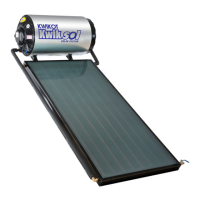
This document describes an integrated heat pump water heater, V Series R134a, designed for heating water for domestic or commercial use. The manual emphasizes that the installation, maintenance, and repair of this water heater must strictly adhere to the appropriate and relevant requirements of SANS 10254. Users are advised to read the manual carefully before installation and maintenance and to keep it for future reference.
Function Description
The air source heat pump water heater utilizes ambient air to heat water, providing an energy-efficient solution for hot water needs. This technology is presented as a modern alternative to traditional heating methods such as coal, electrical, gas, and solar water heating, offering benefits in energy saving and environmental protection. The unit is designed to operate automatically with microcomputer control and a timer function, allowing it to start and stop based on set water temperature and other running conditions without requiring constant supervision.
Usage Features
Safety:
The device prioritizes safety with complete isolation between water and electricity, eliminating the risk of electric shock associated with traditional electrical water heaters. It also avoids the dangers of fuel tubes and storage, such as oil leakage, fire, or explosion. A comprehensive range of protection features is integrated, including compressor delay protection, water-pressure check switch, high and low-pressure protection, super heating protection, anti-phase and open-phase protection, and high-temperature protection. A leakage protection switch must be installed near the heat pump in an accessible location. Users are warned against using damaged wires or switches and must replace them immediately if found. The electrical box should not be opened without first shutting off all power sources to the heat pump.
Transportation and Installation:
During transportation, the heat pump must be kept upright and not tilted more than 45 degrees in any direction. Proper installation location is crucial, requiring good ventilation, proximity to a drainage channel for condensate water discharge, and a smooth, horizontal surface capable of supporting the unit's weight to prevent noise and vibration. The unit should not be installed in areas with pollution, dirt accumulation, fallen leaves, or near inflammable or explosive materials. A wye strainer must be installed before the water inlet to prevent system clogging, and a relief valve is an essential requirement for the water tank. Installing a mixing valve in the user's hot water system is recommended to increase the utilization rate of hot water. The heat pump must be fixed to prevent toppling.
Operation:
Trial operation should only be performed by a qualified technician to ensure correct start-up. The unit is designed to operate within an ambient temperature range of 0°C to 43°C and a water pressure range of 0.15 to 0.8 MPa. The water outlet temperature can range from 28°C to 75°C, with a default hot water temperature of 60°C. Before commissioning, the piping system and water tank must be filled; the unit should not be turned on until water flows from the hot water outlet, indicating a full tank. Once the tank is full, the unit can be powered on and observed for normal operation.
Control System:
The unit features a control panel with various icons for status indication:
- Flashing when the compressor starts running.
- Defrosting indication.
- Showing when the unit starts running.
- Auxiliary electrical heating indication (unused).
- Desired temperature display.
- Clock display.
- Measured water tank temperature display.
- Timer for turning-on the unit.
- Timer for turning-off the unit.
Buttons can be locked or unlocked by pressing the "M" and "SET" buttons simultaneously for 5 seconds. The unit can be turned on or off by pressing the "ON/OFF" button. The clock can be set by an extended press of the "SET" button, allowing adjustment of hour and minute. Water temperature can be set using the up/down arrows, with settings saved automatically after 10 seconds of no operation. The unit will stop automatically when the desired water temperature is reached and restart when it drops to a certain temperature difference (default 5°C below the target). Up to three periods for automatic start/stop can be programmed using the timer function.
Energy Efficiency:
The heat pump water heater is highly energy-efficient, providing the same amount of hot water at approximately 1/4 the cost of electrical water heaters. It can produce 3 to 5 times more hot water than electrical heating for the same electricity consumption.
Components and Design:
The unit features a super-sized evaporator coil with hydrophilic aluminum fins and rifled copper coils, enhancing performance in cold weather. It incorporates world-famous brand compressors known for reliability, quiet operation, energy efficiency, and environmental friendliness. The monoblock design ensures convenient installation and an appealing appearance.
All-weather Running:
The unit is capable of providing hot water regardless of weather conditions, including rainy, snowy days, or at night.
Maintenance Features
General Maintenance:
Before performing any maintenance, the unit must be turned off, and the power supply shut off. Regular maintenance helps ensure proper operation and longevity.
Troubleshooting and Protection:
The unit includes several protection mechanisms:
- Compressor delay protection: A three-minute delay for compressor start/stop, with a one-minute delay on initial power-up.
- High pressure protection: If the high-pressure switch interrupts for 10 seconds after the compressor starts, the unit stops, displays "03E," and sounds an alarm. Possible causes include a destroyed high-pressure switch, lack of water in the tank, a jammed system, a fallen sensor probe, excessive refrigerant, or un-condensable gas. Treatment involves replacing the switch, refilling water, cleaning the system, retightening the probe, or draining refrigerant.
- Low pressure protection: If the low-pressure switch interrupts for 10 seconds after the compressor runs for 3 minutes, the unit stops, displays "04E," and sounds an alarm. Possible causes include a destroyed low-pressure switch, inadequate refrigerant, or dirty evaporator fins. Treatment involves replacing the switch, leak hunting, refilling refrigerant, or cleaning the fins.
- Sensor fault: If any sensor fails, all parts of the unit stop working. Fault codes such as "11E" for coil sensor fault, "12E" for environment sensor fault, and "15E" for water-tank sensor fault indicate open or short circuits. Treatment involves reconnecting wirings, retightening probes, or renovating wirings.
- Overheating of outlet water (05E): Caused by a clogged water line or a faulty water outlet temperature sensor. Treatment includes checking the water system and pump, and checking the sensor's electrical resistance.
- Communication error (09E): Indicates an open or short circuit between the operation panel and the PCB. Treatment involves renovating or replacing the wire.
Common Faults and Treatments:
The manual provides a detailed table of common faults, their possible causes, and recommended treatments:
- Unit doesn't work: Possible causes include power failure, bad connection, or a blown fuse. Treatments include checking the power source, finding and renovating causes, or replacing the fuse.
- Low heating capacity: Possible causes include inadequate refrigerant, drying filter stoppage, or inefficient air-side heat exchanger. Treatments include leak hunting, refilling refrigerant, replacing the drying filter, or cleaning the heat exchanger.
- Compressor doesn't work: Possible causes include power failure, compressor relay destroyed, poor connection, overheating protection, or liquid refrigerant entering the compressor. Treatments include checking and solving problems, replacing the PCB, checking and renovating connections, checking the expansion valve, or replacing the compressor.
- Compressor works but too noisy: Possible causes include destroyed interior components, inadequate refrigeration oil, or a damaged capacitor. Treatments include replacing components, adding refrigeration oil, or replacing the capacitor.
- Fan doesn't work: Possible causes include fans not fixed well, a burned-out electromotor, or a destroyed contactor. Treatments include fixing fans, replacing the electromotor, or replacing the contactor.
- Compressor works but not heating: Possible causes include refrigerant leakage or a compressor fault. Treatments include leak hunting, refilling refrigerant, or replacing the compressor.
- Excessive discharge pressure: Possible causes include too much refrigerant or non-condensable gas in the refrigeration cycle. Treatments include drawing off superfluous refrigerant or driving out gas.
- Low suction pressure: Possible causes include drying filter stoppage, lack of refrigerant, or excessive pressure drop in the heat exchanger. Treatments include replacing the filter, leak hunting, refilling refrigerant, or checking the electronic expansion valve opening.
When a fault occurs, the corresponding fault code will flash on the screen, and an alarm will sound. Users are advised not to attempt repairs themselves without professional technology and to contact an authorized agent or maintenance personnel.
Long-term Storage:
If the unit is not used for an extended period, it should be switched off, disconnected from the power supply, and drained if the ambient temperature is expected to drop below 0°C to prevent ice formation. Similarly, if a power failure lasts more than 5 hours with ambient temperatures below 2°C, the unit should be drained.
Environmental Responsibility:
The heat pump water heater is described as environmentally friendly and pollution-free, contributing to the reduction of the global greenhouse effect.



 To Next Page
 General