
 Need help?
Do you have a question about the LEGRAND Niky S 2 kVA and is the answer not in the manual?
Decoding the LED indicators on the UPS front panel.
Understanding the audible alerts from the UPS.
Automatic self-test upon startup ensures reliable UPS operation.
Procedure for testing battery performance and status indicators.
How to mute audible alarms during battery operation.
Enables starting the UPS in DC mode (battery operation).
Line interactive UPS with AVR for stable output voltage.
Automatic shutdown for short circuit protection.
Saves battery life by shutting down automatically under no load.
Filter to eliminate electromagnetic radio frequency interference.
Surge-protected outlet for devices not requiring backup power.
USB and RS232 interfaces for UPS monitoring and control via computer.
Integrated RJ11/RJ45 protection for telephone or network equipment.
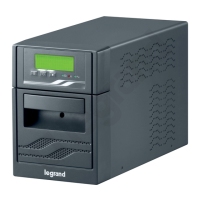
The Niky S 1-1.5-2-3 kVA is an uninterruptible power supply (UPS) designed to provide reliable power to data processing equipment. This manual provides essential information for users, emphasizing the importance of careful reading and adherence to instructions for proper installation and operation. The UPS is intended for civil or industrial use and is not suitable for electro-medical equipment.
The Niky S UPS is a line-interactive system equipped with Automatic Voltage Regulation (AVR). This means it can feed the connected load with a stabilized output voltage even when the mains voltage fluctuates. It offers protection against power outages, overloads, and short circuits, ensuring continuous and stable power delivery to sensitive equipment.
The UPS incorporates an electronic protection system that triggers a shutdown when operating limits are reached or in case of overheating. This automatic shutdown mechanism safeguards both the UPS and the connected devices from potential damage. It also features a "Green function" for CPU microprocessor control, which automatically shuts down the UPS if the battery is discharging under no load, thereby extending battery life.
For communication and control, the Niky S UPS is equipped with USB and RS232 interfaces. These allow a computer to access operational data from the UPS and manage unattended shutdowns of the operating system. Software for this functionality is available for various operating systems, including Win98/ME/2000, Novell, and Linux, and can be downloaded free of charge from the manufacturer's website. A user license is included with the product.
Additionally, the UPS includes an integrated, standard RJ11/RJ45 telephone connection. This feature provides protection for telephone or network equipment, such as modems and telephones, against overvoltage, further enhancing the safety and reliability of connected communication devices.
The Niky S UPS is designed for straightforward operation. To switch it on, press the ON/OFF button until a buzzer sounds. The green LED will illuminate, indicating correct operation with mains power, and the display will be active without any alarm notifications. To switch off the UPS, press the ON/OFF button for at least 3 seconds until the LED and display turn off.
Before initial use, it is recommended to keep the UPS on for 8 hours to fully recharge the battery. While the UPS can be used with a partially charged battery, the backup time available during a power outage will be shorter.
The UPS performs an automatic self-test every time it is switched on, ensuring reliable operation. Users can also manually perform a battery test by pressing the ON button for at least 3 seconds while the UPS is connected to the mains. If the batteries are functioning correctly, the UPS will switch to battery operation for 10 seconds before returning to mains operation. If the battery LED flashes for 5 seconds, it indicates that the batteries are below the minimum charge level. A continuously illuminated battery LED signifies exhausted batteries or batteries that need replacement.
The buzzer, which signals various alarm situations, can be silenced by pressing the ON button for 1 second while the UPS is operating on battery power, provided no other alarm conditions are present. The UPS also has DC start capability, meaning it can be switched on and operate in battery mode even without mains power.
For connecting devices, the UPS provides multiple output outlets. It is important to note that laser printers should not be plugged into the UPS due to their high start-up current. Similarly, household electrical appliances such as hair dryers, air conditioners, and refrigerators should not be connected to the UPS outlets. The UPS also features a full-time surge protection outlet for appliances that do not require battery backup, such as printers and fax machines.
The UPS is equipped with EMI/RFI filtering to protect electronic appliances from damage caused by electromagnetic radio frequency interference, which can result from poor quality mains supply.
Maintenance of the Niky S UPS, particularly tasks involving opening, repairing, or replacing internal parts, must always be performed by specialized technical personnel. Before any such work, the UPS must be switched off using the ON/OFF button on the front panel, and the power cable must be unplugged from the 230V outlet socket.
Battery replacement is a key maintenance aspect. When changing batteries, it is crucial to use batteries of the same type, make, and features. Batteries are considered hazardous waste and must be disposed of in accordance with current regulations. Only qualified technical personnel should replace batteries.
Users are advised to keep the ventilation slits clean to ensure proper heat dissipation from the UPS. This helps maintain optimal operating temperatures and prevents overheating.
The UPS is designed to operate in closed, clean rooms free from flammable liquids, corrosive substances, and excessive humidity. It should not be placed near equipment that generates strong electromagnetic fields (e.g., engines, speakers, monitors) or near equipment sensitive to such fields. Direct sunlight or other heat sources should also be avoided. Liquids should never be poured on or inside the UPS.
The ON/OFF button does not electrically isolate the internal parts of the UPS. To completely isolate the UPS, it must be unplugged from the mains power socket. Users should never open the UPS container, as it may contain dangerously high voltage even when disconnected from the mains. There are no user-serviceable parts inside.
When wiring the outlet line, the total length of the cable from the UPS to the farthest utility should not exceed 10 meters. It is also critical never to disconnect the 230V power plug while the UPS is operating, as this would disconnect the earthing protection for both the UPS and the connected loads.
 General
| Apparent power | 2 kVA |
|---|---|
| Active power | 1200 W |
| Technology | Line-Interactive |
| Input voltage | 230 V |
| Output voltage | 230 V |
| Output voltage tolerance | ±10% |
| Frequency | 50/60 Hz |
| Communication | USB |
| Form factor | Tower |
| Waveform | Simulated Sine Wave |
| Operating Temperature | 0°C to 40°C |
| Storage Temperature | -15°C to 45°C |
| Battery Type | Sealed lead-acid (SLA) |




 To Next Page