EasyManua.ls Logo

LEGRAND Wattstopper DW-100-24 - User Manual

LEGRAND Wattstopper DW-100-24
4 pages
Print Icon
To Next Page IconTo Next Page
Loading...
Wattstopper
®
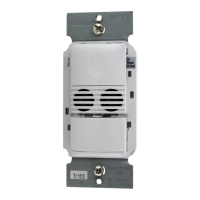
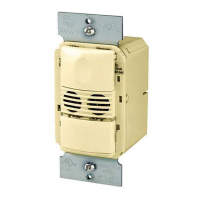
Dual Technology Low Voltage Wall Switch Occupancy Sensor (V3)
Installation Instructions • Instructions d’Installation • Instrucciones de Instalación
No: 24731 – 1/19 rev. 1
Catalog Number • Numéro de Catalogue • Número de Catálogo: DW-100-24
Country of Origin: Made in China • Pays d’origine: Fabriqué en Chine • País de origen: Hecho en China
SPECIFICATIONS
Voltage ............ 18-24VDC, 24VAC or Half-wave rectified AC
Current Consumption .................................................. 35mA
Power Supply .............................. Wattstopper Power Packs
Isolated Relay Rating .............................. 1A @30VDC/VAC
Time Delay Adjustment ............................... 5 to 30 minutes
Walk-Through Mode 3 minutes if no activity after 30 sec.
Test Mode .... 5 sec. for 10 min. with DIP Switch setting
PIR Adjustment ............................... High or Low (DIP Switch)
Ultrasonic Adjustment ...... Minimum to Maximum (trimpot), Off
Frequency ............................................................. 40kHz
Light Level Adjustment ...................................... 8fc to 180+fc
Alerts ...........................................................Selectable Audible
US Patent: 6617560
DESCRIPTION AND OPERATION
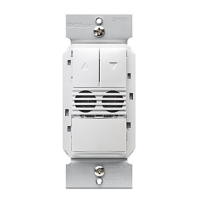
The DW-100-24 Dual Technology Low Voltage Wall
Switch sensor combines advanced passive infrared (PIR)
and ultrasonic technologies into one unit. The combined
technologies help to eliminate false triggering even in difficult
applications.
Selectable operating modes allow the sensor to turn a load
ON, and hold it ON as long as either or both technologies
detect occupancy. After no movement is detected for the
selected time delay, the lights switch OFF. A “walk-through”
mode can turn lights OFF after only 3 minutes, if no activity is
detected after 30 seconds following an occupancy detection.
The DW-100-24 has one relay and one ON/OFF button.
Pressing the button toggles the state of the relay. It also
includes an isolated relay. The relay follows the state of the
sensor only and is not affected by the switch.
Additionally, the DW-100-24 contains a light level sensor. If
adequate daylight is present, the sensor holds the load OFF
until light levels drop, even if the area is occupied. Users can
override this function by pressing the ON/OFF button. See
Light Level Adjustment.
Turning ON the Load (ON Mode)
The DW-100-24 can be programmed for either Auto ON or Manual ON mode. In either mode, the load can be turned ON or OFF using
the ON/OFF button.
Manual ON
DIP#8 ON
With the ON Mode DIP Switch in the ON position, the occupant must press the ON/OFF button to turn ON
the load. The sensor keeps the load ON until no motion is detected for the selected time delay. There is a
30 second re-trigger delay. If occupancy is detected during the delay, the sensor turns the load back ON.
After the re-trigger delay elapses the ON/OFF button must be pressed to turn ON the load.
Auto ON
DIP#8 OFF
With the ON Mode DIP Switch in the OFF position, the load turns ON and OFF automatically based on
occupancy. If the load is turned OFF manually, Presentation Mode operation applies. This prevents the load
from turning ON automatically after it was deliberately turned OFF. Pressing the button to turn lights ON
returns the sensor to Auto ON mode.
Presentation Mode
This is a feature of the Auto ON mode. When the relay is manually turned OFF the DW holds the lights OFF until no motion has been
detected for the duration of the Time Delay. With subsequent occupancy, the DW turns the load ON.
Time Delays
The DW-100-24 holds the load ON until no motion is detected for the selected time delay. Select the time delay using DIP Switch
settings. In the DW-200, both relays use the same delay.
NOTE: Shaded cells below indicate default operation and switch setting.
Test/20 min
(DIP#1 & 2 OFF)
A Test Mode with a short time delay of five seconds is set when DIP Switches 1 & 2 are OFF. It cancels
automatically after ten minutes, or when you set a fixed time delay. When the Test Mode times out, the
sensor will assume a 20 minute time delay. To restart Test Mode, change the time delay setting to any fixed
amount and then return it to the Test setting.
Fixed Time Delay
(DIP#1 ON, & 2 OFF)
Time delays of 5, 15 (default), or 30 minutes are available. See DIP SWITCH SETTINGS for information.
Question and Answer IconNeed help?

Do you have a question about the LEGRAND Wattstopper DW-100-24 and is the answer not in the manual?

Summary

Alerts and Trigger Modes

Trigger Mode Options

Defines four occupancy trigger options based on PIR and Ultrasonic sensor combinations.

Installation

DIP Switch Settings

Adjustments

Light Level Adjustment

How to set or disable the light level threshold for daylight control.

Troubleshooting

Lights Not Turning ON (LED Flashing)

Steps to diagnose why lights do not turn ON when the motion LED flashes.

Lights Not Turning ON (LED Not Flashing)

Steps to diagnose why lights do not turn ON when the motion LED does not flash.

Lights Not Turning OFF

Steps to diagnose why the lights fail to turn OFF after motion has stopped.

Overview

The Wattstopper DW-100-24 is a dual-technology low voltage wall switch occupancy sensor designed to automate lighting control based on occupancy detection. It integrates both passive infrared (PIR) and ultrasonic technologies to enhance detection accuracy and minimize false triggers, even in challenging environments.

Function Description:

The primary function of the DW-100-24 is to turn a connected load (typically lights) ON when occupancy is detected and OFF after a set time delay when no motion is sensed. The sensor offers flexible operating modes, allowing the load to be turned ON automatically (Auto ON) or requiring manual activation (Manual ON). In Auto ON mode, the lights turn on automatically upon detecting occupancy and remain on as long as either the PIR or ultrasonic technology detects movement. In Manual ON mode, the occupant must press the ON/OFF button to turn on the load. Once activated, the lights stay on until no motion is detected for the selected time delay.

The device features an ON/OFF button that toggles the state of the connected relay. It also includes an isolated relay that mirrors the sensor's occupancy state but is not affected by the ON/OFF button, providing an independent occupancy signal.

A built-in light level sensor allows the DW-100-24 to prevent lights from turning ON if there is sufficient ambient daylight, even when the area is occupied. This feature can be overridden by pressing the ON/OFF button.

Usage Features:

The DW-100-24 offers several customizable features through DIP switch settings and trimpot adjustments:

  • Operating Modes (Auto ON/Manual ON):

    • Manual ON (DIP #8 ON): Requires the occupant to press the ON/OFF button to turn on the load. The load remains ON until no motion is detected for the set time delay. A 30-second re-trigger delay ensures the load stays OFF if occupancy is detected briefly after the time delay, requiring another manual press to turn ON.
    • Auto ON (DIP #8 OFF): The load turns ON and OFF automatically based on occupancy detection. If the load is manually turned OFF in this mode, the "Presentation Mode" applies, preventing automatic re-activation until the time delay has elapsed without motion. Pressing the ON/OFF button returns the sensor to Auto ON mode.
  • Time Delays: The sensor holds the load ON for a configurable period after the last detected motion. Available fixed time delays are 5, 15 (default), or 30 minutes.

    • Test Mode (DIP #1 & 2 OFF): A short 5-second time delay for testing purposes. It automatically cancels after ten minutes or when a fixed time delay is set. After Test Mode times out, the sensor defaults to a 20-minute time delay.
  • Walk-Through Mode (DIP #3 ON): This mode shortens the time delay to 3 minutes if no motion is detected after the first 30 seconds of initial occupancy. This is useful for brief visits, such as grabbing a forgotten item. If motion continues beyond 30 seconds, the standard set time delay applies. This mode can be disabled (DIP #3 OFF).

  • PIR Sensitivity Adjustment: The sensor continuously monitors its environment and automatically adjusts PIR sensitivity. Users can also manually set PIR sensitivity to:

    • High (DIP #4 OFF): Default setting, suitable for most applications.
    • Low, 50% (DIP #4 ON): Reduces sensitivity by approximately 50%, useful for situations where the PIR detects motion outside the desired area or where heat sources cause false activations. Masking the lens can also help in such cases.
  • Audible Alerts (DIP #7 ON): The unit can provide audible warnings before the load turns OFF. It beeps at 1 minute, 30 seconds, and 10 seconds before turning OFF the load. In Walk-Through mode, it beeps three times at 10 seconds before turning OFF. Audible alerts can be disabled (DIP #7 OFF).

  • Trigger Mode (DIP Switches 5 & 6): Four options determine how occupancy is triggered and maintained:

    • Standard (Both/Either/Either): Initial occupancy requires both PIR and ultrasonic detection. Maintaining occupancy and re-triggering require either technology.
    • Option A (PIR/Either/Either): Initial occupancy requires PIR. Maintaining occupancy and re-triggering require either technology.
    • Option B (PIR/PIR/PIR): All three actions (initial, maintain, re-trigger) require PIR detection.
    • Option C (Both/Both/Both): All three actions require both PIR and ultrasonic detection.
  • Light Level Adjustment: This feature allows the sensor to hold the lights OFF if adequate daylight is present.

    1. Ensure the room is appropriately lit.
    2. Put the sensor into TEST mode (5-minute window).
    3. Press and hold the ON/OFF button for 3 seconds until a beep is heard.
    4. Step away from the sensor. After 25 seconds, a beep indicates the threshold level is set and retained even after power loss.
    • To disable light level control, press and hold the ON/OFF button for 7 seconds until a double beep tone sounds.
  • Ultrasonic Sensitivity Adjustment: A trimpot located under the ON/OFF buttons allows adjustment of the ultrasonic detection sensitivity.

Coverage Patterns:

The PIR sensor features a two-tiered, multi-cell viewing Fresnel lens with a 180-degree field of view. A red LED flashes when PIR motion is detected. Opaque adhesive tape is provided for masking specific sections of the PIR sensor's view to eliminate unwanted coverage. The ultrasonic sensor has two transceivers operating at 40kHz. For optimal performance, the sensor is recommended for spaces not larger than 18' x 15'.

Maintenance Features:

  • Sensor Adjustment Access: To access DIP switches and trimpots, the wall plate and button cap must be removed. The button cap is reinstalled by inserting its hinges into the tabs and squeezing the top while pressing it into the unit.
  • Reset to Default: To return all features to factory settings, press and hold the ON/OFF button for 10 seconds until a triple beep sounds. This action also disables light level control.
  • Service Mode: Setting the ultrasonic trimpot to MIN (fully counter-clockwise) puts the unit into Service Mode, which can be used as a service switch in case of sensor failure.

The DW-100-24 is designed to fit behind industry-standard decorator-style wall switch cover plates (not included).

LEGRAND Wattstopper DW-100-24 Specifications

General IconGeneral
TypeWall Switch Sensor
Voltage24V DC
Coverage Area1000 sq ft
Coverage Area (sq ft)1000
Coverage Area (sq m)92.9
Operating Temperature32°F to 104°F (0°C to 40°C)
ColorWhite
Accessory TypeOccupancy Sensor
Product TypeOccupancy Sensor
Sensor TechnologyPassive Infrared (PIR)
CertificationsUL, cUL

Related product manuals