Frame Mortise & Tenon Jig User Guide
44
Chapter 6
WORKPIECE AND JOINT OPTIONS
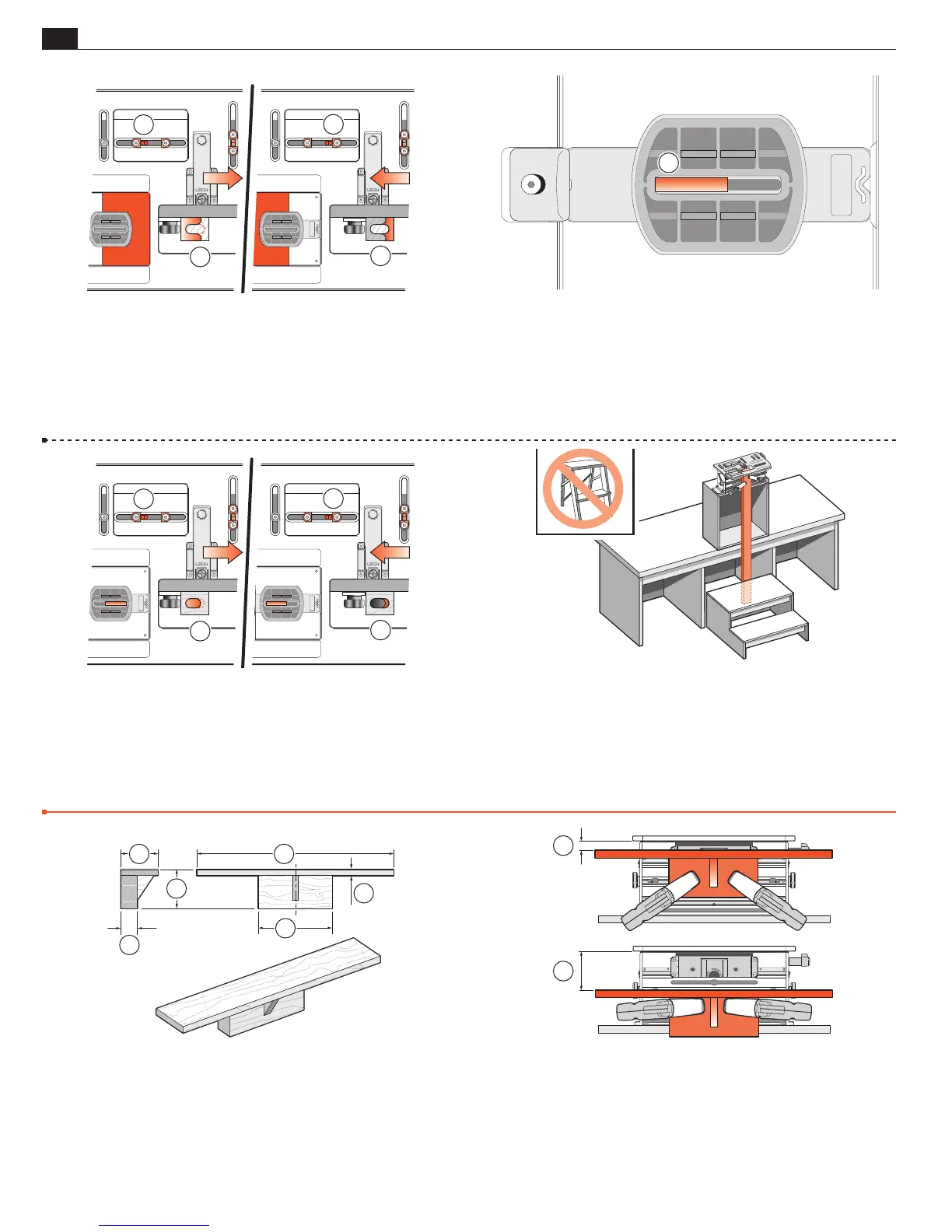
6-15 Then it is:
-Move table right; rout to the left
➀
.
-Move table left; rout to the right
➁
.
Again, use a guard in the guide recess if necessary.
1
1
2
2
6-16 Mortises The rule is the same for mortises except you will
need to use a small piece of that
3
⁄16"[5mm] dowel as a guard in the
guide’s mortise slot
➀
. The dowel should be slightly longer than the
difference between the guide length and joint length; in this example,
slightly longer than 1"[25mm]. In this example, the joint is only 1"
long and the guide mortise slot is 2". So you need a guard dowel to
prevent cutting a mortise longer than required.
1
6-17 So, for the shorter mortises:
Table right; dowel right; rout left side
➀
.
Table left; dowel left; rout right side
➁
.
The length of the dowel guard allows you to rout a mortise slightly
shorter than required in the first cut and to clean out in the sec-
ond cut.
1
1
2
2
6-18 To rout long vertical boards you could build a jig stand to
mount on your bench. Make the stand/bench combination high
enough to accept the desired board length. Bolt securely to the bench.
Make a stable platform as shown here to stand on. Don’t use a
folding step, these are unstable. Other novel solutions: holes in (sus-
pended) floor; jig bolted to deck or mezzanine railing; wall brackets.
■
6-19 Make this bracket to mount and mortise a wide board face,
clamp pieces greater than Leigh Clamp 3" capacity, and center mortises
on boards up to 4
5
⁄8"[115mm] wide or even 6
3
⁄8"[162mm].
1
5
4
3
6
2
6-20 Use the Leigh clamps to secure the bracket to the FMT
Pro clamp face and adjust the distance below the table to slightly
greater than the mortise piece thickness
➀
.
1
1
➀
4
1
⁄2"[115mm]
➁
24"[600mm]
➂
4
3
⁄4"[120mm]
➃
9"[230mm]
➄
2"[50mm]
➅
3
⁄4"[20mm]
Thicker and Wider Boards


 To Next Page