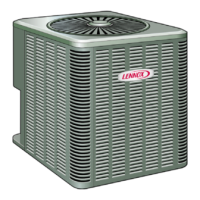
EasyManua.ls Logo

Lennox Merit 10HPB Series - User Manual

Lennox Merit 10HPB Series
18 pages
Print Icon
To Next Page IconTo Next Page
Loading...
Page 1
504,828M
*P504828M*
06/04
*2P0604*
2003 Lennox Industries Inc.
Dallas, Texas, USA
®
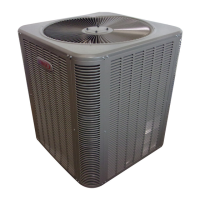
10HPB Outdoor Units
Lennox Merit
®
Series 10HPB outdoor units are approved
and warranted only for installation with specially matched
indoor coils, line sets, and refrigerant control systems as
designated by Lennox. Refer to Lennox Engineering
Handbook for expansion valve kits which must be ordered
separately.
Shipping and Packing List
1 − Assembled 10HPB outdoor unit
1 − Coupling (18, 24 and 30)
Check unit for shipping damage. Consult last carrier imme-
diately if damage is found.
WARNING
Improper installation, adjustment, alteration, service
or maintenance can cause property damage, person-
al injury or loss of life. Installation and service must
be performed by a qualified installer or service
agency.
IMPORTANT
The Clean Air Act of 1990 bans the intentional vent-
ing of refrigerant (CFC’s and HCFC’s) as of July 1,
1992. Approved methods of recovery, recycling or
reclaiming must be followed. Fines and/or incarcera-
tion may be levied for noncompliance.
INSTALLATION
INSTRUCTIONS
10HPB Series Units
HEAT PUMP UNITS
1−1/2 through 5 tons
504,828M
06/04
Supersedes 02/04
Table of Contents
10HPB Outdoor Units 1. . . . . . . . . . . . . . . . . . . . . . . . . . .
Shipping & Packing List 1. . . . . . . . . . . . . . . . . . . . . . . . .
General Information 1. . . . . . . . . . . . . . . . . . . . . . . . . . . .
Unit Dimensions 2. . . . . . . . . . . . . . . . . . . . . . . . . . . . . . .
Setting the Unit 3. . . . . . . . . . . . . . . . . . . . . . . . . . . . . . . .
Electrical 4. . . . . . . . . . . . . . . . . . . . . . . . . . . . . . . . . . . . . .
Refrigerant Piping 6. . . . . . . . . . . . . . . . . . . . . . . . . . . . . .
Refrigerant Metering Device 10. . . . . . . . . . . . . . . . . . . .
Manifold Gauge Set 10. . . . . . . . . . . . . . . . . . . . . . . . . . .
Service Valves 11. . . . . . . . . . . . . . . . . . . . . . . . . . . . . . . .
Leak Testing 12. . . . . . . . . . . . . . . . . . . . . . . . . . . . . . . . . .
Evacuation 13. . . . . . . . . . . . . . . . . . . . . . . . . . . . . . . . . . .
Start−Up 13. . . . . . . . . . . . . . . . . . . . . . . . . . . . . . . . . . . . . .
Charging 14. . . . . . . . . . . . . . . . . . . . . . . . . . . . . . . . . . . . .
System Operation 16. . . . . . . . . . . . . . . . . . . . . . . . . . . . .
Defrost System 16. . . . . . . . . . . . . . . . . . . . . . . . . . . . . . .
Maintenance 18. . . . . . . . . . . . . . . . . . . . . . . . . . . . . . . . . .
Optional Accessories 18. . . . . . . . . . . . . . . . . . . . . . . . . .
Start−Up and Performance Check List 18. . . . . . . . . . . .
RETAIN THESE INSTRUCTIONS
FOR FUTURE REFERENCE
General Information
These instructions are intended as a general guide and do
not supersede national or local codes in any way. Authori-
ties having jurisdiction should be consulted before instal-
lation.
WARNING
This product and/or the indoor unit it is matched with
may contain fiberglass wool.
Disturbing the insulation during installation, mainte-
nance, or repair will expose you to fiberglass wool
dust. Breathing this may cause lung cancer. (Fiber-
glass wool is known to the State of California to
cause cancer.)
Fiberglass wool may also cause respiratory, skin,
and eye irritation.
To reduce exposure to this substance or for further
information, consult material safety data sheets
available from address shown below, or contact your
supervisor.
Lennox Industries Inc.
P.O. Box 799900
Dallas, TX 75379−9900
Litho U.S.A.
Question and Answer IconNeed help?

Do you have a question about the Lennox Merit 10HPB Series and is the answer not in the manual?

Summary

10 HPB Outdoor Units

Shipping and Packing List

Instructions for unpacking and verifying unit contents.

General Information

Overview of installation guidelines and important notices.

Setting the Unit

Installation Clearances

Required spacing around the unit for airflow and service.

Slab Mounting

Guidelines for installing the unit on a ground-level slab.

Roof Mounting

Recommendations for mounting the unit on a roof surface.

Electrical Installation

Electrical Connections and Wiring

Procedures for power supply, grounding, and low-voltage wiring.

Refrigerant Piping

Installing Refrigerant Lines

Guidance on connecting and routing the liquid and vapor lines.

Line Set Isolation

Techniques to prevent vibration and noise transmission.

Vertical Runs of Refrigerant Piping

Refrigerant Line Contact Rules

Critical instructions to prevent refrigerant lines from touching structures.

Horizontal Runs of Refrigerant Piping

Hanging Line Sets

Methods for supporting horizontal refrigerant lines from joists or rafters.

Transitioning Refrigerant Piping

Vertical to Horizontal Runs

Procedures for connecting vertical and horizontal refrigerant line sections.

Outdoor Unit Placement

Optimal Unit Location

Recommendations for positioning the outdoor unit away from windows.

Brazing Connection Procedure

Brazing Steps

Step-by-step guide for brazing refrigerant line connections.

Refrigerant Metering Device

Metering Device Installation

Instructions for installing the expansion valve or fixed orifice.

Manifold Gauge Set

Gauge Set Usage

Guidelines for using a manifold gauge set for system checks.

Service Valves

Accessing Schrader Ports

How to connect gauges to the service valve ports.

Operating Line Service Valves

Procedures for opening and closing liquid/vapor line service valves.

Ball-Type Vapor Line Service Valve

Description and operation of the ball-type service valve.

Leak Testing

Leak Detection Methods

Techniques for identifying refrigerant leaks in the system.

Evacuation

System Evacuation Procedure

Steps to remove non-condensables and moisture from the system.

Start-Up Procedures

Crankcase Heater Pre-Start

Requirement to energize the crankcase heater before starting the unit.

Charging the System

Weighing Refrigerant Charge

Method for charging refrigerant by weight for TXV systems.

Subcooling Method Charging

Procedure for charging based on liquid line subcooling.

Charging with Normal Operating Pressures

Approach Method Charging

Method for charging based on ambient and liquid line temperatures.

System Operation

Filter Drier

Information on the unit's filter drier component.

Crankcase Heater

Description of the crankcase heater function.

Emergency Heat Function

Emergency Heat Operation

How the emergency heat feature works and when to use it.

Defrost System

Defrost Thermostat

Role of the defrost thermostat in initiating defrost cycle.

Defrost Control

Functionality of the defrost control board.

Defrost Control Timing

Settings for defrost cycle initiation intervals.

Pressure Switch Circuit

High Pressure Switch Operation

How the optional high pressure switch affects unit operation.

Diagnostic LEDs

Defrost Control Board LEDs

Interpreting LED flash patterns for diagnostics.

Maintenance Procedures

Outdoor Unit Maintenance

Steps for cleaning and inspecting the outdoor unit.

Indoor Coil Maintenance

Instructions for cleaning the indoor coil.

Start-Up and Performance Checklist

Optional Accessories

List of available optional accessories for the unit.

Overview

This document provides installation instructions for Lennox Merit® Series 10HPB heat pump outdoor units, ranging from 1-1/2 through 5 tons. It covers various aspects from initial setup to maintenance and troubleshooting.

Function Description:

The Lennox Merit® Series 10HPB outdoor units are heat pump systems designed for residential and light commercial applications. They are approved and warranted for installation with specially matched indoor coils, line sets, and refrigerant control systems as designated by Lennox. These units operate under a wide range of weather conditions, providing both cooling and heating functions. The system includes a defrost system to prevent ice buildup on the outdoor coil during heating operation in colder temperatures. An emergency heat function is also integrated, typically used during outdoor unit shutdown or when auxiliary electric heat is staged by outdoor thermostats.
Important Technical Specifications:

  • Model Range: 10HPB Series Units, 1-1/2 through 5 tons.
  • Refrigerant: HCFC-22. The unit is factory charged, and adjustments for varying line set lengths are provided (e.g., 2 ounces per 5 ft. for 5/16 in. liquid line, 3 ounces per 5 ft. for 3/8 in. liquid line).
  • Electrical: Units are approved for use only with copper conductors. Voltage supply must be within the range listed on the unit nameplate. 24V, Class II circuit connections are made in the low voltage junction box.
  • Defrost System: Includes a defrost thermostat and a defrost control board. The defrost thermostat senses 42°F (5.5°C) or cooler to initiate defrost timing and terminates defrost when the liquid line warms up to 70°F (21°C). The defrost control accumulates compressor run times at 30-, 60-, or 90-minute intervals (field-adjustable) before initiating defrost if the thermostat is closed. The maximum defrost period is 14 minutes.
  • Refrigerant Metering Device: 10HPB units are designed for use with check expansion valve systems only. Expansion valve kits (e.g., LB-85759F, LB-85759G) must be ordered separately. If installing a check expansion valve with an indoor coil that includes a fixed orifice, the orifice must be removed.
  • Pressure Switch Circuit: The defrost control incorporates a pressure switch circuit for an optional high-pressure switch, which can lock out the unit if activated.
  • Unit Dimensions:
    • 10HPB18/24: 25 in. (635 mm) height, 24-1/4 in. (616 mm) width.
    • 10HPB30: 29 in. (737 mm) height, 28-1/4 in. (718 mm) width.
    • 10HPB36/42/48/60: 33 in. (838 mm) height, 32-1/4 in. (819 mm) width.
  • Line Set Connections:
    • 10HPB18: 3/8 in. liquid, 5/8 in. vapor.
    • 10HPB24/30: 3/8 in. liquid, 3/4 in. vapor.
    • 10HPB36: 3/8 in. liquid, 3/4 in. vapor.
    • 10HPB42/48: 3/8 in. liquid, 7/8 in. vapor.
    • 10HPB60: 3/8 in. liquid, 1-1/8 in. vapor.
    • Units are designed for line sets up to 50 feet (15 m).
  • Torque Requirements for Service Valves:
    • Service valve cap: 8 ft.-lb. (11 NM)
    • Sheet metal screws: 16 in.-lb. (2 NM)
    • Machine screws #10: 28 in.-lb. (3 NM)
    • Compressor bolts: 90 in.-lb. (10 NM)
    • Gauge port seal cap: 8 ft.-lb. (11 NM)

Usage Features:

  • Installation Clearances: Minimum clearance of 24 inches (610 mm) between multiple units. Service clearance of 30 inches (762 mm) on one side adjacent to the control box, 36 inches (914 mm) on another side, 12 inches (304 mm) on one of the remaining two sides, and 6 inches (152 mm) on the final side. 48 inches (1219 mm) clearance required on top. Maximum soffit overhang is 36 inches (914 mm).
  • Slab Mounting: Top of slab should be high enough to prevent water collection, with a slope tolerance away from the building of 2 degrees or 2 inches per 5 feet (51 mm per 1524 mm).
  • Roof Mounting: Install a minimum of 6 inches (152 mm) above the roof surface. Locate above a load-bearing wall or area that can adequately support the unit. A wind barrier may be required if the coil cannot be mounted away from prevailing winter winds.
  • Refrigerant Piping: Proper isolation of refrigerant lines is crucial to prevent vibration and noise. Use either Lennox L15 series line sets or field-fabricated lines according to the Refrigerant Piping Guide (Corp. 9351-L9). Brazing connections require dry nitrogen purging to prevent oxidation and moisture.
  • Leak Testing: After line set connections, check for leaks using an electronic leak detector or halide. Pressurize the system with dry nitrogen (regulated to 1-2 psig) and a trace amount of HCFC-22 (max 2 ounces or 57g).
  • Evacuation: Evacuate the system to an absolute pressure of 23,000 microns (29.01 inches of mercury) to remove noncondensables and water vapor. A rapid rise in pressure indicates a leak. Final evacuation should reach below 500 microns (29.9 inches of mercury) within a 20-minute period.
  • Start-Up: If equipped with a crankcase heater, it should be energized 24 hours before start-up. Check fan rotation, wiring connections, and voltage supply. Open liquid and vapor line service valves after evacuation.
  • Charging: Unit is factory charged for a 15 ft. (4.6 m) line set. Adjust charge based on line set length.
    • Weighing in the Charge (Outdoor Temp < 65°F / 18°C): Recover refrigerant, leak check, evacuate, then weigh in the nameplate charge.
    • Subcooling Method (Outdoor Temp < 65°F / 18°C): Restrict airflow through the outdoor coil to achieve 200-250 psig (1379-1724 kPa) liquid pressure. Measure liquid line temperature and pressure, then calculate subcooling. Adjust charge to match specified subcooling values (e.g., 5°F for 10HPB18, 7°F for 10HPB24).
    • Normal Operating Pressures / Approach Method (Outdoor Temp ≥ 65°F / 18°C): Compare stabilized pressures with provided tables. Adjust charge to match approach temperature values (liquid temp. minus ambient temp., e.g., 12°F for 10HPB18, 13°F for 10HPB24).
  • Emergency Heat: Activates when the room thermostat is placed in emergency heat mode, isolating the outdoor unit control circuit. It should be used if power has been off for over an hour and outdoor temperature is below 50°F (10°C) to allow the crankcase heater to prevent compressor slugging.

Maintenance Features:

  • General Maintenance: Performed by a qualified installer or service agency at the beginning of each cooling season.
  • Outdoor Unit:
    • Clean and inspect outdoor coil (with power off).
    • Outdoor unit fan motor is pre-lubricated and sealed (no further lubrication needed).
    • Visually inspect all connecting lines, joints, and coils for oil leaks.
    • Check all wiring for loose connections.
    • Check for correct voltage and amp draw on outdoor fan motor.
    • Inspect and clean drain holes in the coil compartment base.
    • Gauge and check refrigerant charge if insufficient cooling is reported.
  • Indoor Coil:
    • Clean coil if necessary.
    • Check connecting lines, joints, and coil for oil leaks.
    • Check condensate line and clean if necessary.
  • Indoor Unit:
    • Clean or change filters.
    • Adjust blower speed for cooling. Measure pressure drop over the coil to determine CFM.
    • For belt drive blowers, check belt for wear and proper tension.
    • Check all wiring for loose connections.
    • Check for correct voltage and amp draw on blower motor.
  • Filter Drier: The unit is equipped with a biflow filter drier. Replace with one of like design if necessary.
  • Crankcase Heater: If equipped, ensure it is energized 24 hours before start-up to prevent compressor damage.
  • Safety: Contains warnings regarding fiberglass wool, electric shock, refrigerant inhalation, explosion hazards from using oxygen to pressurize the system, and equipment damage from deep vacuum operation. All installations and services must comply with national and local codes.

Lennox Merit 10HPB Series Specifications

General IconGeneral
BrandLennox
ModelMerit 10HPB Series
CategoryHeat Pump
LanguageEnglish

Related product manuals