
 Need help?
Do you have a question about the Lennox XC13 Series and is the answer not in the manual?
Explains the scroll compressor design, operation, and specifications for XC13 units.
Outlines the procedure for checking the system for refrigerant leaks using nitrogen.
Explains the importance and process of evacuating the system to remove non-condensables and moisture.
Provides instructions and tables for charging the XC13 system with R-410A refrigerant.
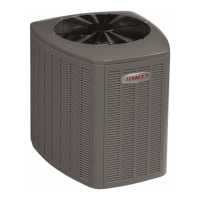
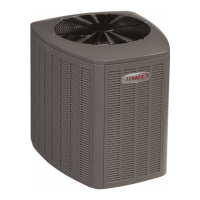
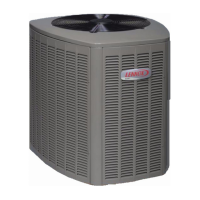
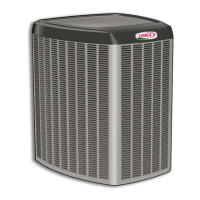
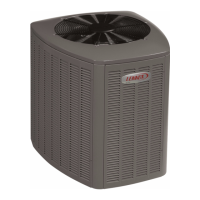
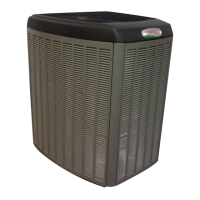
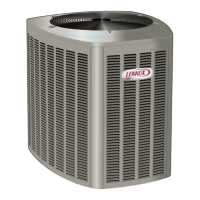
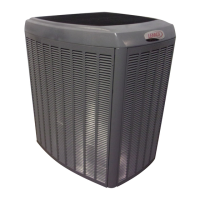
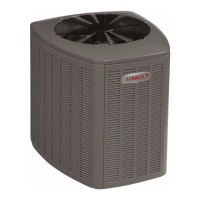
This document describes the Lennox XC13 Series Units, which are high-efficiency residential split-system condensing units. These units are designed to operate with R-410A refrigerant and feature a scroll compressor. Available in sizes ranging from 1 1/2 through 5 tons, the XC13 series is intended for use with an expansion valve or an RFC (Refrigerant Flow Control) in the indoor unit, specifically approved for R-410A. The manual provides comprehensive information covering major components, the refrigerant system, charging procedures, maintenance, and the sequence of operation. It is specifically intended for use by qualified service technicians, and all specifications are subject to change.
The manual emphasizes several critical safety warnings. Improper installation, adjustment, alteration, service, or maintenance can lead to property damage, personal injury, or loss of life. Therefore, installation and service must be performed by a qualified installer or service agency. A crucial warning highlights that operating pressures for R-410A units are significantly higher than those for R-22 units, necessitating the use of service equipment specifically rated for R-410A.
Another important warning concerns electrostatic discharge (ESD), which can affect electronic components. Technicians are advised to take precautions during unit installation and service to protect the unit's electronic controls. This involves neutralizing electrostatic charge by touching hands and all tools on an unpainted unit surface before performing any service procedure.
A shock hazard warning is also present, instructing users to remove all power at the disconnect before removing any access panel. Single-phase XC13 units use single-pole contactors, meaning line voltage exists at all components even when the unit is not in operation, posing a risk of electrical shock.
Regarding refrigerant handling, the manual warns that R-410A refrigerant can be harmful if inhaled and must be used and recovered responsibly to prevent personal injury or death. It also strictly prohibits the use of oxygen to pressurize a refrigeration or air conditioning system due to the danger of explosion upon contact with oil. When using high-pressure gases like dry nitrogen for pressurization, a regulator capable of adjusting pressure from 0 to 450 psig (3103 kPa) must be used.
The warranty will be voided if the covered equipment is removed from its original installation site. Furthermore, the warranty does not cover damage or defects resulting from floods, wind, lightning, or installation and operation in a corrosive atmosphere (e.g., chlorine, fluorine, salt, recycled wastewater, urine, fertilizers, or other damaging chemicals). For compressor warranty coverage, all major components (indoor blower and coil) must be matched according to Lennox recommendations.
The XC13 unit components include an outdoor fan, dual capacitor, contactor, filter drier, compressor, and a high-pressure switch. Access to these components often requires removing louvered panels. The manual provides detailed instructions for removing and installing these panels, emphasizing the importance of holding the panel firmly and stowing it carefully to prevent injury or damage.
The control box, which houses the compressor contactor (K1) and dual capacitor (C12), is described. The compressor contactor energizes the compressor when the indoor thermostat terminal Y1 (24V) signals a demand. The dual capacitor is essential for both the fan motor and the compressor, which are permanent split capacitor motors. An optional Timed Off Control (TOC) may be present, delaying compressor energization for 5 minutes ± 2 minutes between cycles to prevent rapid cycling.
The scroll compressor, designed for R-410A refrigerant and high-pressure operation, is factory-charged with 3MA (32MMMA) P.O.E. oil. The manual explains the scroll compression concept, where one scroll orbits a stationary scroll to compress gas. It notes that scroll compressors are tolerant to liquid return but warns against using them for evacuating or "pumping-down" the system, as deep vacuum operation can cause internal arcing and compressor failure, voiding the warranty.
A filter drier, specifically designed for R-410A, must be installed in the liquid line. It is crucial to replace the drier whenever the unit is exposed to open air during service. The condenser fan motor, a single-phase PSC motor, is controlled by the compressor contactor.
Safety switches include a loss of charge switch, which is a normally closed, auto-reset switch located on the compressor's discharge line. It opens and shuts down the compressor if discharge line temperatures exceed 220°F + 5°F. A high-pressure switch (SPST, manual reset, normally closed) is located in the liquid line of the compressor and removes power from the compressor contactor control circuit if discharge pressure rises above 590 + 10 psi.
Field refrigerant piping involves connecting liquid and suction lines from the condensing unit to the indoor evaporator coil using sweat connections. Lennox L15 (sweat) series line sets are recommended. The liquid and vapor line service valves, along with gauge ports, are accessible from outside the unit for leak testing, evacuating, charging, and checking the charge. Each valve has a factory-installed Schrader valve, protected by a service port cap that also serves as the primary leak seal. Service valves are not rebuildable and must be replaced if failed. Instructions are provided for accessing the Schrader port and opening/closing the service valves.
The Clean Air Act of 1990 prohibits intentional venting of CFCs and HFCs, requiring approved recovery, recycling, or reclaiming methods. Fines and incarceration may be levied for noncompliance.
Leak testing involves connecting an R-410A cylinder and a nitrogen cylinder with a pressure regulator to the manifold gauge set. A trace amount of R-410A is introduced into the line set and indoor unit, followed by pressurization with nitrogen to 150 psig (1034 kPa). All joints are then checked for leaks.
Evacuating the system of noncondensables is critical for proper operation, as these gases combine with refrigerant to corrode copper piping and compressor parts. The evacuation process involves using a thermocouple or thermistor electronic vacuum gauge calibrated in microns. The system is evacuated to an absolute pressure of 23,000 microns (29.01 inches of mercury), then broken with nitrogen, and re-evacuated to below 500 microns (29.9 inches of mercury) within a 20-minute period after shutting off the vacuum pump.
Charging procedures vary based on outdoor temperature and the unit's refrigerant metering device (fixed orifice or TXV systems). R-410A refrigerant cylinders are rose-colored, and refrigerant should be added through the vapor valve in the liquid state. Some cylinders have a dip tube, allowing liquid refrigerant to be drawn without inverting the cylinder.
For fixed orifice systems with outdoor temperatures ≥ 65°F (18°C), the subcooling method is used. This involves measuring liquid line temperature and pressure, determining saturation temperature, and calculating subcooling to compare with specified values. If subcooling is too high, refrigerant must be recovered; if too low, refrigerant must be added.
For TXV systems with outdoor temperatures > 65°F (18°C), the approach method is used. This involves recording outdoor ambient temperature and liquid line temperature, then comparing the difference to specified values. Refrigerant is added to lower the approach temperature or recovered to increase it.
Maintenance should be performed at the beginning of each cooling season. This includes cleaning and inspecting the outdoor coil (which can be flushed with a water hose after power is turned off). The condenser fan motor is prelubricated and sealed, requiring no further lubrication. Technicians should visually inspect connecting lines and coils for oil leaks, check wiring for loose connections, verify correct voltage, and measure the condenser fan motor's amp-draw.
For the indoor coil, maintenance involves cleaning the coil, checking connecting lines and coils for oil leaks, and cleaning the condensate line. Indoor unit maintenance includes cleaning or changing filters, adjusting blower speed for cooling, checking belt drive blowers for wear and tension, checking wiring for loose connections, verifying correct voltage, and measuring the blower motor's amp-draw.
Polyol ester (POE) oils used with R-410A refrigerant absorb moisture quickly, so the refrigerant system must be kept closed as much as possible. Line set caps or service valve stub caps should only be removed when ready to make connections. If the system must be opened for service, such as compressor or drier replacement, precautions must be taken to minimize moisture entry. This involves breaking the system vacuum with dry nitrogen, quickly sealing and replacing faulty components, and evacuating the system. Any time the sealed system is opened, the drier must be replaced, and the system must be evacuated. Evacuation alone will not remove moisture from POE oil; drier replacement is necessary. Recovery machines rated for R-410A refrigerant must be used.
 General
| Refrigerant | R-410A |
|---|---|
| Type | Air Conditioner |
| Warranty | 5-Year Limited Compressor, 5-Year Limited Parts |
| Efficiency | High |
| Cooling Capacity | 1.5 to 5 tons |
| Cooling Capacity (BTU/h) | 18, 000 - 60, 000 |



 To Next Page