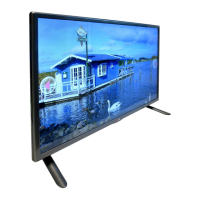
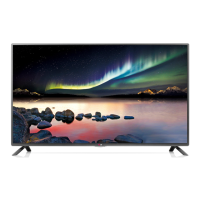
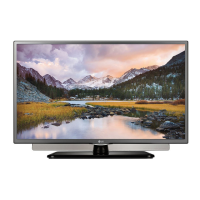
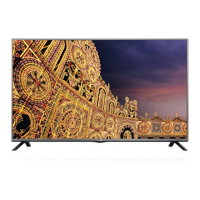
This document is a service manual for an LG LED TV, specifically models 32LB561D/561T/563D/563T and their -TC/-TD variants, identified by chassis LB43T. It provides comprehensive information for servicing, maintenance, and repair.
Function Description:
The device is an LG LED TV, designed for displaying video content and playing audio. It supports various input sources, including DTV, AV (CVBS), Component, HDMI, SPDIF, USB, and Headphone output. The TV incorporates a Main SOC (M1A-256MB) as its central processing unit, along with dedicated modules for power management, tuner functions, audio amplification, and display control. It is designed to operate in different regions (North/Latin America, Europe/Africa, Asia/Oceania) and supports various video and audio standards.
Important Technical Specifications:
- Chassis: LB43T
- Models: 32LB561D/561T/563D/563T, 32LB561D/561T-TC, 32LB563D/563T-TD
- Power Adjustment: Free Voltage
- Operating Conditions:
- Temperature: 25 °C ± 5 °C
- Relative humidity: 65 ± 10 %
- Input voltage: 100-220 V~, 50/60 Hz
- Main SOC: M1A-256MB (IC101)
- Memory: Serial Flash (8Mbit, IC1300), System EEPROM (256Kbit, IC104), NAND Flash (1Gbit, IC102)
- Power Supply: The power block includes sections for +1.5V DDR, +1.10V VDDC, +5V Normal & +5V USB with OCP, +3.3V Normal, and Panel VCC. It features a Dual Power Detect system for +3.5V, +12V, and +24V.
- Video Inputs:
- Component Video Input (Y, CB/PB, CR/PR): Supports resolutions from 720x480 (SDTV 480i/480p) to 1920x1080 (HDTV 1080p) with various H-freq and V-freq combinations.
- HDMI Input (DTV mode): Supports resolutions from 720x480 (SDTV 480P) to 1920x1080 (HDTV 1080P) with corresponding pixel clocks.
- HDMI Input (PC mode): Supports resolutions from 640x350 (EGA) to 1920x1080 (VESA WUXGA) with various H-freq, V-freq, and pixel clock combinations.
- Audio Amplifier: TI TAS5733 (IC5600) with various passive components for filtering and coupling.
- Display: Supports both FHD (51Pin LVDS Connector) and HD (30Pin LVDS Connector) panels, with options for reverse and polarity change in S7LR.
- Tuner: Global tuner block (TU601) for ATV/DTV reception.
- USB: USB (SIDE) port (JK700) with associated power management (TPS65282, IC400).
- HDMI: HDMI1 (JK800) and HDMI2(MHL) (JK801) inputs, with ESD protection (IP4292CZ10-TBR).
- SPDIF: SPDIF Optic Jack (JK1001) for digital audio output.
- Headphone: Headphone jack (JK3000) with associated audio circuitry.
- Control Interface: RS-232C 4PIN and MSTAR DEBUG 4PIN for communication and debugging.
- IR/LED/Digital Eye/Control: Includes circuitry for IR reception, LED indicators, and digital eye sensor.
Usage Features:
- Software Upgrade: The TV supports software upgrades via USB stick. The process involves inserting the USB stick, automatic detection of the update file, and following on-screen prompts to start the upgrade.
- Service Mode Access: Access to adjustment settings (e.g., ADC Calibration, White Balance) is achieved through a service remote control using specific keys like "ADJ" and "IN-START".
- Test Patterns: The service mode provides access to various test patterns (e.g., White, Red, Green, Blue, Black, Off) for display diagnostics.
- Remote Control Functions: The remote control is used for basic TV operations, accessing menus, and performing adjustments in service mode.
- Input Selection: Users can select various input sources (TV, AV, Component, HDMI, USB) to display content.
Maintenance Features:
- Safety Precautions: The manual emphasizes critical safety measures, including the use of an isolation transformer during servicing, replacing parts with specified components, and performing AC leakage current checks. Special safety-related parts are identified in schematic diagrams and exploded views.
- Component Replacement: Detailed procedures are provided for replacing various components, including ICs, "Small-Signal" Discrete Transistors, Power Output Transistors, Diodes, Fuses, and Conventional Resistors. Specific techniques are outlined for handling slotted holes and circuit board foil repair.
- Adjustment Instructions:
- ADC Process: Instructions for ADC calibration using the service remote control and RS232 protocol, including specific command sequences.
- Total Assembly Line Process: Guidelines for White Balance adjustment, including equipment conditions (CA210), aging time considerations, and auto-control interface directions. RS-232C commands for White Balance Start/End and R/G/B Gain/Cut adjustments are provided.
- EDID Write: Instructions for writing EDID data to HDMI ports using the service remote control.
- Troubleshooting Flowcharts: The manual includes detailed repair process flowcharts for various error symptoms:
- A. Video error: Covers "No video/Normal audio," "Tuning fail, Picture broken/Freezing," "Color error," and "Vertical/Horizontal bar, residual image, light spot, external device color error." These flowcharts guide technicians through checks like back light, power board voltages, white balance, tuner signal strength, LVDS cable connections, and external device conditions.
- B. Power error: Addresses "No power" and "Off when on, off while viewing, power auto on/off." Steps include checking LED indicators, power input voltages, and power off mode status.
- C. Audio error: Deals with "No audio/Normal video" and "Wrecked audio/discontinuation/noise." Procedures involve checking user menu settings, audio B+ voltage, speaker connections, and external audio devices.
- D. Function error: Covers "Remote control & Local switch checking" and "External device recognition error." This includes checking remote control operation, cable connections, B+ 3.5V on Main B/D, and IR output signal.
- E. Noise: Addresses "Circuit noise, mechanical noise." It suggests identifying the noise type, checking its location, and potentially replacing the PSU, LED driver, or module.
- F. Exterior defect: Provides guidance for addressing "Exterior defect" by replacing modules, cabinets, remote controllers, or stands.
- Appendix: Exchange T-Con Board/PSU/Module: Visual examples of various display defects (solder defects, abnormal power sections, short/cracks, noise, gradation, vertical/horizontal blocks/lines, light leakage, press damage) are provided to aid in diagnosing issues related to the T-Con board, PSU (LED driver), and the display module itself. "Un-repairable Cases" for modules are highlighted, indicating when a full module exchange is necessary.

 Need help?

 To Next Page
 General