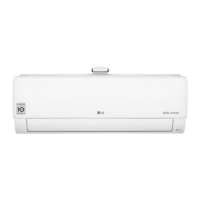
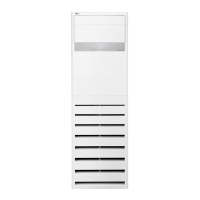
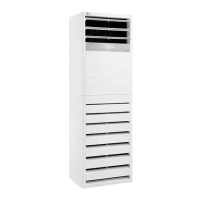
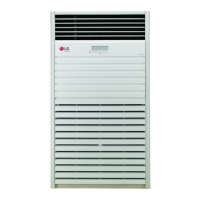
This document is an installation manual for an LG floor-standing air conditioner, model APUW36GT3S1. It provides comprehensive instructions for installation, wiring, piping, testing, and maintenance, along with important safety information and energy-saving tips.
Function Description
The LG APUW36GT3S1 is a floor-standing air conditioner designed for cooling and potentially heating operations (though the manual primarily focuses on cooling-related test runs). Its primary function is to regulate indoor air temperature and humidity, providing a comfortable environment. The unit utilizes a refrigerant system, and proper installation, including leak testing and evacuation, is crucial for its efficient and safe operation. It also features a "Pressure compensation function" to adjust the target pressure when additional piping is used for installation, specifically for pipe lengths exceeding 25 meters.
Important Technical Specifications
- Model: APUW36GT3S1 (Floor standing)
- Piping Length and Elevation:
- Gas Pipe Size: Ø 15.88 mm (5/8 inch)
- Liquid Pipe Size: Ø 9.52 mm (3/8 inch)
- Standard Pipe Length (A): 7.5 m
- Maximum Pipe Length (A): 40 m
- Standard Elevation (B): 5 m
- Maximum Elevation (B): 30 m
- Additional Refrigerant: 40 g/m (for pipe lengths exceeding 7.5 m, calculated as (A - 7.5) x 40 g)
- Electrical Wiring:
- Phase (Ø): 1
- ELCB (Electric Leakage Circuit Breaker): 25 A
- Power Cable (Indoor to Outdoor Unit): 10x3 mm² (normal cross-sectional area 0.75 mm²) for lengths up to 40 m. For lengths over 40 m, a telecommunication line and power line should be connected separately.
- Power Cable (Outdoor Unit): Model APUW36GT3S1 requires a 1-phase connection with a cable type H07RN-F and an area of 2.5 mm².
- Flaring Work Dimensions (for copper pipe):
- Ø 6.35 mm (1/4 inch): A = 1.1~1.3 mm
- Ø 9.52 mm (3/8 inch): A = 1.5~1.7 mm
- Ø 12.7 mm (1/2 inch): A = 1.6~1.8 mm
- Ø 15.88 mm (5/8 inch): A = 1.6~1.8 mm
- Ø 19.05 mm (3/4 inch): A = 1.9~2.1 mm
- Flare Nut Tightening Torque:
- Ø 6.35 mm (1/4 inch): 16±2 N·m
- Ø 9.52 mm (3/8 inch): 38±4 N·m
- Ø 12.7 mm (1/2 inch): 55±6 N·m
- Ø 15.88 mm (5/8 inch): 75±7 N·m
- Ø 19.05 mm (3/4 inch): 110±10 N·m
- Nitrogen Substitution Pressure: 0.02 MPa
- Leakage Test Pressure: No more than 3.8 MPa with dry nitrogen gas.
- Evacuation Time (using 4 CFM vacuum pump):
- Pipe length < 10 m (33 ft): 30 min. or more
- Pipe length > 10 m (33 ft): 60 min. or more
- Target Vacuum: 0.8 Torr
- Test Run Duration: More than 15 minutes (automatically cancelled after 18 minutes).
- Minimum Starting Voltage: 90% of the rated voltage.
- Performance Evaluation: Difference between intake and discharge air temperature should be more than 8 °C (Cooling or Heating).
Usage Features
- Energy Saving Tips:
- Avoid excessive cooling/heating of rooms.
- Block sunlight with blinds or curtains.
- Keep doors and windows closed tightly.
- Adjust airflow direction (vertical/horizontal) to circulate indoor air efficiently.
- Speed up the fan to cool or warm indoor air quickly.
- Open windows regularly for ventilation.
- Clean the air filter every 2 weeks to prevent dust and impurities from blocking airflow or weakening cooling/dehumidifying functions.
- Pressure Compensation Function: This feature allows for adjustment of the target pressure when the installed pipe length exceeds 25 meters, ensuring optimal performance. It is set via a DIP switch on the outdoor unit.
- Test Running: The unit can be put into a test run mode by simultaneously pressing the power button and the temperature down button for 3 seconds. This allows installers to verify proper operation and record performance data.
Maintenance Features
The manual emphasizes several maintenance-related aspects, primarily during installation and initial setup, to ensure long-term reliability and performance:
- Air Filter Cleaning: Users are advised to clean the air filter every two weeks to maintain optimal airflow and efficiency.
- Regular Inspection for Gas Leakage: After installation and repair, it is crucial to inspect for gas leakage, as this can lead to product failure.
- Cleaning: Use a soft cloth for cleaning. Avoid wax, thinner, or strong detergents, as these can damage the unit's appearance.
- Periodic Cleaning (Seaside Installations): For units installed near the seaside, periodic cleaning (more than once a year) of dust or salt particles stuck on the heat exchanger with water is recommended to prevent corrosion.
- Refrigerant Piping Principles: The manual details three key principles for refrigerant piping:
- Drying: No moisture inside the pipes. Moisture can lead to hydrolysis of refrigerant oil, degradation of refrigerant oil, poor insulation of the compressor, and clogging of EEV/capillary.
- Cleanliness: No dust inside the pipes. Dust can also lead to degradation of refrigerant oil, poor insulation of the compressor, and clogging of EEV/capillary.
- Airtight: No refrigerant leakage. Leakage results in gas shortages, degradation of refrigerant oil, and poor insulation of the compressor.
- Nitrogen Substitution Method: During welding of plumbing pipes, nitrogen substitution is required to prevent the formation of oxide film inside the piping. Oxide film can clog components and hinder compressor operation. Nitrogen gas at 0.02 MPa pressure should be used, and oxygen, carbon dioxide, or Chevron gas are strictly prohibited due to their harmful effects on refrigerant oil and flammability.
- Leakage Test and Evacuation: Before operation, the refrigerant system must be checked for leaks using dry nitrogen gas at a pressure of no more than 3.8 MPa, followed by evacuation with a vacuum pump to remove incondensible gases and moisture. This prevents issues like increased system pressure, higher operating current, reduced efficiency, and corrosion.

 Need help?
 General

 To Next Page