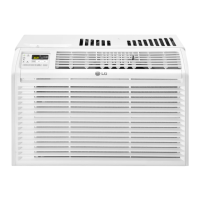
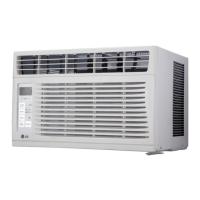
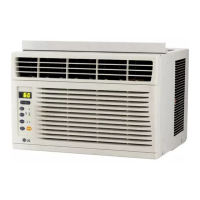
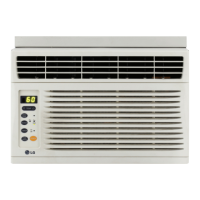
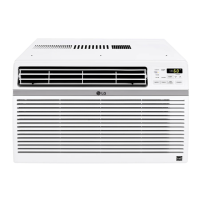
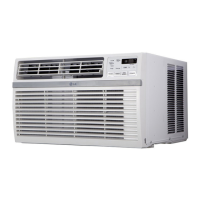
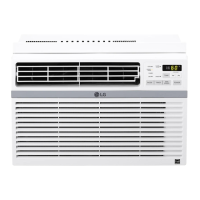
This document is an owner's manual for an LG window air conditioner, specifically model LW6019ER. It provides comprehensive instructions for installation, operation, maintenance, and troubleshooting, ensuring safe and efficient use of the appliance.
The air conditioner is designed to provide cooling and dehumidification for a room. It features various operational modes to suit different environmental conditions and user preferences. The primary function is to cool the air, which is achieved through a refrigeration cycle involving a compressor, evaporator, and condenser. The unit also offers a dehumidification (Dry) mode, which is particularly useful in rainy or damp conditions, and a Fan mode for air circulation without cooling. An Energy Saver mode is included to optimize energy consumption by cycling the compressor and fan based on the room's temperature.
For user interaction, the air conditioner is equipped with a control panel on the unit itself and a wireless remote control. Both allow users to power the unit on or off, adjust the fan speed (Low, Medium, High), and set a delay timer for automatic turn-on or turn-off. The temperature can be controlled within a range of 60 °F to 86 °F (16 °C to 30 °C) in Cool mode. The remote control provides convenient access to these functions from a distance.
Installation of the unit is detailed, emphasizing secure and firm placement to prevent vibration and noise. It is designed for standard double-hung windows with specific opening widths and vertical clearance requirements. Proper tilting of the unit towards the outside (about 1/4") is crucial for condensed water drainage. The manual also addresses storm window requirements, providing instructions for using wood shims to ensure correct drainage if a storm window frame interferes. The installation process involves attaching curtain panels, securing the unit with screws and L brackets, and applying foam strips and heatproof foam to seal gaps and improve cooling efficiency. The heatproof foam is specifically mentioned to enhance the air conditioner's cooling capability.
The air conditioner's design includes a slinger fan, an additional feature that improves efficiency. This fan picks up condensed water from the base pan and expels it through the condenser, aiding in the cooling process. Airflow direction can be adjusted both horizontally and vertically using the louvers, allowing users to direct the cooled air as needed. A ventilation lever is also present, which can be pushed in for maximum cooling performance or pulled out to draw fresh air into the room.
Maintenance is straightforward and primarily focuses on the air filter. Users are advised to check and clean the air filter at least twice a month. A "Clean Filter" LED on the control panel illuminates after 250 hours of operation as a reminder to clean the filter. Cleaning involves removing the filter, washing it with lukewarm water below 40 °C (104 °F), and gently shaking off excess water. Regular filter cleaning is essential for maintaining cooling capacity and preventing frost accumulation on the evaporator. The manual also suggests periodically checking and cleaning the condenser coils (outside of the unit) if they become clogged with soot or dirt. For general cleaning, the front grille and cabinet can be wiped with a cloth dampened in a mild detergent solution, followed by polishing with liquid appliance wax.
The manual also covers important safety instructions, including electrical data and grounding requirements. It highlights the importance of connecting the unit to a properly rated, protected, and sized power circuit and always plugging it into a grounded outlet. The power cord includes a current interrupter device with TEST and RESET buttons, which should be tested periodically. Users are warned against using extension cords, surge protectors, or multi-outlet adapters with this appliance.
Troubleshooting guidance is provided for common issues such as the unit not starting, not cooling effectively, freezing up, or dripping water. It also describes normal operational sounds, including high-pitched chatter from the compressor, rushing air from the fan, gurgling/hissing from refrigerant, vibration, and pinging/swishing from water hitting the condenser. For more complex issues or if a "CH" error code appears, users are directed to contact customer service.
Overall, this manual serves as a comprehensive guide for the safe, effective, and long-lasting operation of the LG window air conditioner, emphasizing ease of use and maintenance.


 To Next Page
 General