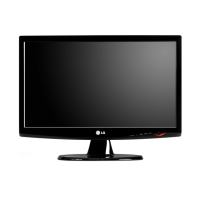
Need help?
Do you have a question about the LG W1643C and is the answer not in the manual?
Provides essential safety guidelines for the operation and usage of the display unit.
Details important precautions and guidelines for the safe and proper installation of the display.
Instructions on how to clean the display screen and its parts safely and effectively.
Guidance on how to repack the unit using original materials for transport or shipping.
Information regarding the proper disposal of the product, considering environmental regulations.
Step-by-step instructions for assembling the monitor stand to the display unit.
Detailed guide on how to safely remove the monitor stand from the display unit.
Guidance on adjusting the display panel for optimal viewing comfort and ergonomic posture.
Instructions for connecting the display to a computer and powering it on.
Instructions on how to use the cable holder for managing display cables.
Details the buttons on the front panel and their respective functions for operating the display.
Guides users through the process of making adjustments to image size, position, and parameters using the OSD.
Presents a comprehensive table of all available On Screen Display controls, adjustments, and setting menus.
Explains the icons, menu names, and button tips for navigating and selecting items within the OSD system.
Details OSD adjustments for Picture (Brightness, Contrast, Gamma) and Color (Preset, Red, Green, Blue) settings.
Explains OSD settings for Tracking, including Horizontal, Vertical, Clock, Phase, and Sharpness adjustments.
Covers OSD setup options such as Language, OSD Position, White Balance, Power Indicator, and Factory Reset.
Details OSD options accessible via the FUN button, including 4:3 IN WIDE and PHOTO EFFECT settings.
Explains OSD options accessed via the F-ENGINE button: MOVIE, INTERNET, USER, NORMAL, and DEMO modes.
Provides solutions for common issues when the display shows no image, checking power and signal connections.
Addresses problems like incorrect display position, visible bars, or noise, offering solutions via AUTO/SET and other OSD controls.
Guides on installing the display driver and troubleshooting monitor recognition issues like Plug&Play.
Details the display panel type, size, pixel pitch, and other visual characteristics.
Covers sync input, video input, resolution, plug&play, power consumption, and input power requirements.
Provides dimensions, weight, tilt range, AC-DC adapter info, and operating/storage environmental conditions.
Lists available display resolutions, their horizontal and vertical frequencies, and identifies the recommended mode.
Explains the meaning of the LED indicator colors for different operational states like On Mode, Sleep Mode, and Off Mode.
This document is a user's guide for the LG W1643C display, providing essential information on its installation, operation, and maintenance.
The LG W1643C is a flat panel active matrix-TFT LCD display designed for use with computers. Its primary function is to display visual output from a connected computer system. The display features an On Screen Display (OSD) control system, allowing users to adjust various image parameters and operating settings for optimal viewing. It supports both PC and Mac connections via a D-sub cable. The display is equipped with a power button and an indicator light that shows its operational status (On Mode, Sleep Mode, Off Mode).
The display offers several features to enhance the user experience:
To connect the display, users must first ensure that the power to the monitor, computer system, and other attached devices is turned off. The display connects to a computer via a D-sub cable. For Mac users, a separate plug adapter may be required to convert the 15-pin high-density D-sub VGA connector to a 15-pin 2-row connector. Shielded signal interface cables with ferrite cores are recommended to maintain standard compliance.
The display comes with a stand that requires assembly. Users need to place the monitor face down on a soft cloth, assemble the stand base into the stand body, and secure it by tying down the base lock. Once assembled, the monitor can be carefully positioned. The display allows for tilt adjustment within a range of -5° to 15° for maximum comfort. It is recommended that the forward tilt angle does not exceed 5 degrees for ergonomic viewing. The stand can also be disassembled by following a reverse procedure, which involves changing a lock on the product and pulling out the stand.
The display includes a cable holder feature (though not available on all models) to help organize cables, contributing to a tidier workspace.
The front panel of the display features several controls:
The OSD system facilitates quick and easy adjustments to image size, position, and operating parameters. To make adjustments:
The OSD offers a comprehensive range of adjustments, including:
The manual provides troubleshooting steps for common issues:
The manual outlines important precautions and cleaning instructions to ensure the longevity and safe operation of the display:
 General
| Resolution | 1366 x 768 |
|---|---|
| Panel Type | TN |
| Response Time | 8 ms |
| Connectivity | VGA |
| Aspect Ratio | 16:9 |
| Screen Size | 15.6 inches |
| Viewing Angle | 90°/50° |
| Input Connectors | VGA |
| Power Consumption | 18W |

 To Next Page