Need help?
Do you have a question about the LifeSafety Power M8 and is the answer not in the manual?
Details the M8/M8P power control modules and their function in FPO power supply systems.
Lists the standards to which the M8/M8P equipment has been tested and approved.
Provides key electrical and physical specifications for the M8/M8P modules.
Describes the procedure for mounting the M8/M8P board to an enclosure using standoffs.
Explains how to connect the M8/M8P to the FPO system, including required and optional connections.
Details the 8 input terminal strips and their use with dry contact or voltage inputs.
Explains the function of FlexIO connectors for passing FAI and Fault signals.
Describes the bi-color LEDs indicating the status of each zone output.
Explains the yellow Fault LED and conditions that trigger it.
Details the jumpers used to select the power supply input for each output.
Describes the 8 output terminals and their use for powering devices.
Covers the optional fuses for each zone output or PTCs on the M8P version.
Explains the BR, B1, and B2 connectors for system power and data bus connections.
Details the SPI connector for communication with the NL4 board.
Explains the built-in reverse protection diodes and how to remove them if needed.
Provides diagrams and instructions for connecting input and output field wiring.
Guides users on how to access the M8/M8P configuration via the NL4 interface.
Describes the M8 Status page, its fields, and manual output control options.
Details various programming parameters such as input types, output loads, and limits.
Illustrates typical input and output wiring configurations for various scenarios.
Provides detailed examples for each zone, covering different input and output types.
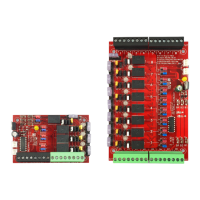
The M8/M8P power control modules are designed to expand the capabilities of an FPO power supply system, adding 8 zones for powering and monitoring various critical devices such as locks, cameras, and other equipment. These modules are specifically designed to be used in conjunction with an NL4 network module, which facilitates communication and control within the system.
A key feature of the M8/M8P is its flexibility in power sourcing. It can accept either one or two voltage sources, and these sources are selectable on a zone-by-zone basis, allowing for tailored power delivery to different devices. This adaptability ensures that various devices with different power requirements can be integrated into the same system.
The input capabilities of the M8/M8P are highly programmable through software. Each input can be configured to accept a voltage, dry contact, or open collector input. This versatility allows for integration with a wide range of control signals and sensors. For instance, when using a dry contact input, the contact is placed across the A and B terminals. It's normal to measure a voltage across these terminals, which is current-limited to prevent damage to the activation contact. For voltage inputs, the voltage is connected to the B terminal, and the A terminal is left disconnected. The activation voltage must be common grounded with the system voltage and fall within the 12V to 24VDC range. For open collector inputs, a jumper is placed across the A and B terminals, and the open collector is connected to B, with the input source also common grounded with the M8/M8P board's power source.
Output zones are equally flexible, with software-selectable options for FAI operation, constant output, maglock output, or fail-safe/fail-secure door strike outputs. Output zone 8 offers additional programmability as a dry contact output, further enhancing the module's adaptability. The "P" suffix in the model number indicates Class 2 Power Limited outputs, which is an important safety and compliance feature.
Mounting the M8/M8P board is straightforward, utilizing four snap-in standoffs provided with the module. Users simply locate the appropriate mounting holes in the enclosure, snap in the standoffs, align the board, and snap it onto the standoffs, ensuring proper orientation. All connections to the module must be completed within the same room and not exceed a length of 3 meters.
The module includes several visual indicators for status and fault conditions. Output Status LEDs (1-8) are bi-color (green/blue) and indicate the status of each output. When powering lock devices, a steady ON light means the door is locked (fuse or PTC intact), slow flashing (1 per second) indicates the door is unlocked (due to zone input or FAI), fast flashing (4 per second) signals a fault detected on the zone, and OFF means the fuse or PTC is open, or the zone is disabled in software. When set for constant output, ON steady means output is powered, slow flashing means output is unpowered (due to FAI), fast flashing indicates a fault, and OFF means the fuse or PTC is open or the zone is disabled. The LED color also indicates output voltage: green for 12V and blue for 24V. A yellow FAULT LED illuminates when the M8/M8P detects a ruptured output fuse or other fault conditions, such as tripped upper or lower limits, and this fault condition is also transmitted to the power supply via FlexIO.
For power distribution, the M8/M8P features Buss Selection Yellow Jumpers (1-8) that allow selection of either B1 or B2 power supply inputs for each output. If only one power supply is used, the jumper is set to Position 1. The module also includes BR Connectors (J5 & J6) for the DC Common buss, ensuring all DC boards in the system are properly wired together. B2 Connectors (J7 & J8) are for connecting to the B2 buss, which can be a second power supply or a B100 secondary supply in dual voltage systems. B1 Connectors (J1 & J2) connect to the B1 buss, which receives voltage from the first power supply.
Maintenance features include optional output fuses (F1-F8) for each zone in the fused version of the M8. In the M8P (PTC) version, these are replaced with soldered-in PTCs. The module also has built-in reverse protection diodes across each output. If a delay in lock release is observed, the diode for that specific zone can be removed by cutting and separating the exposed diode lead, while leaving the diode body soldered to the PCB. This should only be done for outputs requiring removal.
Communication with the NL4 board is handled via the SPI Connector (J13), which requires an SPI cable to be connected at all times for proper operation. The M8/M8P will not function if connected to an NL2 board.
Software programming of the M8/M8P board is done through the NL4's GUI interface. The M8 Status Page provides an overview of the board's current state and allows manual output control. Key fields include Device ID, Model, M8 Notes, AC Power status, Output #, Output Description (programmable descriptive name for each zone), Voltage (V) and Current (A) measurements at the output terminals, Power (W) calculation, Power Ready status, Control Input state (Active/Inactive), FAI State, and Cycle Count (total number of cycles for each output). Buttons are available to enable/disable selected or all outputs, reset selected or all outputs (disabling them for 5 seconds), and reset selected or all cycle counts.
The Programming Page allows for detailed configuration. Users can set the Control Input Type (Normally Closed, Normally Open, Open Collector, Voltage, Disabled), Output Load Type (Maglock, Fail-Secure Strike, Constant ON), and define how FAI conditions or AC Loss affect outputs (Unlock on FAI Activation, Unlock on AC Loss). Email alerts for faults can also be configured (Email Alert on Fault).
Advanced programming features include setting Voltage Lower and Upper Limits (V) and Current Lower and Upper Limits (A) for each zone to trigger faults. A Cycle Count Limit can also be set. The Output Limit Setting Aid simplifies setting these limits by allowing users to enter desired percentages above and below measured values. After connecting all output field wiring to the devices, clicking "Start Measurement" will cycle each output on and off, measure voltage and current levels, and automatically set the upper and lower limits based on the entered percentages. This comprehensive set of features makes the M8/M8P a versatile and robust solution for power control and monitoring in various security and critical device applications.
 General
| Output Voltage | 12 or 24 VDC |
|---|---|
| Number of Outputs | 8 |
| Main Supply Voltage | 120-240 VAC |
| Input Voltage | 120-240 VAC |
| Operating Temperature | 0°C - 49°C (32°F - 120°F) |
| Humidity | 0% to 95% non-condensing |


 To Next Page