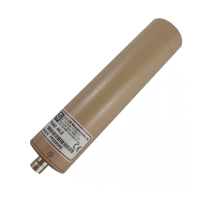
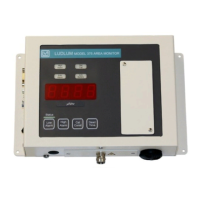
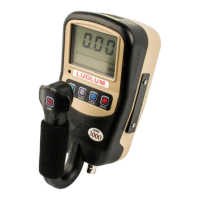
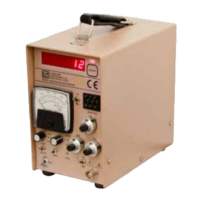
Model 2200 Scaler Ratemeter
Ludlum Measurements, Inc. Page 10 March 2016
Adjust DISCR until scaler meter reaches 75% of generated, incoming
count rate. The input sensitivity is now set for 10 mV with
THRESHOLD set for 1.00.
Proceed to use instrument with THRESHOLD setting at 1.00 or
more.
For Geiger Mueller (GM) detectors:
Set the THRESHOLD and the pulser as in the first three steps for
scintillation detectors.
Disconnect pulser and set the THRESHOLD on 3.00 and proceed
to use the instrument. The input sensitivity is approximately 30 mV.
At settings less than this, double-pulsing may occur. Some GM tubes
may require even higher settings of 7.00 or 8.00.
For proportional detectors:
Set the THRESHOLD on 1.00.
Connect the scaler to the pulser.
Set the pulser pulse height at 2 mV.
Adjust the DISCR until the scaler meter reaches 75% of the
generated incoming count rate. The input sensitivity is now set for 2
mV with the THRESHOLD SET ON 1.00.
Proceed to use instrument with THRESHOLD setting at 1.00 or
more.
Operating Point
The instrument and detector operating point is established by setting the
probe voltage (HV) and instrument sensitivity (DISCR and THRESHOLD).
Efficiency, background, and noise for a given detector system are fixed by
the physical makeup of the detector and rarely vary from unit to unit.
However, the selection of the operating point makes a marked difference in
the apparent contribution of these three sources of count.
In the singular case of the GM detector, a minimum operating voltage is
required to establish the GM operating region. (At lower voltages, the
detector operates as a very insensitive proportional counter.) This detector is
not capable of energy discrimination (pulse-height discrimination).
For gain sensitive detectors (proportional or scintillation), the most
straightforward method of selecting the operating point is to develop a

 To Next Page
 Loading...