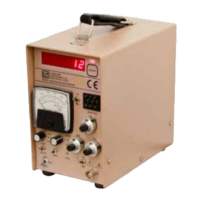
Model 2200 Scaler Ratemeter
Ludlum Measurements, Inc. Page 11 March 2016
graph, relating count rate to system gain. This relationship is commonly
referred to as a plateau or instrument plateau curve. System gain may be
changed by adjusting detector high voltage (HV), THRESHOLD control or
DISCR (amplifier gain).
Determining Instrument Plateau
Set window ON-OFF at OFF.
Set the time multiplier toggle switch to X0.1 and the MINUTES
thumbwheel switch to 001. This gives a 0.1 minute count.
Set THRESHOLD control at 1.0.
With the detector shielded from the source, adjust the high-voltage control
by 100-volt increments and take a plot of HV-versus-background coutn rate
until the detector voltage rating is reached. Return the HV control to zero.
Note: If the detector voltage is reached before any background counts are
detected, turn the DISCR clockwise to increase the sensitivity.
Expose the detector to a source and again make a plot of count-versus-
voltage.
Plot both sets of data and select the operating point to correspond with the
maximum source count and minimum background count. Avoid areas of
very fast count rate changes with small changes in detector voltage. The
optimum operating point for low background detectors is just above the
inflection point (or break-over point) of the plateau curve. If the background
count is irrelevant, shift the operating point to the plateau center for greater
stability.
Operating the Instrument
Ensure that all settings and adjustments have been properly made. Proceed
to use the instrument.

 To Next Page
 Loading...