7
• Avoid placing loudspeakers in the corners of a
room. This increases the low frequency output and
can cause the sound to be muddy and indistinct.
• Avoid placing loudspeakers against a wall. This, too,
increases the low frequency output, though not as
much as corner placement. However, if you do need
to reinforce the low frequencies, this is a good way
to do it.
•
Avoid placing the speakers directly on a hollow stage
fl oor. A hollow stage can resonate at certain frequen-
cies, causing peaks and dips in the frequency response
of the room. It’s better to place the loudspeakers on a
stand designed to handle the weight of the S408s.
•
Position the loudspeakers so the high-frequency
drivers are 2 to 4 feet above ear level for the audience
(make allowances for a standing/dancing in the aisles
audience). High frequencies are highly directional
and tend to be absorbed much easier than lower
frequencies. By providing direct line-of-sight from the
loudspeakers to the audience, you increase the over-
all brightness and intelligibility of the sound system.
•
Highly reverberant rooms, like many gymnasiums
and auditoriums, are a nightmare for sound system
intelligibility. Multiple refl ections off the hard walls,
ceiling, and fl oor play havoc with the sound. Depend-
ing on the situation, you may be able to take some
steps to minimize the refl ections, such as putting
carpeting on the fl oors, closing draperies to cover
large glass windows, or hanging tapestries or other
materials on the walls to absorb some of the sound.
However, in most cases, these remedies are not
possible or practical. So what do you do? Making
the sound system louder generally doesn’t work
because the refl ections become louder, too. The
best approach is to provide as much direct sound
coverage to the audience as possible. The farther
away you are from the speaker, the more prominent
will be the refl ected sound.
Use more speakers strategically placed so they are
closer to the back of the audience. If the distance
between the front and back speakers is more than
about 100 feet, you should use a delay processor to
time-align the sound. (Since sound travels about 1
foot per millisecond, it takes about 1/10 of a second
to travel 100 feet.)
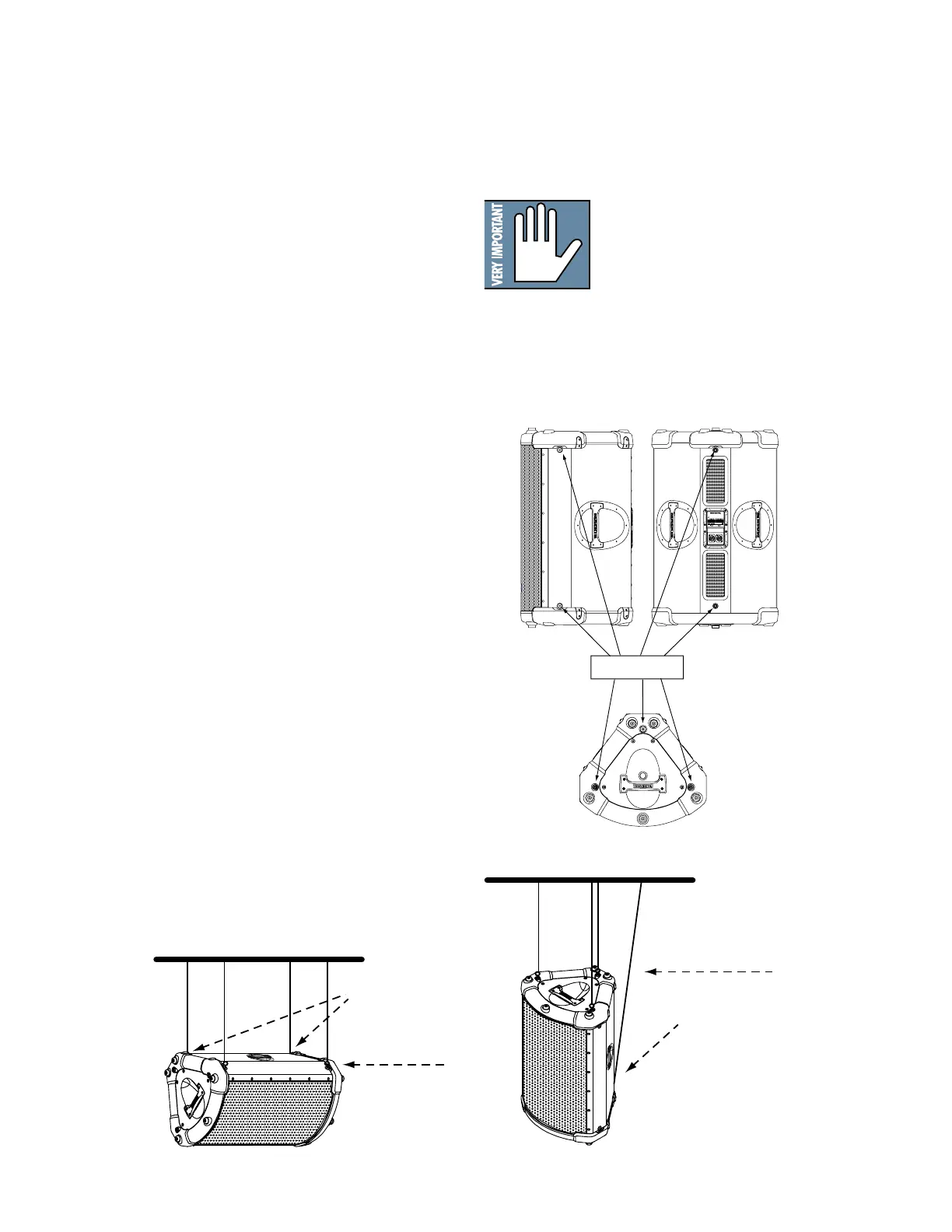
RIGGING
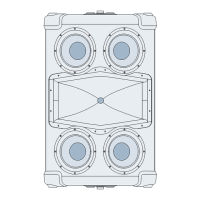
The S408 cabinets are fi tted with twelve rigging points
as shown in the diagram below. These are 3/8" inserts
with blocking bolts installed. Remove the blocking bolts
and use eyebolts for rigging.
WARNING: Never attempt to
suspend the S408 loudspeakers by
their handles. If you want to sus-
pend them, use the rigging points
only. Consult a professional rigger or
structural engineer prior to suspending loudspeakers
from a structure not intended for that use. Always know
the working load limit of the structure supporting the
loudspeaker array. Always make sure that the rigging
hardware minimum rating is at least fi ve times the
actual load.
S408
DESIGNED BY MACKOIDS IN WHITINSVILLE, MA & WOODINVILLE, WA,USA
"MACKIE" AND THE "RUNNING MAN" FIGURE
ARE REGISTERED TRADEMARKS OF LOUD TECHNOLOGIES INC. • COPYRIGHT ©2005
Rigging Points
Two each Side Two on Back
Three on Top
Three on Bottom
Side Flypoints
Back Flypoints
(adjust angle)
Top Flypoints
Lower Back Flypoint
(adjusts angle)


 To Next Page