ainship 40 Trawler Sin
le & Twin • Boatin
Safet
4.
s
ou read
our owner’s manual, please note hazard
warnin
s which alert
ou to sa
et
and precautions and
unsafe conditions or operatin
procedures. We have
included these warnin
s because we are concerned
about
our sa
et
and the sa
et
o
our passen
ers.
azard statements
enerall
have five parts
1. The hazard s
mbol.
2. A si
nal word which indicates the severit
of the haz-
r
. A concise description o
the hazard.
4. The results of i
norin
the hazard
.
teps
or avoidin
the hazard
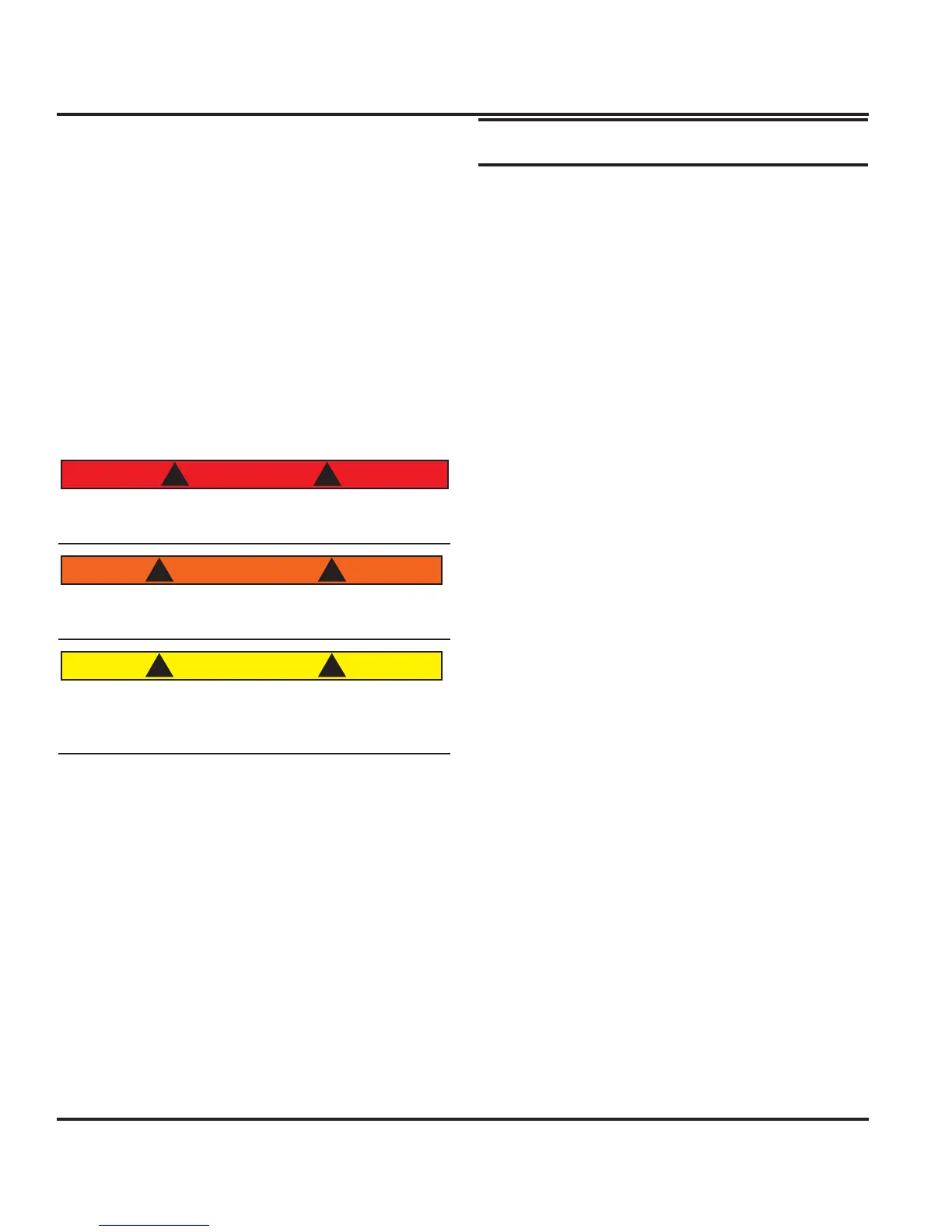
The three si
nal words which indicate the severit
of a
azard are dan
er, warnin
, and caution. The meanin
s
the
conve
are as
ollows
DANGER
! !
Calls attention to immediate hazards that will result in
severe in
ur
or death
WARNING
! !
Identifies hazards or unsafe practices that could re-
sult in personal in
ur
or death
CAUTION
! !
Indicates hazards or unsafe
ractices that could re-
sult in minor personal in
uries, propert
dama
e, o
omponent dama
e
lso included in this manual are owner advisor
state-
ments identi
ied as "Important" or "Note". Unlike the
azar
commun
cat
on statements, t
e
a
ert
ou to con-
ditions a
ectin
equipment operation, maintenance, and
ervicin
practices
Important: This is a general advisory statement or procedure
intended to prevent damage to the equipment or associated
component.
Note: This is a general advisory statement relating to equip-
ment operating and maintenance procedures. Its intent is to call
attention to information more important than normal text.
.1 Safet
Boatin
safet
and the safet
of
our passen
ers are
our
responsibilit
. You should
ull
understand and become
familiar with the operatin
and safet
procedures and
recaut
ons
n t
s manua
an
t
e ot
er manua
s
n t
e
owner’s packet be
ore
ou launch
our new boat
.1.1 Safe O
eration
Followin
is
eneral information about safe operation.
Keep
our boat and equipment in sa
e operatin
condi-
tion. Inspect the hull, en
ines, safet
equipment, and all
oat
n
ear re
u
ar
Important: Federal law requires you, the owner, to provide and
maintain safety equipment on your new boat. Consult your
Coast Guard, state, and local regulations to ensure your boat
has all required safety equipment on board. Additional equip-
ment may be recommended for your safety and that of your
passengers. Make yourself aware of its availability and use.
BE VERY CAREFUL when fuelin
our boat. Be sure
ou know the capacit
o
our boat’s
uel tank and the
amount o
uel
ou use when operatin
at
requentl
used en
ine speeds
RPMs
. Ask
our dealer about the
apacit
o
our boat’s
uel tank.
wa
s
now w
ere
ou are on t
e
oat,
now t
e naut
-
al terms
or the di
erent areas o
our boat. At the end
o
this chapter are shown a
eneral la
out o
these terms
and illustrate the areas that ma
be of importance to
u.
ake sure
ou have enou
h fuel on board for anticipated
ruisin
requirements. In
eneral, use 1
3 o
our suppl
to reach
our destination and 1
3 to return. Keep 1
3 in
reserve for chan
es in
our plans due to weather or other
ir
m
t
n
Note: Your generator supply line is located higher on the aux-
iliary fuel tank than the engine’s supply lines. This is for your
safety in that your generator cannot deplete your fuel supply
should it ever be left running.
Be sure li
esavin
and
ire extin
uishin
equipment is
on board. This equipment must meet re
ulator
a
enc
tan
ar
s, an
t s
ou
e not
cea
e, access
e, an
in a sa
e operatin
condition. Your passen
ers should
know where this equipment is and how to use it.



 To Next Page