ainship 40 Trawler Sin
le & Twin • Boatin
Safet
4.1
that other vessels see
ou. Most recreational vessels
are less than 30
eet in len
th and, accordin
to
The
ules of the Road”, shall be equipped with navi
ation
li
hts. These li
hts not onl
have a certain arc throu
h
which the
can be seen but must be seen
rom a mini-
mum distance. The followin
li
htin
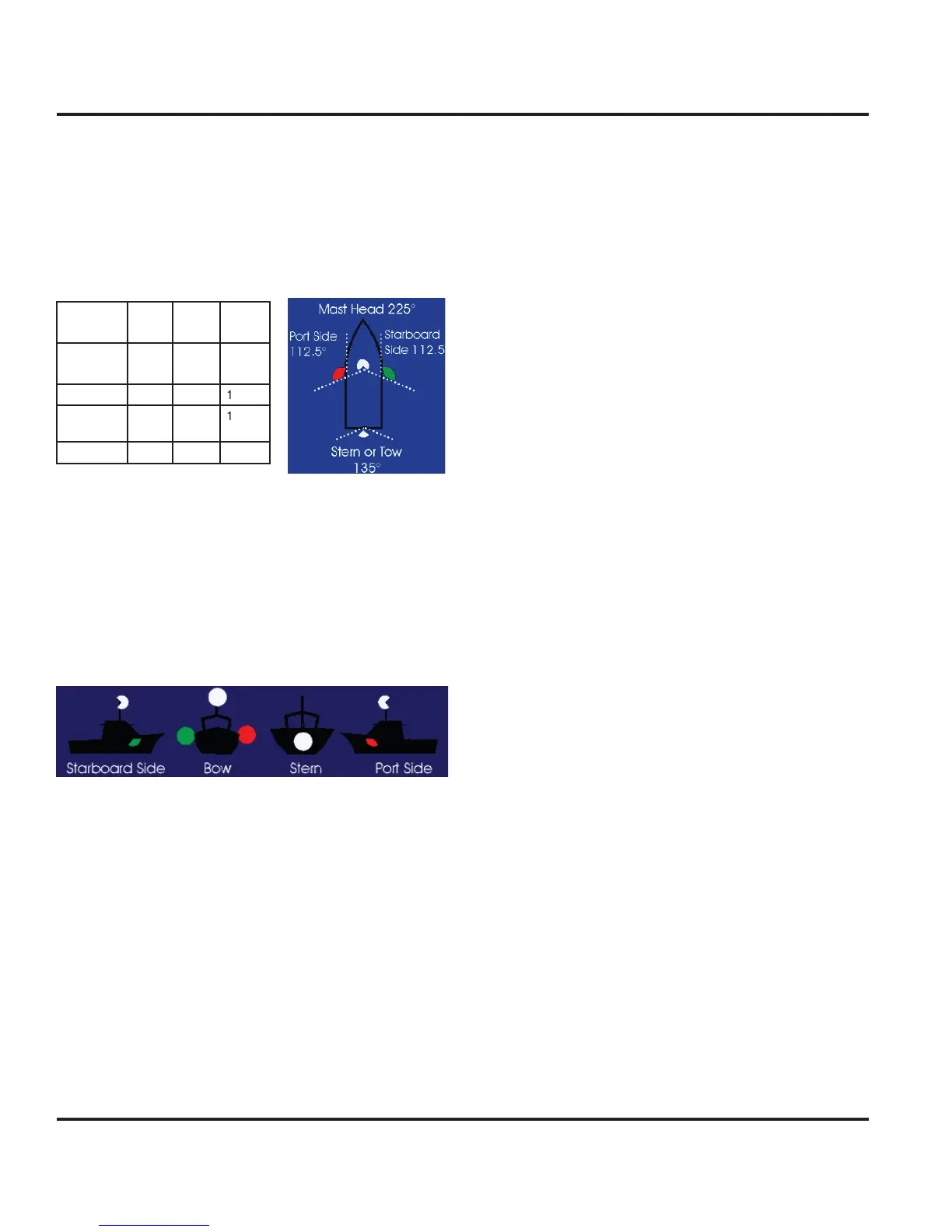
requirements are
or recreational vessels less than 12 meters in len
th
approximatel
39.4”
Ligh
r
olor
i
i
l
an
th
Li
h
Wh
tarboar
112.
r
r
ideli
h
112.
ternli
h
Wh
The arc o
the li
hts and color allows
ou to determine the
direction a vessel is movin
. How
ood are
our li
hts
ou s
ou
test t
em to see
ow v
s
e
ou m
t
e
at ni
ht. Whether on a trailer or at the marina, switch
n
our li
hts and see how well the
can be seen. Walk
awa
from the boat or row awa
, if
ou are at anchor or
at a moorin
, and see how visible the li
hts are as
ou
move
urther awa
. How eas
are the
to see a
ainst the
back
round of li
hts on shore?
oes
our stern li
ht shine dead astern over the required
135 de
ree arc or does it shine to one side or up or down.
an it be seen from the required 2 miles and wh
is that
important
As an example, let’s sa
that
our stern li
ht,
or some reason, can onl
be seen
or
mile. You are
underwa
at 8 knots and a lar
e ship is approachin
at
15 knots. The ship is onl
4 minutes awa
rom collision
with
ou. B
the time the ship
mi
ht” see
ou, identi
t
e
t an
ec
e on t
e react
on t
at s
ou
e ta
en,
it is too late. A ship travelin
at
5 knots ma
take miles
to stop. Look at the stern li
ht a
ain, as
ou move
rom
the stern toward the bow. Does the stern li
ht “disap-
pear” as the sideli
ht
appears”
The stern li
ht should
disappear and sideli
ht appear at 22.5 de
rees aba
t the
beam. If
ou don’t see the
reen starboard sideli
ht or
the red port sideli
ht when the stern li
ht disappears,
there is a problem with the arc o
one or all o
these li
hts.
This means that i
another boat were approachin
ou at
t
e an
e w
ere no
ts are seen, t
ere
s
ncrease r
s
lli
i
n.
If both the sternli
ht and sideli
hts are seen bri
htl
at the
same time,
ou still have a problem. A vessel approach-
in
won
t know whether the
are overtakin
or crossin
an
w
et
er t
e
s
ou
ve-wa
or stan
-on.
You should also check to make sure that
our masthead
t
sappears at t
e same t
me eac
s
e
t
sap-
pears and the
both disappear when the stern li
ht
.
heck
our sideli
hts
rom dead ahead. You should see
both red and
reen. However, b
movin
toward one
side b
1-3 de
rees,
ou should then see onl
one li
ht.
I
ou still see two li
hts, an approachin
vessel won’t be
able to tell which direction
ou are
oin
It is ver
important to be seen
rom a distance but also
or an approachin
vessel to be able to determine
our
ir
ti
n
f tr
v
l.
When boatin
at ni
ht, remember the
ollowin
:
When
two
ts
ou see a
ea
, turn
our
e
m an
s
ow
our
r
.
.5.4 Sound Si
nalin
Devic
Your boat is provided with a horn which con
orms with
.S. Coast Guard requirements for boats of this size. All
lass A boats are recommended to carr
a hand, mouth,
r whistle, as well as a power operated horn. The device
should be used to promote safe passin
, as well as a
warnin
to other vessels in
o
, or con
ined areas, or as
a si
nal to operators o
locks or drawbrid
es. Followin
are stan
ar
w
st
e s
na
s
ne Prolon
ed Blast..........Warnin
i
nal
ne Short Blast..........Pass on m
port sid
Two
hort Blasts..........Pass on m
starboard sid
Three
hort Blasts..........En
ines in Revers
Five or More Blasts..........Dan
er Si
nal



 To Next Page