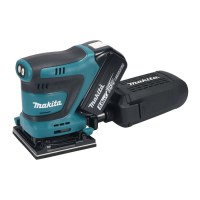
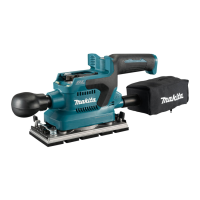
The Makita Cordless Random Orbit Sander, models DBO140 and DBO180, is a versatile power tool designed for sanding large surfaces of wood, plastic, metal, and painted materials. It operates on D.C. 14.4V or D.C. 18V battery cartridges, offering cordless convenience for various applications.
Function Description
The sander utilizes a random orbit motion to achieve a smooth finish, minimizing swirl marks. It features a start/speed adjusting button that allows users to cycle through three speed modes: high, middle, and low. The high-speed mode is suitable for regular sanding, the middle speed for finish sanding, and the low speed for polishing. A separate stop button is provided for quick and easy shutdown.
The tool is equipped with a battery protection system for Lithium-ion batteries with a star marking. This system automatically cuts off power to the tool under specific conditions to extend battery life and prevent damage. These conditions include:
- Overload: If the tool draws an abnormally high current, it will stop. The user should stop the application that caused the overload and then press the start/speed adjusting button to restart. If the tool does not restart, the battery may be overheated and needs to cool down.
- Low battery voltage: When the remaining battery capacity is too low, the tool will not operate. In this situation, the battery needs to be removed and recharged.
For battery cartridges equipped with an indicator, users can check the remaining battery capacity by pressing the check button. Indicator lamps will light up for a few seconds, showing the charge level in increments (75-100%, 50-75%, 25-50%, 0-25%). If the battery needs charging or has malfunctioned, specific blinking patterns or no lights will indicate this.
The sander can be used with an abrasive disc for sanding operations. For dust collection, it can be fitted with an optional dust bag or a paper filter bag, which helps reduce dust-related hazards. The skirt, which prevents dust from scattering, can be adjusted to 12 different directions to suit various purposes.
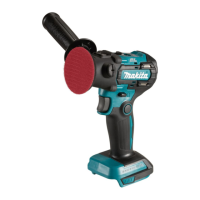
Beyond sanding, the tool can also be used for polishing operations with optional accessories such as sponge pads, felt pads, or wool pads. When applying wax, a sponge pad is recommended, and the tool should be run at low speed to smooth out the wax. For removing wax, a felt pad is used, also at low speed.
Usage Features
- Cordless Operation: Powered by Makita battery cartridges, offering freedom of movement without the need for a power outlet.
- Variable Speed Control: Three speed modes (high, middle, low) allow for precise control over sanding and polishing intensity, adapting to different materials and desired finishes.
- Easy Abrasive Disc Installation: Abrasive discs attach to the pad, with holes needing to be aligned for optimal dust extraction.
- Dust Management: The optional dust bag or paper filter bag can be easily installed and emptied, contributing to a cleaner work environment. The dust bag is installed by directing its mouth downwards, and the dust nozzle is secured by turning it clockwise. Emptying involves unlocking the dust nozzle by turning it counterclockwise and tapping the bag lightly.
- Adjustable Skirt: The skirt can be removed and reinstalled, with 12 directional options to prevent dust scattering during operation. It's crucial to ensure the skirt is properly fastened and set at the designated angle to avoid damage.
- Polishing Capability: With appropriate optional pads (sponge, felt, wool), the sander transforms into a polishing tool, expanding its utility.
- Battery Indicator: For compatible battery cartridges, a check button and indicator lamps provide real-time feedback on remaining battery capacity, helping users plan their work and avoid unexpected power loss.
Maintenance Features
- Battery Cartridge Handling: Always ensure the tool is switched off and the battery cartridge is removed before any adjustments, maintenance, or storage. The battery cartridge should be installed fully until the red indicator is no longer visible, ensuring it is securely locked. Avoid forcing the cartridge if it doesn't slide in easily.
- Cleaning: Keep handles and grasping surfaces dry, clean, and free from oil and grease for safe handling.
- Pad Inspection: Regularly check the pad for cracks or breakage before use, as damage can lead to personal injury.
- Dust Bag/Filter Maintenance: Empty the dust bag when it is about half full. For paper filter bags, remove them by pinching the cardboard lip and pulling it out of the holding tab.
- General Tool Care: Maintain power tools and accessories by checking for misalignment, binding of moving parts, or breakage. Any damaged parts should be repaired by a Makita Authorized Service Center using genuine replacement parts.
- Avoid Harsh Chemicals: Never use gasoline, benzine, thinner, alcohol, or similar substances for cleaning, as they can cause discoloration, deformation, or cracks.
- Battery Storage: Store idle power tools and battery cartridges out of reach of children. Do not store the tool or battery in locations where the temperature may exceed 50 °C (122 °F). If the tool is not used for a long period, the battery should be removed.
- Battery Charging: Charge battery cartridges before they are completely discharged. Avoid overcharging, as it shortens battery service life. Charge batteries at room temperature (10 °C - 40 °C / 50 °F - 104 °F) and allow hot batteries to cool down before charging. Charge batteries if not used for long periods (more than six months).
- Genuine Parts: Only use genuine Makita batteries and accessories to ensure safety, optimal performance, and to maintain warranty validity.

 Need help?
 General

 To Next Page