Need help?
Do you have a question about the Makita HM1101C and is the answer not in the manual?
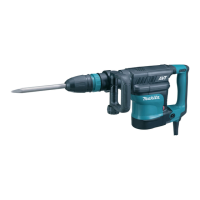
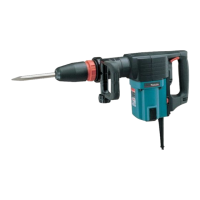
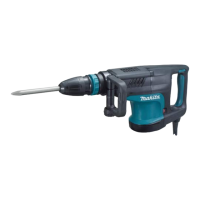
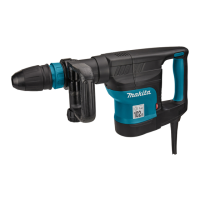
This document is an instruction manual for the Makita Demolition Hammer models HM1111C and HM1101C. It provides comprehensive information on the tool's function, usage, and maintenance, ensuring safe and effective operation.
The Makita Demolition Hammer is designed for chiselling work in concrete, brick, stone, and asphalt, as well as for driving and compacting with appropriate accessories. It is a double-insulated power tool, meaning it can be operated from sockets without an earth wire, provided it is connected to a power supply of the same voltage as indicated on the nameplate and operates on single-phase AC supply.
The tool features an adjusting dial that allows for speed changes, controlling the blows per minute. This adjustment can be made even while the tool is running, with settings from 1 (lowest speed) to 5 (full speed). For the HM1111C model, the blows at no load per minute are intentionally reduced to minimize vibration, increasing to the specified rates once the bit engages with the concrete.
An indicator lamp system provides operational feedback. A green Power-ON indicator lamp illuminates when the tool is plugged in, indicating power supply. If this lamp does not light up, it may signal a malfunction in the mains cord or controller. If the lamp is lit but the tool doesn't start, it could be due to worn carbon brushes, or issues with the controller, motor, or ON/OFF switch. A red service indicator lamp flickers when the carbon brushes are nearly worn out, signaling that servicing is required. After approximately 8 hours of use following this indication, the motor will automatically shut off.
The demolition hammer is equipped with a switch lever for easy operation. To start the tool, the switch lever is pushed to the "ON (I)" position on the left side. To stop it, the lever is pushed to the "OFF (O)" position on the right side. For extended use and operator comfort, the switch can be locked in the "ON" position, though users are cautioned to maintain a firm grasp on the tool when doing so.
The tool comes with either a D-shaped side handle or a stick-type side grip, both serving as auxiliary handles. The D-shaped side handle can be swung 360° vertically and secured at any desired position, as well as at eight different horizontal positions. The stick-type side grip can be swung to either side for easy handling. Both handles are adjusted by loosening a clamp nut (for the D-shaped handle) or turning the grip counterclockwise (for the stick-type grip), positioning it, and then tightening it securely. It is crucial to hold the tool firmly with both hands using the D-shaped side handle or side grip and the switch handle during operation. Applying slight pressure on the tool prevents it from bouncing uncontrollably, and pressing too hard will not increase efficiency.
Installing and removing bits is a straightforward process. Before installation, the bit shank should be cleaned and bit grease applied. The bit is then inserted into the tool, turned, and pushed in until it engages. To remove, the releasing cover is pulled down, and the bit is pulled out. If a bit cannot be pushed in, the releasing cover should be pulled down a couple of times before reinserting the bit. After installation, users should always ensure the bit is securely held by attempting to pull it out.
The bit angle can be adjusted to 12 different positions. To change the angle, the change ring is slid forward, turned to the desired angle, and then slid back to secure the bit in place.
For optimal performance and safety, several operational guidelines are provided. Users are advised to wear ear protectors, a hard hat, safety glasses, and/or a face shield, along with a dust mask and thickly padded gloves. The bit must be secured before operation, and screws should be checked for tightness regularly due to vibration. In cold weather or after long periods of disuse, the tool should be warmed up by operating it under no load to loosen lubrication. A firm footing is essential, and no one should be below when using the tool in high locations. Hands must be kept away from moving parts, and the tool should only be operated when hand-held. The tool should not be pointed at anyone during operation, as the bit could fly out. Bits and nearby parts can become extremely hot after use, so direct contact should be avoided. Unnecessary no-load operation should also be avoided. When working with materials containing toxic chemicals, caution should be exercised to prevent dust inhalation and skin contact, following material supplier safety data.
The Makita Demolition Hammer is designed with a grease-packed lubrication system, eliminating the need for hourly or daily lubrication. However, it requires regular relubrication, which should be performed by Makita Authorized or Factory Service Centers. For all other maintenance, adjustments, and repairs, it is recommended to send the complete tool to a Makita Authorized or Factory Service Center to ensure product safety and reliability, using only Makita replacement parts.
Before performing any inspection or maintenance, it is crucial to ensure the tool is switched off and unplugged. Users are warned against using gasoline, benzine, thinner, alcohol, or similar substances for cleaning, as these can cause discoloration, deformation, or cracks. The manual also includes instructions for lubricating and changing accessories, and emphasizes keeping handles dry, clean, and free from oil and grease.
 General
| Input Power/Wattage | 1100 W |
|---|---|
| Vibration Level | 12.5 m/s² |
| Power Supply Cord/Cable Length | 2.5 m |
| Power Source | Corded Electric |
| Blows per Minute | 1100 bpm |

 To Next Page