Need help?
Do you have a question about the Makita JS1602 and is the answer not in the manual?
Declaration of conformity specific to European Union countries.
Essential safety guidelines concerning electrical connections and usage.
Precautions for maintaining a safe environment to prevent workplace accidents.
Operator safety measures, including protective equipment and attentiveness.
Guidelines for proper operation, maintenance, and handling of the power tool.
Detailed explanation of the tool's switch mechanism and its operational modes.
Information on the maximum material thickness that can be safely sheared.
Procedure for checking shear blades for wear before use to ensure performance.
Instructions on how to rotate or replace blades for optimal cutting.
Techniques for securely holding workpieces and performing shearing safely.
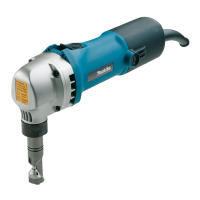
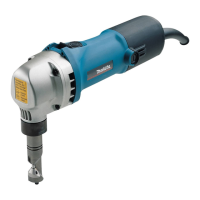
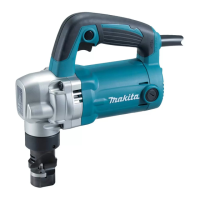
This document is an instruction manual for the Makita Metal Shear JS1602, a power tool designed for cutting sheet steel and stainless sheet steel. The manual provides comprehensive information on the tool's safe operation, assembly, functional description, maintenance, and optional accessories.
The Makita Metal Shear JS1602 is a double-insulated power tool intended for precision cutting of sheet metal. It operates on a single-phase AC supply, ensuring compatibility with standard power outlets without the need for an earth wire. The tool's primary function is to shear various types of sheet steel and aluminum plates, with specific maximum cutting capacities depending on the material's tensile strength.
The core of the shearing mechanism involves an upper and a lower blade. Both blades are designed with four cutting edges on each side (front and back). This multi-edge design allows for extended use; when a cutting edge becomes dull, the blades can be rotated 90 degrees to expose a new, sharp edge. Once all eight edges on both the upper and lower blades are dull, they must be replaced with new ones to maintain optimal cutting performance.
The tool features a slide switch for operation. It can be started by sliding the switch to the "I (ON)" position. For continuous operation, the switch can be locked in the "ON" position by pressing its front. To stop the tool, the rear of the slide switch is pressed, and then it is slid to the "O (OFF)" position. This mechanism ensures controlled operation and prevents unintentional starting.
The design of the shear includes a thickness gauge integrated into the yoke. This gauge allows the operator to quickly check if the material fits within the groove, indicating whether it is shearable according to the tool's capabilities for mild or stainless steel plate. This feature helps prevent attempts to cut materials thicker than recommended, which could lead to tool breakdown or injury.
The manual emphasizes several key usage features and safety precautions to ensure efficient and safe operation of the Metal Shear JS1602.
Before any operation, it is crucial to inspect the blades for wear. Dull or worn blades will compromise the shearing action and reduce the tool's service life. The process of rotating or replacing blades is detailed, involving the removal of blade securing bolts with a hex wrench. When installing new or rotated blades, it is essential to ensure that the upper blade is firmly secured without any gap between it and the beveled surface of the blade holder. Similarly, the lower blade must be pressed against the yoke, contacting its beveled portions and the tip of the lower blade positioning screw, before tightening the securing bolt. This precise installation is critical for proper shearing and to prevent clearance issues. The lower blade positioning screw is factory-assembled and should not be tampered with.
When holding the tool, operators are instructed to maintain a firm grip with one hand on the housing. It is vital to keep hands away from moving parts and to avoid touching the metal part during operation. The shear should be moved parallel with the material being cut to ensure a smooth and accurate cut.
For optimal cutting, the materials should be fastened securely to a workbench using workholders. This prevents movement of the workpiece, enhancing safety and cutting precision. The manual also specifies that when cutting, the shear should always be positioned so that the material being cut away is on the operator's right side. This orientation is important for safety and control.
The tool has a maximum cutting width, which varies depending on the material thickness. For instance, with mild steel of 1.6 mm thickness, the maximum cutting width is 100 mm, while for thicknesses under 1.2 mm, there is no limit. For stainless steel of 1.2 mm thickness, the maximum cutting width is 80 mm, and for thicknesses under 1.0 mm, there is no limit. The minimum cutting radius for 1.0 mm mild steel is 30 mm, indicating the tool's capability for curved cuts.
The manual strongly advises against forcing the power tool and instead recommends using the correct tool for the application to achieve better and safer results at the designed rate. It also highlights the importance of staying alert, watching what you are doing, and using common sense while operating the tool, especially when tired or under the influence of substances.
Proper maintenance is essential for the safety, reliability, and longevity of the Makita Metal Shear JS1602. The manual outlines several key maintenance practices.
Before performing any inspection or maintenance, it is imperative to ensure that the tool is switched off and unplugged from the power source. If the tool has a detachable battery pack, it should be removed. This preventive measure significantly reduces the risk of accidental starting and potential injury.
The manual explicitly warns against using gasoline, benzine, thinner, alcohol, or similar solvents for cleaning the tool. These substances can cause discoloration, deformation, or cracks in the tool's components, compromising its structural integrity and safety.
Regular inspection of the blades for wear is a crucial maintenance task. As mentioned, dull blades impair cutting performance and shorten the tool's lifespan. The instructions for rotating and replacing blades are part of routine maintenance to ensure sharp cutting edges are always available.
For any repairs, carbon brush inspection and replacement, or other maintenance and adjustments, the manual specifies that these tasks should be performed by Makita Authorized Service Centers. This ensures that only genuine Makita replacement parts are used, which is vital for maintaining the product's safety and reliability. Using unauthorized parts or attempting complex repairs without proper training can compromise the tool's functionality and safety.
The manual also emphasizes the importance of keeping cutting tools sharp and clean. Properly maintained cutting tools with sharp edges are less likely to bind and are easier to control, contributing to safer and more efficient operation.
Overall, the maintenance guidelines are designed to help users keep their Metal Shear JS1602 in optimal working condition, ensuring its safe and effective performance over time.
 General
| Input power | 380 W |
|---|---|
| Power source | AC |
| Minimum cutting radius | 30 mm |
| Cutting capacity in steel (400 N/mm²) | 1.6 mm |
| Cutting capacity in steel (600 N/mm²) | 1.2 mm |
| Cutting capacity in steel (800 N/mm²) | 0.8 mm |
| Cutting capacity in aluminum (250 N/mm²) | 2.5 mm |
| Idle stroke rate (max) | 4000 spm |
| Product color | Black, Blue |
 Weight and Dimensions
| Depth | 255 mm |
|---|---|
| Width | 74 mm |
| Height | 146 mm |
| Weight | 1600 g |


 To Next Page