EasyManua.ls Logo

Makita JS3201 - User Manual

Makita JS3201
8 pages
Print Icon
To Next Page IconTo Next Page
Loading...
INSTRUCTION MANUAL
Metal Shear
JS3201
ENGLISH: Original instructions
DOUBLE INSULATION
Read before use.
Question and Answer IconNeed help?

Do you have a question about the Makita JS3201 and is the answer not in the manual?

Summary

Specifications and Symbols

Product Specifications

Details on model, cutting capacities, dimensions, and weight.

Symbols Explained

Explanation of icons used on the equipment for user understanding.

Intended Use

States the tool is designed for cutting sheet and stainless steel.

Power Supply Requirements

Details electrical connection and double insulation features.

Noise and Vibration Information

Provides emission levels and necessary safety warnings.

EC Declaration of Conformity

Information regarding product conformity for European countries.

General Power Tool Safety Warnings

Work Area Safety Guidelines

Instructions for maintaining a clean, lit, and safe working environment.

Electrical Safety Precautions

Guidance on power connections, cords, and avoiding electric shock.

Personal Safety Measures

Recommendations for operator alertness, PPE, and tool handling.

Operation, Maintenance, and Safety

Power Tool Use and Care

Proper usage, maintenance, and storage of the power tool.

Service and Lubrication

Instructions for qualified servicing and lubrication.

Shear Safety Warnings

Specific safety precautions for operating the metal shear.

Blade Management and Operation

Permissible Shearing Thickness

Table and guidance on maximum material thickness for cutting.

Rotating or Replacing Blades

Procedure for blade maintenance and replacement.

Blade Inspection

Checking blades for wear to ensure proper shearing action.

Assembly and Operational Procedures

Blade Assembly Adjustments

Instructions for securing blades and adjusting clearance.

Holding Material Securely

Method for fastening materials using workholders.

Shearing Method Guidance

Technique for smooth cuts, including material positioning.

Maximum Cutting Width and Maintenance

Maximum Cutting Width Limits

Specifies maximum cutting width for different materials.

Minimum Cutting Radius

Details the smallest radius for cutting materials.

Replacing Carbon Brushes

Procedure for checking and replacing worn carbon brushes.

Optional Accessories

List of recommended accessories for the tool.

Overview

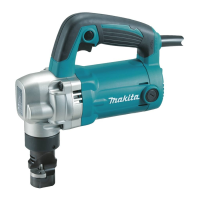
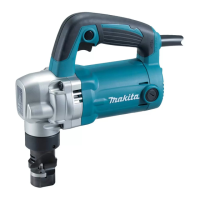
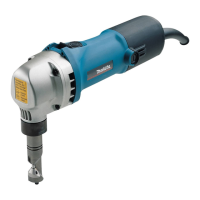
This document provides an instruction manual for the Makita Metal Shear JS3201, a double-insulated power tool designed for cutting sheet steel and stainless sheet steel. It emphasizes safety warnings, operational procedures, and maintenance instructions to ensure safe and effective use.

Function Description

The Makita Metal Shear JS3201 is engineered for precision cutting of various types of sheet metal. It operates by utilizing a pair of blades—an upper blade and a lower blade—that shear through the material. Both blades are designed with four cutting edges on each side, allowing for rotation to expose new, sharp edges as existing ones become dull. This design extends the lifespan of the blades and ensures consistent cutting performance. The tool is powered by a single-phase AC supply and is double-insulated, making it safe for use with sockets without an earth wire.

The shearing process involves placing the workpiece between the blades and activating the tool. The design ensures that the material cut away is positioned to the right side of the operator, enhancing visibility and control. For smooth cuts, the tool should be tipped slightly backward while advancing it. The tool's switch mechanism includes a trigger for starting and stopping, and a lock button for continuous operation, providing operator comfort during extended use.

Usage Features

The JS3201 offers several features to facilitate efficient and safe operation:

  • Cutting Capacity Gauge: A groove on the yoke serves as a thickness gauge for shearing mild or stainless steel plate. If the material fits within this groove, it is shearable, indicating that the tool is suitable for the task. The manual provides a table detailing maximum shearing thicknesses for different material types (steel up to 400 N/mm², 600 N/mm², 800 N/mm², and aluminum up to 200 N/mm²), ensuring users operate within safe limits to prevent tool breakdown or injury.
  • Minimum Cutting Radius: The tool is capable of cutting a minimum radius of 50 mm when working with 2.3 mm mild steel, allowing for curved cuts and greater versatility in applications.
  • Maximum Cutting Width: For a workpiece length of 1,800 mm, the maximum cutting width for mild steel (3.2 mm thickness) is 90 mm, and for stainless steel (2.5 mm thickness) is 70 mm. This specification helps users plan their cuts effectively.
  • Workpiece Securing: The manual strongly recommends fastening materials to be cut to a workbench using workholders. This practice ensures stability during operation, which is crucial for safety and achieving accurate cuts.
  • Blade Adjustment: The clearance between the upper and lower blades is adjustable using a thickness gauge. This adjustment is critical for optimizing cutting performance based on the material thickness. The process involves semi-tightening the lower blade securing bolt, inserting the appropriate thickness gauge, working the lower blade positioning bolt until the gauge moves with some difficulty, and then firmly tightening the securing bolts and hex nut. This precise adjustment ensures efficient shearing and prolongs blade life.
  • Ergonomics and Control: Users are instructed to hold the tool firmly with one hand on the main handle. The switch trigger and lock button are designed for easy access and control, allowing for both momentary and continuous operation. Proper footing and balance are emphasized to maintain control in unexpected situations.
  • Safety Guidelines: The manual includes comprehensive safety warnings, covering work area safety, electrical safety, and personal safety. It advises against operating the tool in explosive atmospheres, keeping children and bystanders away, and using personal protective equipment such as eye protection, dust masks, and hearing protection. It also highlights the importance of checking the switch trigger function before use and ensuring the tool is switched off and unplugged before any adjustments or maintenance.

Maintenance Features

Regular maintenance is crucial for the longevity and safe operation of the Makita Metal Shear JS3201:

  • Blade Inspection and Rotation/Replacement: Users are advised to regularly inspect the blades for wear. Dull blades lead to poor shearing action and reduced tool life. When a cutting edge becomes dull, both the upper and lower blades can be rotated 90 degrees to expose a new, sharp edge. Once all eight edges on both blades are dull, both blades must be replaced with new ones. The process involves removing blade securing bolts with a hex wrench, rotating or replacing the blades, and then re-securing them, ensuring no gap exists between the upper blade and the beveled surface of the blade holder.
  • Carbon Brush Inspection and Replacement: The carbon brushes should be checked regularly and replaced when they wear down to the limit mark. It is important to keep the carbon brushes clean and free to slip in their holders, and both brushes should be replaced simultaneously with identical carbon brushes. This involves removing brush holder caps with a screwdriver, taking out worn brushes, inserting new ones, and securing the caps.
  • General Cleaning: The tool and its air vents must be kept clean. Regular cleaning of the air vents prevents obstruction and ensures proper cooling of the motor. Users are warned against using gasoline, benzine, thinner, alcohol, or similar substances for cleaning, as these can cause discoloration, deformation, or cracks.
  • Professional Servicing: For product safety and reliability, any repairs, maintenance, or adjustments beyond routine user tasks should be performed by Makita Authorized Service Centers using genuine Makita replacement parts.
  • Accessory Maintenance: The manual also mentions the importance of following instructions for lubricating and changing accessories, although specific details for lubrication are not provided in the excerpt.

By adhering to these operational and maintenance guidelines, users can ensure the safe, efficient, and extended use of their Makita Metal Shear JS3201.

Makita JS3201 Specifications

General IconGeneral
Minimum Cutting Radius25 mm
TypeJigsaw
Orbital Settings3
Power SourceElectric
No Load Speed0 - 3, 100 spm
Strokes per Minute500 - 3, 100

Related product manuals