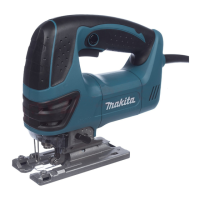
This document describes the Makita M4301 Jig Saw, an instruction manual for a power tool designed for sawing various materials.
Function Description
The Makita M4301 Jig Saw is a power tool primarily intended for sawing wood, plastic, and metal materials. Its design, coupled with an extensive range of accessories and saw blades, makes it versatile for many purposes, including curved or circular cuts. The tool offers both orbital and straight-line (up and and down) cutting actions. The orbital cutting action thrusts the jig saw blade forward on the cutting stroke, significantly increasing cutting speed. The cutting action can be changed by turning a lever to the desired position, allowing for optimized performance based on the material and desired cut type.
Important Technical Specifications
- Model: M4301
- Length of stroke: 18 mm
- Blade type: B type
- Max. cutting capacities:
- Wood: 65 mm
- Mild steel: 6 mm
- Strokes per minute (min⁻¹): 0 - 3,100
- Overall length: 214 mm
- Net weight: 1.9 kg
- Safety class: Double Insulation
- Noise levels (according to EN62841-2-11):
- Sound pressure level (LPA): 82 dB(A)
- Sound power level (LWA): 93 dB(A)
- Uncertainty (K): 3 dB(A)
- Vibration total value (tri-axial vector sum, according to EN62841-2-11):
- Work mode: cutting boards
- Vibration emission (aħ,B): 8.0 m/s²
- Uncertainty (K): 1.5 m/s²
- Work mode: cutting sheet metal
- Vibration emission (aħ,M): 5.0 m/s²
- Uncertainty (K): 1.5 m/s²
The tool is double-insulated, meaning it can be operated from sockets without an earth wire. Specifications may vary by country and are subject to change due to ongoing research and development.
Usage Features
The M4301 Jig Saw incorporates several features to enhance usability and safety:
- Switch Action: The tool is started by pulling the switch trigger, with speed increasing proportionally to pressure. For continuous operation, the switch trigger can be pulled and then locked using the lock button. To stop from the locked position, the trigger is pulled fully and then released.
- Cutting Action Selection: A lever allows users to select between straight-line cutting (position 0) for mild steel, stainless steel, and plastics, and three orbital cutting actions (positions I, II, III).
- Position 0 (Straight line cutting action): Ideal for clean cuts in wood and plywood, and for cutting mild steel, stainless steel, and plastics.
- Position I (Small orbit cutting action): Suitable for cutting mild steel, aluminum, and hard wood.
- Position II (Medium orbit cutting action): Recommended for cutting wood and plywood.
- Position III (Large orbit cutting action): Designed for fast cutting in aluminum, mild steel, wood, and plywood.
- Blade Installation and Removal: To install a jig saw blade, the bolt on the blade holder is loosened with a hex wrench. The blade, with teeth facing forward, is inserted as far as possible, ensuring its back edge fits into the roller, then the bolt is tightened. Removal is the reverse procedure. Only B-type jig saw blades should be used to prevent insufficient tightening and potential injury.
- Bevel Cutting: The base can be tilted to make bevel cuts at any angle between 0° and 45° (left or right). This is achieved by loosening a bolt on the back of the base, positioning it in the cross-shaped slot, tilting the base to the desired angle (indicated by graduations on the motor housing), and then tightening the bolt. The dust cover must be raised for bevel cuts.
- Front Flush Cuts: For flush cuts, the bolt on the back of the base is loosened, and the base is slid all the way back before tightening the bolt.
- Cutouts: Internal cutouts can be made by "Boring a starting hole" or "Plunge cutting."
- Boring a starting hole: Requires pre-drilling a starting hole (12 mm or more in diameter) and inserting the jig saw blade into it.
- Plunge cutting: Allows cutting without a starting hole by tilting the tool on the front edge of the base, positioning the blade point above the workpiece, applying pressure to keep the base steady, switching on the tool, and slowly lowering the back end of the tool until the blade pierces the material.
- Finishing Edges: For trimming or dimensional adjustments, the jig saw blade is run lightly along the cut edges.
- Metal Cutting: A suitable coolant (cutting oil) should always be used when cutting metal to prevent significant blade wear. Greasing the underside of the workpiece can also serve as an alternative.
- Dust Extraction: The tool can be connected to a Makita vacuum cleaner via a hose inserted into the hole at the rear of the tool for clean cutting operations. Dust extraction is not possible during bevel cuts.
- Rip Fence (Optional Accessory):
- Straight cuts: For repeatedly cutting widths of 160 mm or less, the rip fence ensures fast, clean, straight cuts. It is inserted into the rectangular hole on the side of the base with the fence guide facing down, slid to the desired cutting width, and secured with a bolt.
- Circular cuts: For cutting circles or arcs of 170 mm or less in radius, the rip fence is installed with the fence guide facing up. A circular guide pin is inserted through one of the holes on the fence guide and secured with a threaded knob. The rip fence is then slid to the desired cutting radius and the bolt tightened, with the base moved all the way forward. Specific jig saw blades (B-17, B-18, B-26, or B-27) are recommended for circular cuts.
- Anti-splintering Device (Optional Accessory): For splinter-free cuts, this device can be used by moving the base all the way forward and inserting it between the two protrusions of the base. It cannot be used when making bevel cuts.
- Hex Wrench Storage: The hex wrench can be stored on the tool itself to prevent loss when not in use.
Maintenance Features
- General Maintenance: Always ensure the tool is switched off and unplugged before performing any inspection or maintenance.
- Lubrication: The roller should be lubricated occasionally.
- Cleaning: Chips or foreign matter adhering to the jig saw blade and/or blade holder should be cleaned out to ensure proper blade tightening.
- Repairs and Replacement: To maintain product safety and reliability, repairs, carbon brush inspection and replacement, and any other maintenance or adjustment should be performed by Makita Authorized or Factory Service Centers, using genuine Makita replacement parts.
- Prohibited Substances: Never use gasoline, benzine, thinner, alcohol, or similar substances, as they can cause discoloration, deformation, or cracks.

 Need help?
 General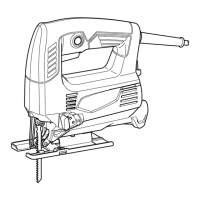

 To Next Page