Need help?
Do you have a question about the Makita DTM50 and is the answer not in the manual?
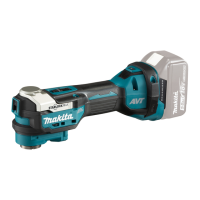
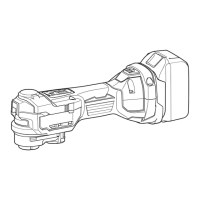
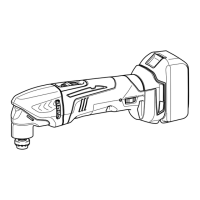
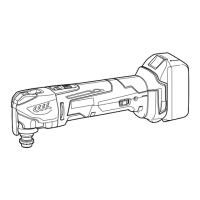
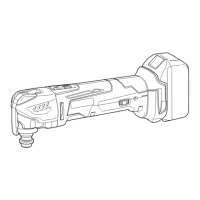
The Makita Cordless Multi-Tool, models DTM40 and DTM50, is a versatile power tool designed for a variety of tasks including sawing, cutting, grinding, and sanding. It is particularly well-suited for working close to edges and for flush cutting. This tool is intended for use on materials such as wood, plastic, gypsum, non-ferrous metals, and fastening elements like unhardened nails and staples. It can also be used for working with soft wall tiles, as well as for dry sanding and scraping small surfaces.
The multi-tool operates with an oscillating motion, allowing for precise and controlled work. It features an adjustable orbital stroke rate, which can be set using a dial with settings from 1 to 6. A higher number on the dial corresponds to a higher orbital stroke rate, allowing users to select the appropriate speed for their specific workpiece and application. When adjusting the dial, it's important to turn it through each intermediate number rather than forcing it directly from 1 to 6 or vice versa, to prevent damage to the tool.
The tool is powered by a D.C. 14.4 V or D.C. 18 V battery cartridge, depending on the model. It is equipped with a battery protection system for Lithium-ion batteries with a star marking, which automatically cuts off power to extend battery life under conditions of overload or low battery voltage. If the tool is overloaded and draws an abnormally high current, it will stop. To restart, the user must slide the slide switch to the "O (OFF)" position, address the cause of the overload, and then slide the switch back to the "I (ON)" position. If the tool stops due to an overheated battery, it should be allowed to cool before restarting. When the battery voltage is too low, the tool will not operate, and the battery needs to be recharged.
A front lamp is integrated into the tool, which illuminates when the slide switch is in the "I (ON)" position. This lamp provides visibility of the work area and automatically turns off after the slide switch is moved to the "O (OFF)" position. The front lamp also blinks if the tool is overloaded and its temperature reaches a certain level, indicating that the tool will automatically stop.
To start the tool, the slide switch is moved to the "I (ON)" position, and to stop it, the switch is moved to the "O (OFF)" position. Before installing or removing the battery cartridge, it is crucial to ensure the tool is switched off to prevent accidental start-up and potential injury. When installing the battery cartridge, it should be held firmly along with the tool, aligning the tongue on the cartridge with the groove in the housing. It should be inserted all the way until it locks in place, indicated by the red indicator on the button disappearing. Forcibly installing the cartridge or not fully seating it can lead to it accidentally falling out.
The multi-tool allows for the installation of various application tools (optional accessories) such as saw blades, scrapers, and sanding pads. These tools are secured by tightening an installation bolt with a hex wrench. The tool flange has protrusions that fit into holes in the application tool, ensuring a secure fit. Application tools can be installed at an angle of every 30 degrees to suit different work requirements. When using sanding application tools, the sanding pad and sanding paper should be mounted to match the sanding pad direction, utilizing the hook and loop type fitting system for easy attachment and removal. Sanding papers with dust extraction holes should be aligned with those on the sanding pad. For application tools with different installation sections, a correct adapter (optional accessory) must be used.
For cutting, sawing, and scraping operations, the application tool should be placed on the workpiece, and then the tool moved forward at a pace that does not slow down its movement. Excessive pressure or forcing the tool in directions without a cutting edge can reduce efficiency and damage the tool. For sanding, it is recommended to use a test material to determine the correct orbital stroke rate. Using the same grit sanding paper for the entire workpiece is advised to achieve a fine finish.
The tool also supports dust extraction with an optional attachment. This involves installing dust nozzles and a nozzle band onto the tool, then securing a felt ring and sanding pad onto the dust attachment with the application tool installation bolt. A vacuum cleaner hose can then be connected to the dust extraction attachment for cleaner operation.
Regular maintenance is essential for the safety and reliability of the multi-tool. Before performing any inspection or maintenance, the tool must be switched off, and the battery cartridge removed. It is important to avoid using gasoline, benzine, thinner, alcohol, or similar substances, as these can cause discoloration, deformation, or cracks.
Any repairs, carbon brush inspection and replacement, or other maintenance and adjustments should be performed by Makita Authorized Service Centers, using genuine Makita replacement parts.
The hex wrench, used for installing and removing application tools, has a dedicated storage location on the tool to prevent it from being lost when not in use.
For battery cartridges, it is crucial to recharge them only with the specified charger. Overcharging a fully charged battery shortens its service life, so it should only be recharged when tool power diminishes. Charging should occur at room temperature (10 °C - 40 °C / 50 °F - 104 °F). A hot battery cartridge should be allowed to cool before charging. If the battery cartridge is not used for a long period, it should be charged every six months.
The battery cartridge should never be disassembled, shorted, or exposed to water, rain, fire, or excessive temperatures above 130 °C (266 °F). If electrolyte contacts the eyes, immediate medical attention is required. Damaged or modified battery packs should not be used, and service of battery packs should only be performed by the manufacturer or authorized providers. The tool and battery cartridge should not be stored in locations where temperatures may reach or exceed 50 °C (122 °F). Dropping or striking the battery should be avoided.
 General
| Model | DTM50 |
|---|---|
| Oscillations Per Minute | 6, 000 - 20, 000 OPM |
| Power Source | Cordless |
| Voltage | 18V |
| Oscillation Angle | 3.2 degrees |
| Battery Type | Li-ion |

 To Next Page