1-151-15
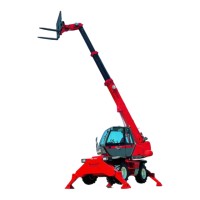
3 - LIFT TRUCK USED ON STABILIZERS3 - LIFT TRUCK USED ON STABILIZERS
- Set the two stabilizers on the gr- Set the two stabilizers on the ground and raise the two front wheels of the ound and raise the two front wheels of the lift truck (fig. lift truck (fig. D1).D1).
-- Correct the slope using the stabilizCorrect the slope using the stabilizers (fig. D2) and make suers (fig. D2) and make sure the truck is horizontalre the truck is horizontal
by checking the level. The bubble of the level must be between the two lines (see: 2by checking the level. The bubble of the level must be between the two lines (see: 2
- DESCRIPTION: INSTRUMENTS AND CONTROLS). In this position, the two front wheels- DESCRIPTION: INSTRUMENTS AND CONTROLS). In this position, the two front wheels
must be off the ground.must be off the ground.
E - TAKING UP A LOAD ON THE GROUNDE - TAKING UP A LOAD ON THE GROUND
-- Approach the lift truck perpendicular to the load, with the jib retracted and the forks iApproach the lift truck perpendicular to the load, with the jib retracted and the forks in a horizontal position (fig. En a horizontal position (fig. E1).1).
-- Adjust the fork spread and centering in connection with the loaAdjust the fork spread and centering in connection with the load (fig. E2) (optional solutd (fig. E2) (optional solutionsions
exist, consult your dealer).exist, consult your dealer).
- Never lift a load with a single fork.- Never lift a load with a single fork.
Beware of the risks of trapping or squashing limbs when manually adjusting the Beware of the risks of trapping or squashing limbs when manually adjusting the forks.forks.
-- Move the lift truck forward slowly (1) and bring the forks tMove the lift truck forward slowly (1) and bring the forks to stop in front of the loao stop in front of the load (fig.d (fig.
E3), if necessary, slightly lift the jib (2) while taking up the load.E3), if necessary, slightly lift the jib (2) while taking up the load.
- Bring the load into the transport position.- Bring the load into the transport position.
-- Tilt the load far enough backwards to ensure stabilTilt the load far enough backwards to ensure stability (loss of load on brakinity (loss of load on braking or goingg or going
downhill).downhill).
FOR A NON-PALLETIZED LOADFOR A NON-PALLETIZED LOAD
-- Tilt the carriage (1) Tilt the carriage (1) forforwards and move the wards and move the lift truck slowly flift truck slowly fororwards (2), to inswards (2), to inserert the forkt the fork
under the load (fig. E4) (block the load if necessarunder the load (fig. E4) (block the load if necessary).y).
-- Continue to move Continue to move the lift truck forwards (2) tilting the carriage (3) the lift truck forwards (2) tilting the carriage (3) (fig. E4) ba(fig. E4) backwards tockwards to
position the load on position the load on the forks and check the forks and check the load’s longitudinal and lateral stability.the load’s longitudinal and lateral stability.
E1E1
E2E2
11
22
E3E3
11
22
33
E4E4
F - TAKING UP AND LAYING A HIGH LOAD ON T
F - TAKING UP AND LAYING A HIGH LOAD ON T
II
RESRES
You must not raise the jib if you have not checked the transverse attitude of the lift truck (see:You must not raise the jib if you have not checked the transverse attitude of the lift truck (see:
INSTRUCTIONS FOR HANDLING A LOAD: INSTRUCTIONS FOR HANDLING A LOAD: D - TRANSVERSE D - TRANSVERSE ATATTITUDE OF THE LIFT TRUCK).TITUDE OF THE LIFT TRUCK).
REMINDER:REMINDER: Make sure that the following operatiMake sure that the following operations can be perforons can be performed with good visibilmed with good visibilityity
(see: OPERATIONS INSTRUCTIONS UNLADEN AND LADEN: D (see: OPERATIONS INSTRUCTIONS UNLADEN AND LADEN: D - VISIBILITY).- VISIBILITY).
TAKITAKING UP A HIGH LOAD ON NG UP A HIGH LOAD ON TTIIRESRES
- Ensure that the forks will easily pass under the load.- Ensure that the forks will easily pass under the load.
-- Lift and extend the jib (1) (Lift and extend the jib (1) (2) until the forks are level 2) until the forks are level with the load, moving twith the load, moving the lift truck (3)he lift truck (3)
forward if necessary (fig. F1), moving very slowly and carefully.forward if necessary (fig. F1), moving very slowly and carefully.
-- Always think about keepiAlways think about keeping the distance necessary to fit the forks under thng the distance necessary to fit the forks under the load, betweene load, between
the pile and the lift truck the pile and the lift truck (fig. F1) and use the shor(fig. F1) and use the shortest possible length of jib.test possible length of jib.
-- Stop the forks in front of the load by alternately extending and retractiStop the forks in front of the load by alternately extending and retracting the jib (1) or, ifng the jib (1) or, if
necessary, moving the lift truck forward (2) (fig. F2). Put the handbrake on and set thenecessary, moving the lift truck forward (2) (fig. F2). Put the handbrake on and set the
forward/reverse selector to neutral.forward/reverse selector to neutral.
-- Slightly lift the load (Slightly lift the load (1) and incline the carriage (2) backwards to stabilize the l1) and incline the carriage (2) backwards to stabilize the load (fig. F3).oad (fig. F3).
- Tilt the load suf- Tilt the load sufficiently backwards to ensure its stabilityficiently backwards to ensure its stability..
-- Watch the longiWatch the longitudinal stability litudinal stability limiter and warning device (see: INSTRUCmiter and warning device (see: INSTRUCTIONS FORTIONS FOR
HANDLING A LOAD: HANDLING A LOAD: C - LC - LONGITUDINAL STABILITY LIMITER AND WARNING DEVICEONGITUDINAL STABILITY LIMITER AND WARNING DEVICE). If it ). If it isis
o erloaded replace the load in the place from hich it as takeno erloaded replace the load in the place from hich it as taken
11
22
33
F1F1
11
F2F2



 To Next Page
 Loading...