9
pressure oxygen, and can vary in terms
of the exact level of partial pressure they
happen at. It is commonly accepted that
partial pressures up to 1.4bar are tolerable,
and several training agencies advocate
maximum oxygen partial pressures up to
1.6bar.
- Long exposure effects to oxygen partial
pressures over 0.5bar due to repeated and/
or long dives. These can affect the central
nervous system, cause damage to lungs or
to other vital organs.
Puck Pro keeps you safe with respect to these
two effects in the following ways (as long as it
is set to either air or nitrox):
• Against sudden effects: Puck Pro has
an MOD alarm set for a user-defined
ppO
2
max. As you enter the oxygen
concentration for the dive, Puck Pro shows
you the corresponding MOD for the defined
ppO
2
max. The default value of ppO
2
max
from the factory is 1.4bar. This can be
adjusted to your preference between 1.2 and
1.6bar. Please refer to section 2.1 for more
information on how to change this setting. If
Puck Pro is set to air, the ppO
2
max is set to
1.4bar by default.
• Against long exposure effects: Puck Pro
“tracks” the exposure by means of the
CNS% (Central Nervous System). At levels
of 100% and higher there is risk of long
exposure effects, and consequently Puck
Pro will activate an alarm when this level
of CNS% is reached. Puck Pro also warns
you when the CNS level reaches 75%. Note
that the CNS% is independent of the value of
ppO
2
max set by the user.
3.2 ALARMS
Puck Pro can alert you of potentially dangerous
situations. There are five different alarms:
- Ascent rate alarm;
- Exceeding a safe ppO
2
/MOD;
- CNS =100%;
- Missed decompression stop;
- Low battery during the dive
WARNING
When in bottom timer mode, all warnings
and all alarms are OFF aside for the low
battery alarm.
NOTE
- Alarms are both visual and audible, as
described in detail below.
- Ascent rate alarm has priority over
other alarms if they are triggered
simultaneously.
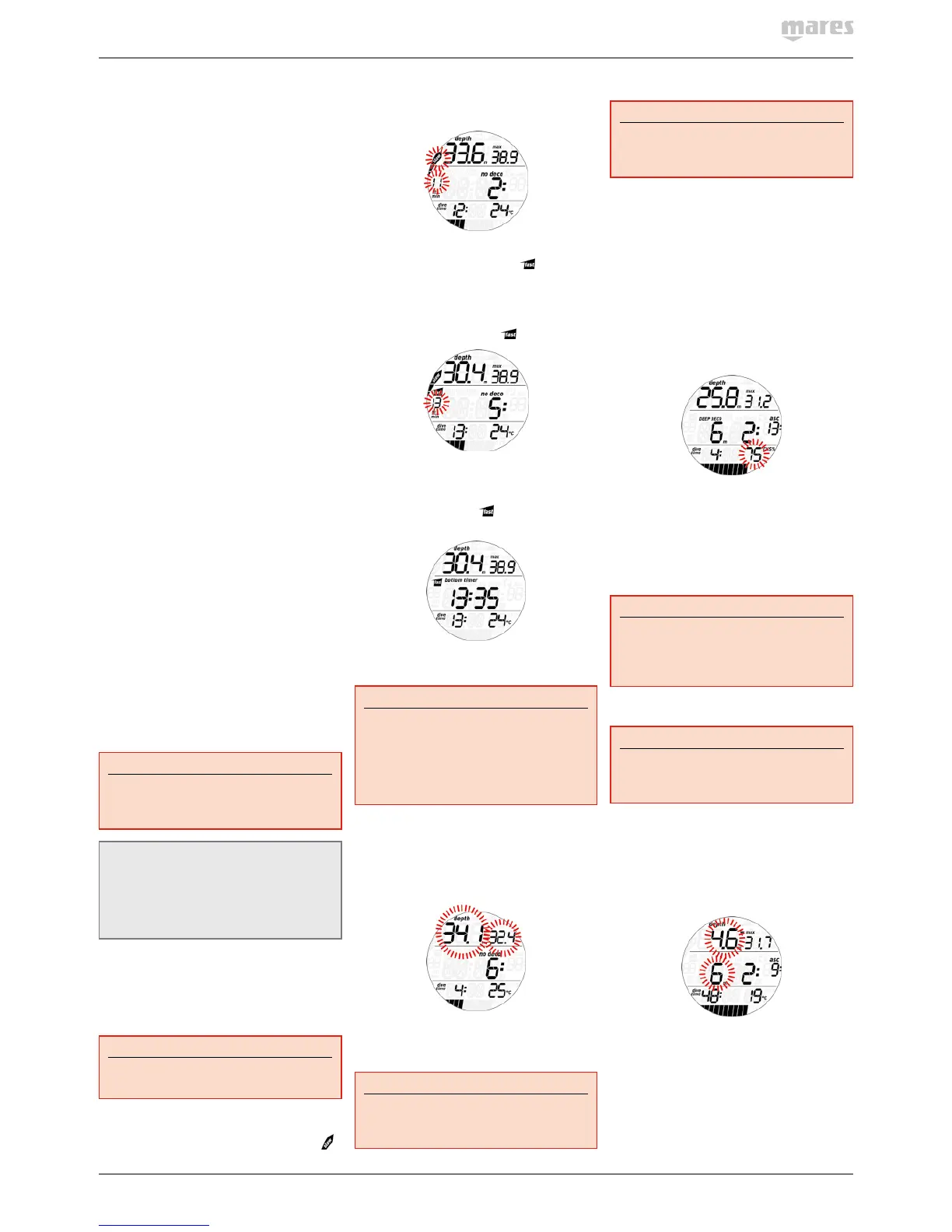
3.2.1 ASCENT RATE
As soon as depth decreases Puck Pro activates
the ascent rate control algorithm and displays
the calculated value. This is shown to the very
left in the middle row of the display.
WARNING
A rapid ascent increases the risk of
decompression sickness.
If Puck Pro determines an ascent rate of 10m/
min / 30ft/min or higher, the fast ascent alarm
is triggered: an audible alarm goes off, the
appears on the display and the speed value
blinks. This persists until the ascent rate is
reduced to 10m/min / 30ft/min or less.
If the ascent rate exceeds 12m/min / 40ft/min
at a depth below 12m / 40ft, the
blinks as
well. If a speed in excess of 12m/min / 40ft/min
is maintained for two thirds or more of the
depth at which the alarm was first triggered,
Puck Pro considers it a dive violation and the
display will show the steady symbol.
In this case, if the diver attempts a repetitive
dive after surfacing, Puck Pro will only function
as a depth gauge and timer (bottom timer
mode), and will display on the screen
throughout the dive.
3.2.2 MOD/ppO
2
WARNING
- The MOD should not be exceeded.
Disregarding the alarm can lead to
serious injury or death.
- Exceeding a ppO
2
of 1.6bar can lead to
sudden convulsions resulting in serious
injury or death.
When the diver reaches a depth at which the
ppO
2
of the inspired gas exceeds the maximum
limit entered in the corresponding setting (from
1.2 to 1.6bar), an audible alarm goes off, the
current depth starts to blink and the value of the
MOD is shown to the right of the current depth.
The alarm persists until the diver has
ascended enough for the ppO
2
to return within
the set limit.
WARNING
When the
MOD
alarm is triggered, ascend
immediately until the alarm stops. Failure to
do so could result in serious injury or death
.
3.2.3 CNS = 100%
WARNING
When the CNS reaches 100% there is
danger of oxygen toxicity. Start procedure
to terminate the dive.
Oxygen toxicity exposure is tracked on Puck
Pro by means of the CNS% based on currently
accepted recommendations for exposure limits.
This toxicity is expressed as a percentage
value which ranges from 0% to 100%. When
the value reaches 75%, an alarm goes off and
CNS value blinks on the screen. Additionally
the CNS becomes the default item in the lower
right corner: if you call up other information
such as the temperature or the time of day,
after 8 seconds the CNS appears again. Ascend
to shallower depth to decrease oxygen loading
and consider terminating the dive.
When the oxygen toxicity level approaches
100%. The alarm message and the audible
signal are repeated for 5 seconds in one-
minute intervals after the first occurrence
and for as long as the value of CNS stays at
or above 100%. Consider terminating the dive
immediately!
WARNING
Diving with oxygen toxicity at levels of 75%
or greater may put you into a potentially
hazardous situation, which could result in
serious injury or death.
3.2.4 MISSED DECOMPRESSION STOP
WARNING
Violating a mandatory decompression
obligation may result in serious injury or
death.
If you ascend above the decompression stop
depth by more than 0.3m (1ft), a downward
pointing triangle appears, an audible alarm
goes off and both the current depth and the
depth of the deco stop start blinking. This
alarm remains active until you return to the
correct depth.



 To Next Page
 Loading...