headline bars
continuation tabs
notes
warnings
15
headline bars
continuation tabs
notes
warnings
model no. 054-8258-2 | contact us 1.800.689.9928
14
OPERATING INSTRUCTIONS
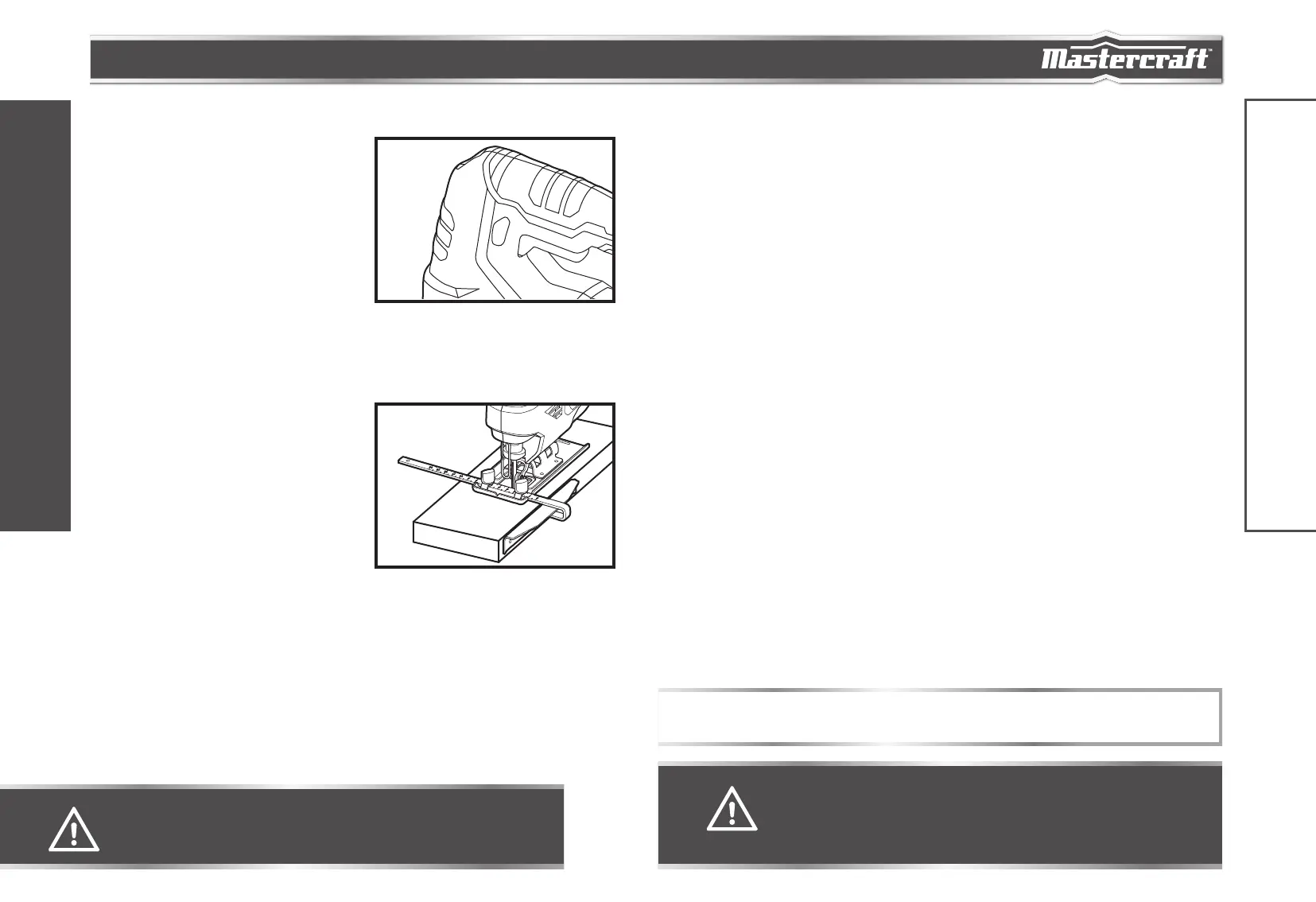
TURNING ON AND OFF
(fig 7)
1. Connect the power cord of your jigsaw to a standard
household power outlet.
2. To turn the saw ON, depress the on/off trigger
switch.
3. To turn the tool OFF, release the trigger switch.
4. To lock the on/off trigger switch in the “on” position,
press the trigger switch and, while holding it “on”,
press in the lock-on button from either side. The
lock-on button allows the operator to keep the jigsaw running without squeezing the trigger switch. This
feature is convenient for continuous sawing applications.
5. To release the lock-on button, press and release the trigger switch.
STRAIGHT CUTTING
(fig 8)
A straight cut can be made by clamping a piece of wood
or a straight edge to the workpiece and guiding the edge
of the saw against it. Make the cut from one direction
only. Never cut halfway and then complete the cut from
the opposite end.
The straight cut can be also made by using the parallel
guide supplied with this tool.
GENERAL CUTTING
1. Make sure that the workpiece is firmly clamped to prevent the workpiece from moving while cutting.
2. Use the appropriate type and size of blade for the workpiece material and size.
3. Check for clearance behind the workpiece so that the blade will not impact another surface.
4. Clearly mark the line of cut.
5. Hold the saw firmly. Make sure to keep your hand on the insulated gripping areas only.
6. Turn on the jigsaw and bring it to the maximum desired cutting speed before applying the blade to the
workpiece.
7. Do not force the tool. Keep the shoe plate flat against the workpiece while cutting. Use only enough steady
pressure on the blade to keep the saw cutting.
8. Reduce pressure as the blade comes to the end of the cut.
9. Allow the saw to come to a complete stop before removing the blade from the workpiece.
10. If sawing fiberglass, plaster, wallboard, or spackling compound, clean the saw motor vents frequently with
a vacuum or compressed air. Always wear safety goggles when cleaning tools using compressed air. These
materials are highly abrasive and may accelerate the wear on motor bearings and brushes.
METAL CUTTING
When cutting metal, clamp the material down. Be careful to move the saw along slowly. Use lower speeds.
Do not twist, bend, or force the blade. If the saw jumps or bounces, use a blade with finer teeth. If the blade
seems clogged when cutting soft metal, use a blade with coarser teeth.
For easier cutting, lubricate the blade with a stick of cutting wax, if available, or cutting oil when cutting steel.
Thin metal should be sandwiched between two pieces of wood or tightly clamped onto a single piece of wood
(wood on top of the metal). Draw the cut lines or design on the top piece of wood.
OPERATING INSTRUCTIONS
OPERATING INSTRUCTIONS
WARNING!
• Allow the blade to come to a complete standstill before setting the jigsaw down.
• Make sure the switch is not locked in the ON position before plugging your jigsaw.
fig 7
fig 8
WARNING!
• Do not allow familiarity with the saw to make you careless.
• Always securely and support the workpiece. Always maintain proper control of the jigsaw.
Failure to clamp and support the workpiece and loss of control of the saw could result in
serious injury.
NOTICE: Always apply a steady, firm, downward pressure on the front of the saw as you cut. This will
keep the saw blade from jumping out of the workpiece.



 To Next Page