SAFETY GUIDELINES
SAFETY GUIDELINES
• Keep tool dry, clean, and free from oil and grease. Always use a clean cloth when cleaning. Never
use brake fluids, gasoline, petroleum-based products, or any solvents to clean tool.
• Stay alert and exercise control. Watch what you are doing and use common sense. Do not operate
tool when you are tired. Do not rush.
• Do not use tool if switch does not turn it on and off. Have defective switches replaced by an
authorized service centre.
• Use only correct blades. Do not use blades with incorrect size holes. Never use blade washers or
blade bolts that are defective or incorrect. The maximum blade capacity of your saw is 10" (25.4 cm).
Blades that do not match the mounting hardware of the saw will run off-centre causing loss of control.
• Before making a cut, be sure all adjustments are secure.
• Be sure blade path is free of nails. Inspect for and remove all nails from lumber before cutting.
• Never touch blade or other moving parts during use.
• Firmly mount the tool on a secure surface to ensure its stability before operating the tool.
• Never start a tool when any rotating component is in contact with the workpiece.
• Do not operate a tool while under the influence of drugs, alcohol, or any medication.
• When servicing use only identical replacement parts. Use of any other parts may create a hazard
or cause product damage.
• Use only recommended accessories listed in this manual or addendums. Use of accessories that are
not listed may cause the risk of personal injury. Instructions for safe use of accessories are included
with the accessory.
• Double check all setups. Make sure blade is tight and not making contact with saw or workpiece
before connecting to power supply.
• Do not allow familiarity (gained from frequent use of your saw) to cause a careless mistake.
Always remember that a careless fraction of a second is sufficient to inflict serious injury. Use extra
caution and keep your attention on your operation when making repetitive cuts. Reduce the monotony of
operations by frequently taking breaks, cleaning up saw dust, or checking the tool's condition.
1) Guarding related warnings
• Keep guards in place. Guards must be in working order and be properly mounted. A guard
that is loose, damaged, or is not functioning correctly must be repaired or replaced.
• Always use saw blade guard, riving knife and anti-kickback device for every through-cutting
operation. For through-cutting operations where the saw blade cuts completely through the thickness
of the workpiece, the guard and other safety devices help reduce the risk of injury.
• Immediately reattach the guarding system after completing an operation (such as rabbeting,
dadoing or resawing cuts) which requires removal of the guard, riving knife and/or
anti-kickback device. The guard, riving knife, and anti-kickback device help to reduce the risk of
injury.
2) Cutting procedures warnings
• DANGER: Never place your fingers or hands in the vicinity or in line with the saw blade. A
moment of inattention or a slip could direct your hand towards the saw blade and result in serious
personal injury.
• Feed the workpiece into the saw blade or cutter only against the direction of rotation.
Feeding the workpiece in the same direction that the saw blade is rotating above the table may result in
the workpiece, and your hand, being pulled into the saw blade.
• Never use the mitre gauge to feed the workpiece when ripping and do not use the rip fence
as a length stop when cross cutting with the mitre gauge. Guiding the workpiece with rip fence
and the mitre guage at the same time increases the likelihood of saw blade binding and kickback.
• When ripping, always apply the workpiece feeding force between the fence and the saw
blade. Use a push stick when the distance between the fence and the saw blade is less than
6" (15 cm), and use a push block when this distance is less than 2" (5 cm). “Work helping”
devices will keep your hand at a safe distance from the saw blade.
• Use only the push stick provided by the manufacturer or constructed in accordance with the
instructions. This push stick provides sufficient distance between the hand and the saw blade.
• Never use a damaged or cut push stick. A damaged push stick may break causing your hand to slip
into the saw blade.
• Do not perform any operation “freehand”. Always use either the rip fence or the mitre gauge to
position and guide the workpiece. “Freehand” means using your hands to support or guide the
workpiece, in lieu of a rip fence or mitre gauge. Freehand sawing leads to misalignment, binding and
kickback.
• Never reach around or over a rotating saw blade. Reaching for a workpiece may lead to accidental
contact with the moving saw blade.
• Provide auxiliary workpiece support to the rear and/or sides of the saw table for long and/or
wide workpieces to keep them level. A long and/or wide workpiece has a tendency to pivot on the
table’s edge causing loss of control, saw blade binding and kickback.
• Make sure the saw blade is not contacting the guard, riving knife or the workpiece before
the switch is turned on. Inadvertent contact of these items with the saw blade could cause a
hazardous condition.
• Adjust the riving knife as described in this instruction manual. Incorrect spacing, positioning and
alignment can make the riving knife ineffective in reducing the likelihood of kickback.
• For the riving knife and anti-kickback device to work, they must be engaged in the
workpiece. The riving knife and anti-kickback device are ineffective when cutting workpieces that are
too short to be engaged with the riving knife and anti-kickback device. Under these conditions a
kickback cannot be prevented by the riving knife and anti-kickback device.
• Use the appropriate saw blade for the riving knife. For the riving knife to function properly, the saw
blade diameter must match the appropriate riving knife and the body of the saw blade must be thinner
than the thickness of the riving knife and the cutting width of the saw blade must be wider than the
thickness of the riving knife.
1312
model no. 055-6742-8 | contact us 1-800-689-9928
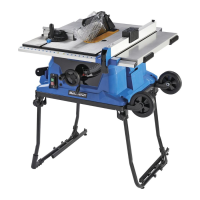
Safety instructions for table saws


 To Next Page
 Loading...