5
BASIC COMPRESSOR FEATURES
A. ELECTRIC MOTOR: The motor is used to power the pump. It is equipped with a thermal overload
protector and an automatic reset. If the motor overheats for any reason, the thermal overload protector
will shut it down in order to prevent the motor from being damaged. The motor will automatically restart
when it has cooled completely.
B. AIR COMPRESSOR PUMP: The pump compresses the air and discharges it into the tank via the
piston that moves up and down in the cylinder.
C. PRESSURE SWITCH: This switch turns the compressor on and off. It is operated manually, and when
it is in the ON position, it allows the motor to start if the pressure in the air tank is below the factory set
cut-in pressure, and allows the motor to stop if the pressure in the air tank reaches the factory set cut-
out pressure. Be sure to set this switch to the OFF position when the compressor is not being used
and before unplugging the compressor.
D. PRESSURE RELIEF VALVE: This valve is used to prevent system failure by draining pressure from
the system when it reaches a preset level if the pressure switch has not shut down the motor. It will
pop open automatically, or it can be activated manually by pulling the ring on the valve.
E. AIR PRESSURE REGULATOR: The regulator is used to adjust the pressure inside the line to the tool
that is being used. Turn the knob clockwise to increase the pressure and counter-clockwise to
decrease the pressure.
WARNING:Do not exceed the tool’s maximum working pressure.
F. TANK PRESSURE GAUGE: The gauge measures the pressure level of the air that is stored in the
tank. It cannot be adjusted by the operator, and it does not indicate the pressure inside the line.
G. REGULATED PRESSURE GAUGE: The gauge measures the regulated outlet pressure.
H. AIR LINE OUTLET: The outlet is connected to the 1/4” (6.4 mm) NPT air hose.
I. AIR TANK DRAIN VALVE: The drain valve is used to remove moisture from the air tank after the
compressor is shut off.
WARNING:Do not attempt to open the drain valve when there is more than 10 PSI of air pressure in
the tank.
J. AIR TANK: The tank is where the compressed air is stored.
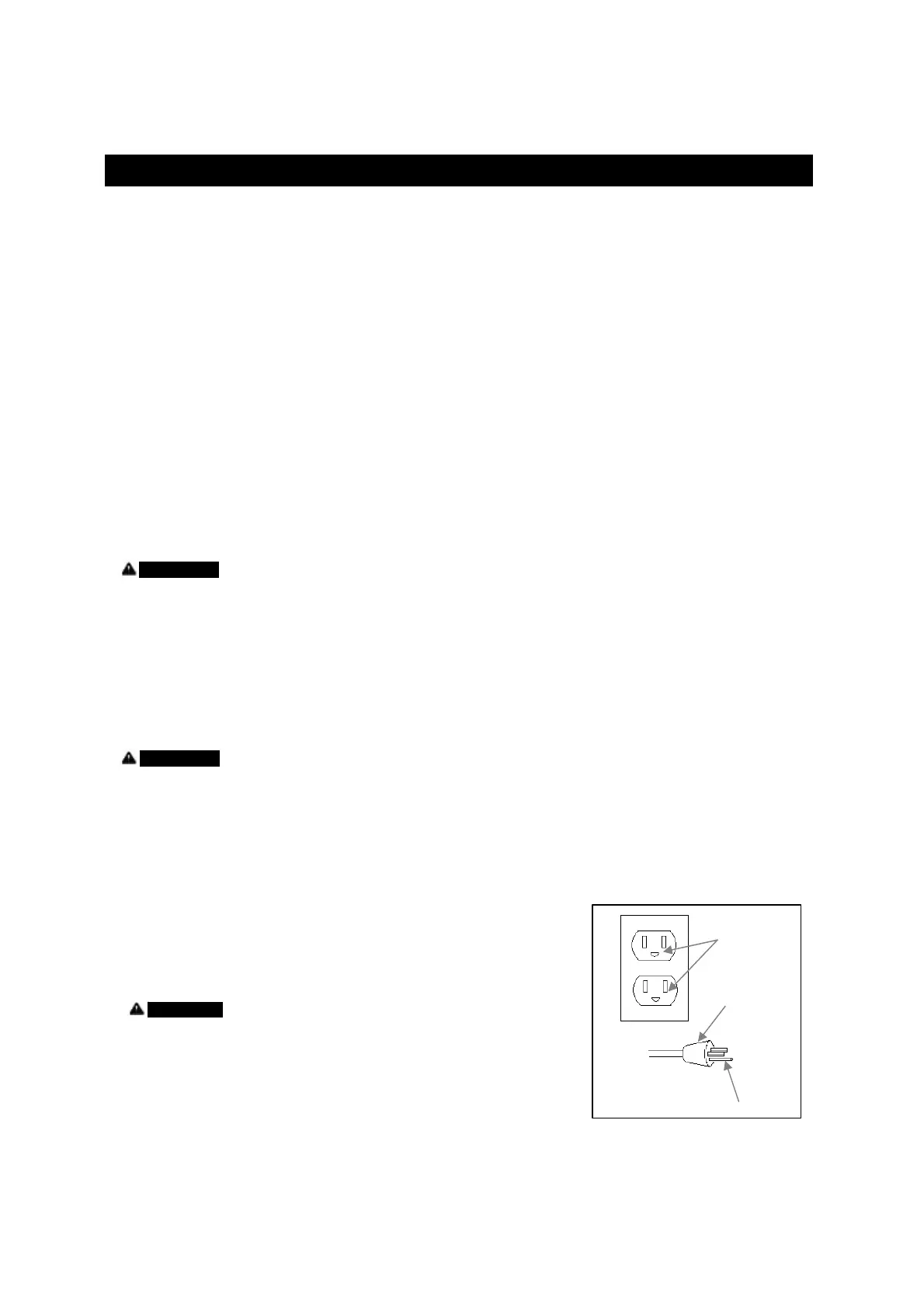
K. POWER CORD: This compressor should be used on a nominal 115 V grounded circuit. Use a power
cord that is equipped with a grounding plug. Verify that the compressor is plugged into an outlet that
has the same configuration as the plug (see Figure 1). Do not use an adaptor with this compressor.
If the grounding instructions are not completely understood, or if
there is any doubt as to whether the compressor is properly
grounded, check with a licensed electrician Do not alter the plug in
any way. If it will not fit into the outlet, have the proper type of
outlet installed by a licensed electrician.
DANGER:Improper installation of the grounding plug will
result in a risk of electric shock. If it is necessary to repair or
replace the cord or plug, do not connect the grounding wire to
either flat blade terminal. The grounding wire is in the green coating.
115V/15 A
Plug
Grounded
outlet
115V/15 A
Grounding Pin
Plug



 To Next Page