7
2. SPECIFICATIONS AND TECHNICAL DATA
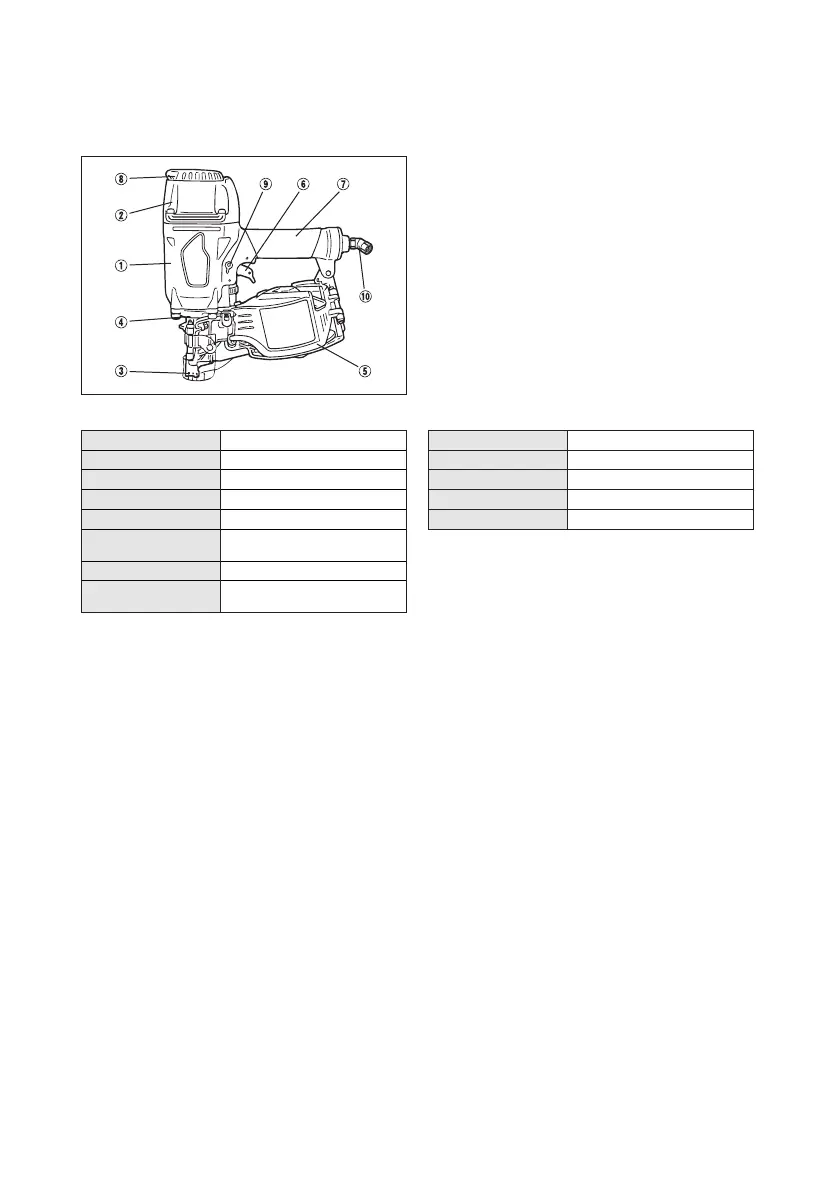
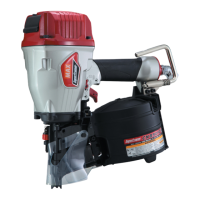
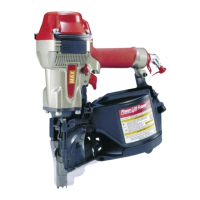
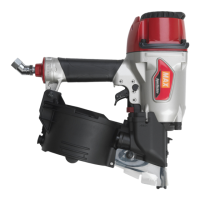
1. NAME OF PARTS
2. TOOL SPECIFICATIONS
PRODUCT NO. CN665D
HEIGHT 12-5/8˝ (321 mm)
WIDTH 5˝ (130 mm)
LENGTH 11˝ (280 mm)
WEIGHT 6.2 lbs. (2.8 kg)
RECOMMENDED
70 to 100 p.s.i. (5 to 7 bar)
OPERATING PRESSURE
LOADING CAPACITY 300 Nails
AIR CONSUMPTION
1.20Rat 90 p.s.i. (6 bar)
operating pressure
q
Frame
w
Cylinder Cap
e
Contact Arm
r
Nose
t
Magazine
y
Trigger
u
Grip
i
Exhaust Cover
o
Trigger Lock Dial
!0
Swivel Joint
3. FASTENER SPECIFICATIONS
PRODUCT NO. CN665D
NAIL LENGTH 1-1/2˝ to 2-1/2˝ (38 to 65 mm)
SHANK DIAMETER
.092˝ to .131˝ (φ2.3 to φ3.3 mm)
SHANK TYPE Smooth, Ring, Screw
HEAD DIAMETER
.224˝ to .276˝ (φ5.7 to φ7.0 mm)
TOOL AIR FITTINGS:
This tool uses a 1/4˝ N.P.T. male plug. The inside diameter should be .28˝ (7mm) or larger. The fitting must be capable of
discharging tool air pressure when disconnected from the air supply.
RECOMMENDED OPERATING PRESSURE:
70 to 100 p.s.i. (5 to 7 bar). Select the operating air pressure within this range for best fastener performance.
DO NOT EXCEED 120 p.s.i. (8 bar).
4. TECHNICAL DATA
q
NOISE
A-weighted single-event ------ LWA, 1s, d 94.99 dB
sound power level
A-weighted single-event ------ LpA, 1s, d 88.00 dB
emission sound pressure
level at work station
IThese values are determined and documented in accordance to EN12549:1999+A1:2008.
NOTE: These values are tool-related characteristic values and do not represent the noise generation at the point of use. Noise
at the point of use will for example depend on the working environment, the workpiece, the workpiece support, and the number
of driving operations. In addition, reference should be made to noise reduction measures.
NOTE: Workplace design can also serve to reduce noise levels, for example placing workpieces on sound-damping supports
(see also ISO11690-1).
w
VIBRATION
Vibration characteristic value = 4.30 m/s
2
These values are determined and documented in accordance to ISO 28927-13
NOTE: The vibration emission value above is a tool-related characteristic value and does not represent the influence to the
hand-arm-system when using the tool. Any influence to the hand-arm-system when using the tool will for example depend on
the gripping force, the contact pressure force, the working direction, the adjustment of energy supply, the workpiece, the
workpiece support.
5. APPLICATIONS
*General constuction works including panel sheathing, decking, subflooring, siding


 To Next Page