Need help?
Do you have a question about the Max SN883RH and is the answer not in the manual?
Recommends safety glasses and hearing protection for user safety.
Stresses using compressed air within specified pressure limits and avoiding flammable substances.
Covers trigger control, discharge safety, fastener use, and mechanism checks.
Includes fitting, disconnection, empty magazine, elevated work, general rules, and cautions.
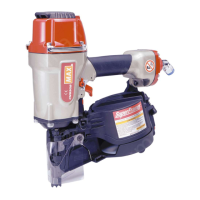
Identifies and labels the main components of the pneumatic nailer.
Details tool dimensions, capacity, and fastener requirements like length and diameter.
Specifies required air fittings and recommended operating pressure.
Provides measured noise and vibration levels according to industry standards.
Outlines common uses for the pneumatic nailer in construction and framing.
Details the need for a clean, regulated air supply and a 3-piece airset.
Specifies hose diameter, length, and the need for a quick-disconnect fitting.
Outlines essential checks like eye protection, air supply, and trigger function before use.
Details the steps for safely loading nails into the magazine.
Guides on performing a test firing and adjusting air pressure for optimal performance.
Explains single and sequential actuation modes and safe firing practices.
Advises not to fire empty, use a 3-piece airset, and use recommended oil.
Lists essential daily checks including air lines, lubricator, filter, screws, and contact arm.
Provides instructions for storing the tool to prevent rust and damage, and keep out of reach of children.
States that troubleshooting and repairs should only be done by authorized distributors or specialists.
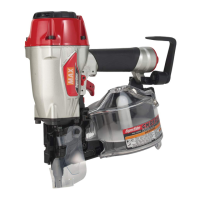
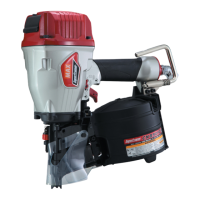
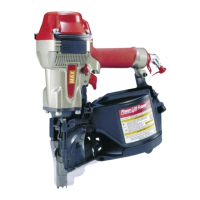
The MAX SN883RH, SN883CH/34, and SN883CH/28 are pneumatic nailers designed for various fastening applications. These tools are primarily used for floor and wall framing, subflooring, roof and wall sheathing, and fencing. As pneumatic nailers, they operate on compressed air, requiring an air compressor as their sole power source. It is crucial to never use high-pressure gas or combustible gases like oxygen or acetylene, as this poses a severe explosion risk. The tools are designed to function within an air pressure range of 70 to 100 p.s.i. (5 to 7 bar), with the pressure adjusted according to the specific work being performed. The operating pressure should never exceed 120 p.s.i. (8 bar), and connecting the tool to air pressure exceeding 200 p.s.i. (14 bar) can cause the tool to burst.
Safety is paramount when operating these nailers. Users must always wear safety glasses or goggles to protect against dust or flying fasteners. Eye protection should conform to ANSI Z87.1 standards and provide both frontal and side protection. In environments with high noise levels, ear protection may also be required. The tool should never be operated near flammable substances like thinner or gasoline, as volatile fumes can be drawn into the compressor, leading to an explosion. A proper fitting that releases air pressure when disconnected from the supply source must be used to prevent the tool from remaining charged with air after disconnection.
Before operation, a thorough check of the tool is necessary. All screws and bolts must be tight and properly installed. The contact arm and trigger should move smoothly. The air supply should be connected, and the tool checked for any air leakage. When holding the tool, fingers should be kept off the trigger unless intending to drive a fastener. The discharge outlet should never be pointed towards oneself or other personnel. Only specified fasteners should be used, as others can cause malfunction. When driving fasteners, the discharge outlet of the nose must be properly placed on the work surface to prevent fasteners from flying up. Hands and body parts must be kept away from the fastener discharge area. Fasteners should not be driven close to the edge or corner of the workpiece, or into thin materials, as this can cause splitting or flying fasteners. Driving fasteners on top of other fasteners should also be avoided to prevent deflection and injury.
Loading nails requires careful attention. The air supply must be disconnected, and fingers kept off the trigger. The contact arm should not be pressed against any object. Nails are loaded into the slot at the rear of the magazine until they go over the nail stopper. The pusher is then pulled to the rear end of the magazine and gently released. Abrupt release of the pusher can cause nail jamming or dry-firing.
The SN883RH, SN883CH/34, and SN883CH/28 models offer different firing mechanisms. The tool is shipped with SINGLE ACTUATION selected. In this mode, the tool drives a nail each time the contact arm is depressed while the trigger is pulled, or when the trigger is pulled and kept pulled after the contact arm is depressed. A second nail cannot be fired until the trigger is released and the tool cycles. To avoid double firing or accidental firing, the trigger should be pulled rapidly and firmly.
The tool can be switched to CONTACT ACTUATION with an ANTI-DOUBLE FIRE MECHANISM. This mechanism, protected by US patent 5597106 and UK patent 2286790, is designed to prevent unintended second fasteners from being driven due to recoil. Before switching triggering methods, the air supply must always be disconnected. To switch, the spring pin, indicated by a " mark, is gently pushed out with an accessory punch. The switching lever is then removed in the direction of the arrow. When switching back to SINGLE ACTUATION, the switching lever facing the "S" mark is equipped with the spring pin to the trigger by reverse procedure. It is critical to use the designated original sintering steel grey metallic switching lever; using any other lever can lead to serious accidents, such as fasteners firing just by pulling the trigger. The tool should never be installed with the switching lever from previous models, as this also poses a serious accident risk.
For contact fire operation, the trigger is held, and the contact arm is depressed against the work surface. For single fire operation with the anti-double fire mechanism, the contact arm is depressed against the work surface, and then the trigger is pulled. The tool will not fire a second nail until the trigger is released and the tool can cycle.
The driving depth can be adjusted using the adjustment dial. Before making any adjustments, the air supply must be disconnected. After setting the air pressure, a few nails are driven into a material sample to determine if adjustment is needed. If adjustment is required, the air supply is disconnected again, and the adjustment dial is turned according to the marks on the contact arm area. Finally, the air supply is reconnected.
An optional contact tip can be attached to the tip of Contact Arm "B" when driving nails into soft material. This tip can be stored on the arm cover when not in use. The tool is also equipped with a trigger lock mechanism. To drive nails, the trigger must be pushed and rotated from the LOCK to the UNLOCK position.
Removing jammed nails also requires strict adherence to safety protocols. The air supply must always be disconnected before attempting to remove jammed nails. First, the pusher lever is pushed to release the strip nails from the pusher. Then, the nail stopper is pushed, and the strip nails are removed from inside the magazine. The pusher is pulled back and held using the hole and a rod. Finally, the jammed nail is removed from the nose using a punch or a slotted screwdriver. For the SN883RH model, a magnet in the nose holds nails. If the collation strip is broken, nails might remain in the nose even if the magazine appears empty. It is crucial to confirm that no nails remain in the nose after removing nails from the magazine, with the air supply disconnected, to prevent accidental firing.
Maintenance is essential for optimal performance and longevity. The nailer should never be fired when empty. Using a 3-piece airset (air filter, regulator, oiler) is highly recommended. Failure to do so allows moisture and dirt from the compressor to enter the tool, leading to rust, wear, and poor performance. The hose length between the airset and the tool should not exceed 5 meters to prevent air pressure reduction. Velocite or turbine oil (ISO VG32) should be used to lubricate the tool. After operations, 2 or 3 drops of oil should be placed into the air plug inlet with a jet oiler.
Daily or pre-operation inspection and maintenance include:
When storing the tool for extended periods, a thin coat of lubricant should be applied to steel parts to prevent rust. The tool should be stored in a warm, dry place, out of reach of children, and never in a cold weather environment. All quality tools will eventually require servicing or parts replacement due to normal wear. Troubleshooting and repairs should only be carried out by MAX CO., LTD. authorized distributors or other specialists.
According to European Norm EN 792-13, effective from 01.01.2001, fastener driving tools with contact actuation must be marked with the symbol "Do not use on scaffoldings, ladders." They should not be used for specific applications such as changing driving locations involving scaffoldings, stairs, ladders, or ladder-like constructions (e.g., roof laths), closing boxes or crates, or fitting transportation safety systems on vehicles and wagons.
 General
| Model | SN883RH |
|---|---|
| Category | Power Tool |
| Operating Pressure | 70-120 psi |
| Power Source | Pneumatic |
| Tool Category | Nail Gun |
| Type | Nail Gun |
| Fastener Type | Nails |


 To Next Page