8
–
24
Customer Information and Reporting Safety Defects
Uniform Tire Quality Grading System (UTQGS)
Temperature-A, B, C
The temperature grades A (the highest), B, and C, represent the tire's resistance to the
generation of heat and its ability to dissipate heat when tested under controlled conditions on
a specied indoor laboratory test wheel.
Sustained high temperature can cause the material of the tire to degenerate and reduce tire
life, and excessive temperatures can lead to sudden tire failure.
Grade C corresponds to a level of performance which all passenger vehicle tires must meet
under the Federal Motor Vehicle Safety Standard No. 109. Grades B and A represent higher
levels of performance on the laboratory test wheel than the minimum required by law.
WARNING
Keep your vehicle's tires properly inated and not overloaded:
Driving with improperly inated or overloaded tires is dangerous. Excessive speed,
underination, or excessive loading, either separately or in combination, can cause heat
buildup and possible tire failure. The temperature grade for this tire is established for a
tire that is properly inated and not overloaded.
These grades will be added to the sidewalls of passenger vehicle tires over the next several
years according to a schedule established by the NHTSA and the tire manufacturers.
The grade of tires available as standard or optional equipment on Mazda vehicles may vary
with respect to grade.
ALL PASSENGER VEHICLE TIRES MUST CONFORM TO THESE GRADES AND TO
ALL OTHER FEDERAL TIRE-SAFETY REQUIREMENTS.
UNIFORM TIRE QUALITY GRADING
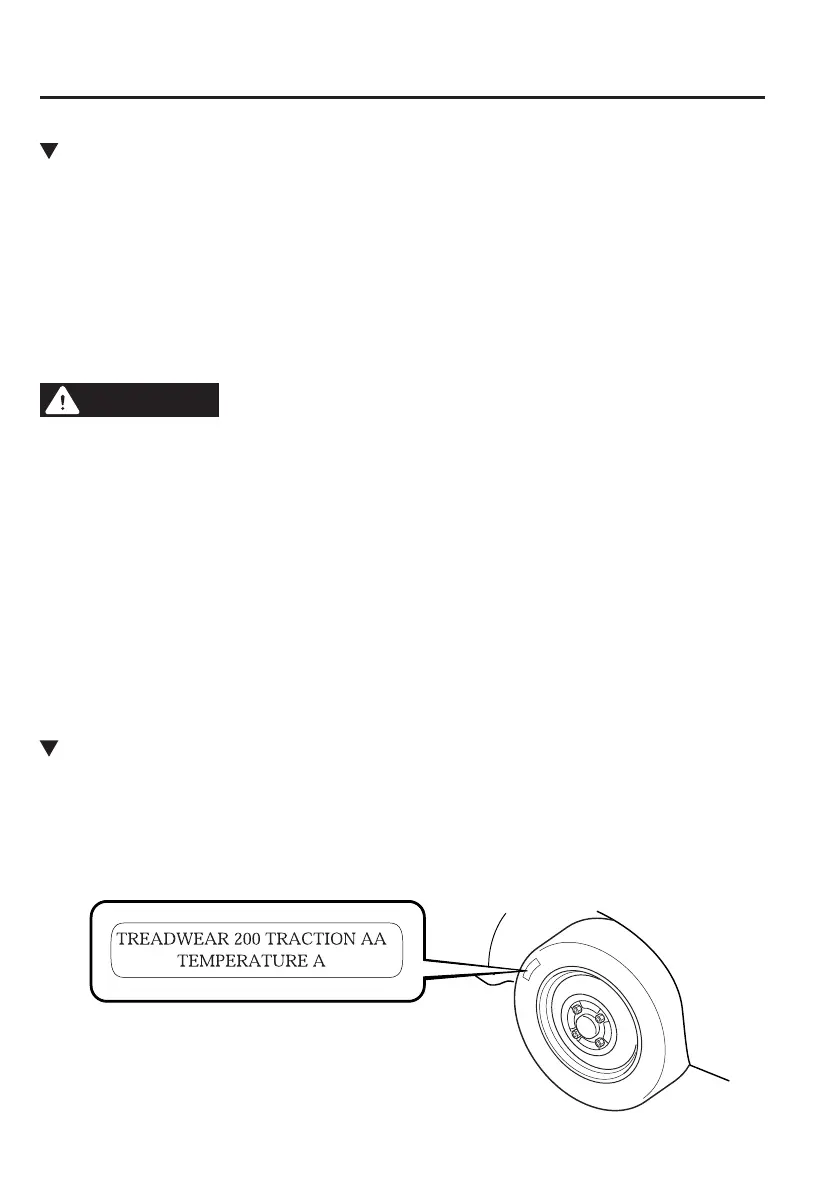
Quality grades can be found where applicable on the tire sidewall between tread shoulder
and maximum section width.
For example:
TREADWEAR 200 TRACTION AA TEMPERATURE A
Mazda6_8FH2-EA-16F_Edition1.indb 24 2016/05/10 19:25:01



 To Next Page