EasyManua.ls Logo

Mazda RX-7 - Checking the Seal Stroke; Eccentric Shaft

Mazda RX-7
52 pages
Print Icon
To Next Page IconTo Next Page
To Previous Page IconTo Previous Page
Loading...
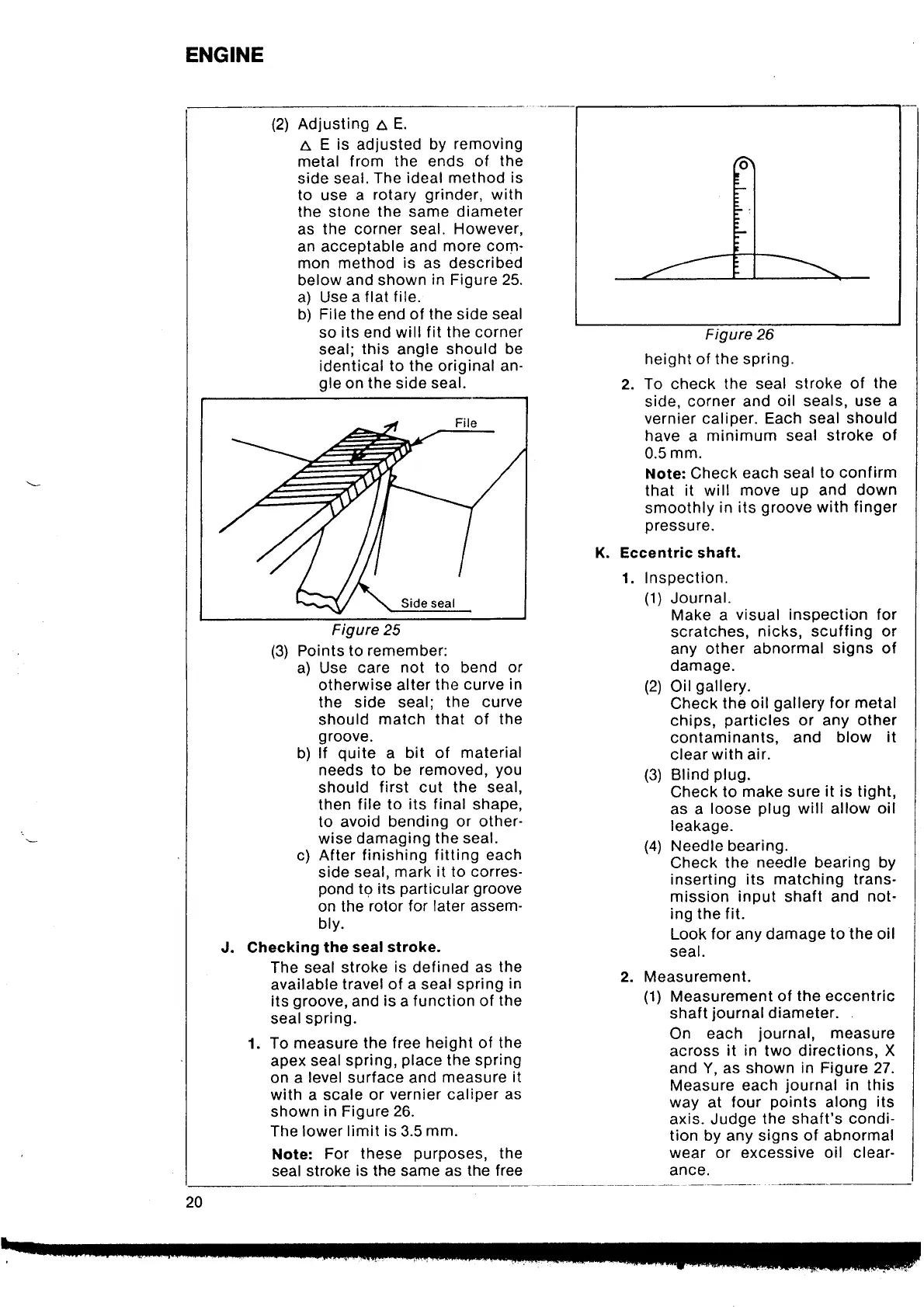
Figure 25
ENGINE
(2)
Adjusting
a
E.
a
E
is adiusted
by removing
metal
from the ends of
the
side seal.
The ideal
method is
to use a
rotary
grinder,
with
the stone
the
same
diameter
as the corner seal.
However,
an
acceptable
and
more com-
mon method
is
as described
below and shown
in
Figure 25.
a) Useaflatfile.
b)
File the
end
of the side seal
so
its
end will
f it the corner
seal;
this
angle
should be
identical to the original an-
gle
on the side
seal.
(3)
Points to
remember:
a) Use
care
not to
bend
or
otherwise alter
the curve
in
the side seal:
the curve
should match that
of the
groove.
lf
quite
a bit of
material
needs to be
removed,
you
should
first cut the seal.
then
file to
its final
shape,
to avoid bending
or other-
wise damaging
the seal.
After finishing
fitting each
side
seal, mark
it lo corres-
pond
to its
particular groove
on the
rotor for later
assem-
blv.
J. Checking
the
seal stroke.
The seal
stroke
is
defined
as the
available
travel of a seal spring
in
2'
its
groove,
and
is
a
function of the
sealspring.
1. To
measure the free
height of the
apex
seal spring,
place
the spring
on a
level
surface and
measure
it
with
a
scale or
vernier caliper as
shown
in
Figure 26.
The lower
limit is
3.5
mm.
Note:
For lhese
purposes,
the
seal stroke
is the same as
the free
Figure 26
height of the spring.
2. fo check
the seal stroke
of
the
side,
corner and
oil
seals,
use a
vernier
caliper.
Each seal
should
have
a
minimum seal
stroke of
0.5
mm.
Note: Check
each seal
to conf
irm
that it will
move up and
down
smoothly
in
its
groove
with finger
pressure.
K. Eccentric shaft.
Inspection.
(1)
Journal.
Make a
visual inspection for
scratches,
nicks,
scuffing
or
any
other abnormal
signs of
damage.
(2)
Oilgallery.
Check
the oil
gallery
for metal
chips,
particles
or any
other
contaminants,
and
blow
it
clear
with
air.
(3)
Blind
plug.
Check
to
make
sure
it is tight,
as a
loose
plug
will allow
oil
leakage.
(4)
Needle bearing.
Check
the needle bearing by
inserting its
matching
trans-
mission input shaft and
not-
ing the f it.
Look
for
any
damage to the oil
seal.
Measurement.
(1)
Measurement
of
the
eccentric
shaft
journal
diameter.
On each
journal,
measure
across
it in
two directions, X
and
Y,
as
shown
in
Figure 27.
Measure
each
journal
in this
way
at
four
points
along
its
axis. Judge
the shaft's
condi-
tion by
any
signs of abnormal
wear or excessive oil clear-
ance.
1.
b)
c)

Table of Contents

Related product manuals