EasyManua.ls Logo

MCi MC8 Crusader - Steering Gear; Description and Operation

Default Icon
429 pages
Print Icon
To Next Page IconTo Next Page
To Previous Page IconTo Previous Page
Loading...
Crusader
MC-8
[ "°' 11-2
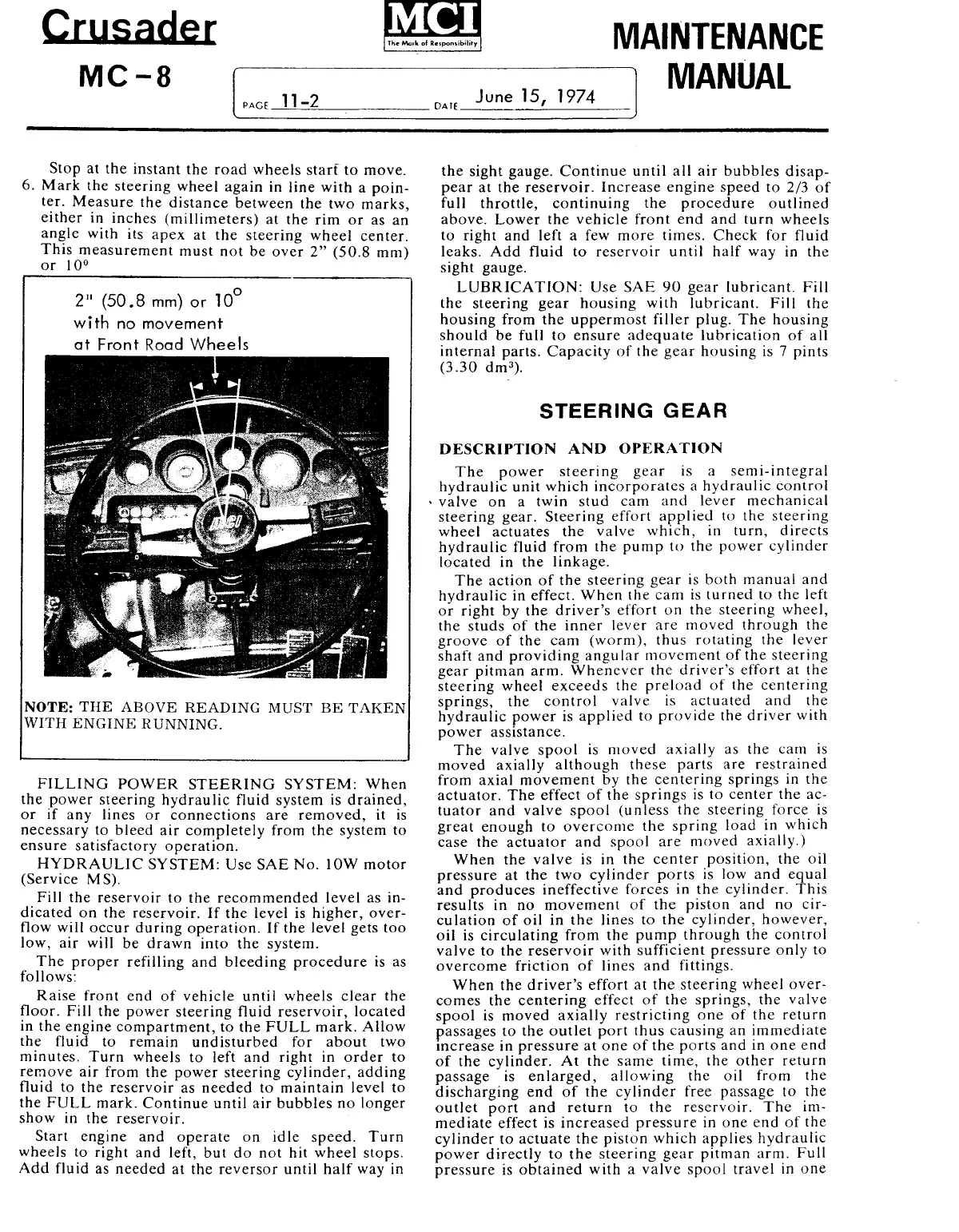
Stop
at
the
instant
the
road
wheels
starf
to
move.
6.
Mark
the
steering
wheel
again
in
line
with
a
poin-
ter.
Measure
the
distance
between
the
two
marks,
either
in
inches
(millimeters)
at
the
rim
or
as
an
angle
with
its
apex
at
the
steering
wheel
center.
This
measurement
must
not
be
over
2"
(50.8
mm)
or
10°
0
2" (50
.8
mm)
or
10
with
no
movement
at
Front Road
Wheels
NOTE:
THE
ABOVE
READING
MUST
BE
TAKEN
WITH
ENGINE
RUNNING.
FILLING
POWER
STEERING
SYSTEM:
When
the
power
steering
hydraulic
fluid
system
is
drained,
or
if
any
lines
or
connections
are
removed,
it
is
necessary
to
bleed
air
completely
from
the
system
to
ensure
satisfactory
operation.
HYDRAULIC
SYSTEM:
Use
SAE
No.
I
OW
motor
(Service
MS).
Fill
the
reservoir
to
the
recommended
level
as in-
dicated
on
the
reservoir.
If
the
level
is
higher,
over-
flow
will
occur
during
operation.
If
the
level
gets
too
low,
air
will
be
drawn
into
the
system.
The
proper
refilling
and
bleeding
procedure
is as
follows:
Raise
front
end
of
vehicle
until
wheels
clear
the
floor.
Fill
the
power
steering
fluid
reservoir,
located
in
the
engine
compartment,
to
the
FULL
mark.
Allow
the
fluid
to
remain
undisturbed
for
about
two
minutes.
Turn
wheels
to
left
and
right
in
order
to
remove
air
from
the
power
steering
cylinder,
adding
fluid
to
the
reservoir
as
needed
to
maintain
level
to
the
FULL
mark.
Continue
until
air
bubbles
no
longer
show
in
the
reservoir.
Start
engine
and
operate
on
idle
speed.
Turn
wheels
to
right
and
left,
but
do
not
hit
wheel
stops.
Add
fluid
as
needed
at
the
reversor
until
half
way
in
MAINTENANCE
DATE-
__
]
MANUAL
June
15,
1974
.
the
sight
gauge.
Continue
until
all
air
bubbles
disap-
pear
at
the
reservoir.
Increase
engine
speed
to
2/3
of
full
throttle,
continuing
the
procedure
outlined
above.
Lower
the
vehicle
front
end
and
turn
wheels
to
right
and
left
a
few
more
times.
Check
for
fluid
leaks.
Add
fluid
to
reservoir
until
half
way
in
the
sight
gauge.
LUBRICATION:
Use
SAE
90
gear
lubricant.
Fill
the
steering
gear
housing
with
lubricant.
Fill
the
housing
from
the
uppermost
filler
plug.
The
housing
should
be
full
to
ensure
adequate
lubrication
of
all
internal
parts.
Capacity
of
the
gear
housing
is 7
pints
(3.30
dm
3
).
STEERING
GEAR
DESCRIPTION
AND
OPERATION
The
power
steering
gear
is a
semi-integral
hydraulic
unit
which
incorporates
a
hydraulic
con~rol
,
valve
on
a
twin
stud
cam
and
lever
mechanical
steering
gear.
Steering
effort
applied
to
the
steering
wheel
actuates
the
valve
which,
in
turn,
directs
hydraulic
fluid
from
the
pump
to
the
power
cylinder
located
in
the
linkage.
The
action
of
the
steering
gear
is
both
manual
and
hydraulic
in
effect.
When
the
cam
is
turned
to
the
left
or
right
by
the
driver's
effort
on
the
steering
wheel,
the
studs
of
the
inner
lever
are
moved
through
the
groove
of
the
cam
(worm),
thus
rotating
the
lever
shaft
and
providing
angular
movement
of
the
steering
gear
pitman
arm.
Whenever
the
driver's
effort
at
!he
steering
wheel
exceeds
the
preload
of
the
centering
springs,
the
control
valve
is
actuated
and
t_he
hydraulic
power
is
applied
to
provide
the
driver
with
power
assistance.
The
valve
spool
is
moved
axially
as
the
cam
is
moved
axially
although
these
parts
are
restrained
from
axial
movement
by
the
centering
springs
in
the
actuator.
The
effect
of
the
springs
is
to
center
the
ac-
tuator
and
valve
spool
(unless
the
steering
force
is
great
enough
to
overcome
the
spring
load
in
which
case
the
actuator
and
spool
are
moved
axially.)
When
the
valve
is
in
the
center
position,
the
oil
pressure
at
the
two
cylinder
ports
is
low
and
equal
and
produces
ineffective
forces
in
the
cylinder.
This
results
in
no
movement
of
the
piston
and
no
cir-
culation
of
oil
in
the
lines
to
the
cylinder,
however,
oil
is
circulating
from
the
pump
through
the
control
valve
to
the
reservoir
with
sufficient
pressure
only
to
overcome
friction
of
lines
and
fittings.
When
the
driver's
effort
at
the
steering
wheel
over-
comes
the
centering
effect
of
the
springs,
the
valve
spool
is
moved
axially
restricting
one
of
the
return
passages
to
the
outlet
port
thus
causing
an
immediate
increase
in
pressure
at
one
of
the
ports
and
in
one
end
of
the
cylinder.
At
the
same
time,
the
other
return
passage
is
enlarged,
allowing
the
oil
from
the
discharging
end
of
the
cylinder
free
passage
to
the
outlet
port
and
return
to
the
reservoir.
The
im-
mediate
effect
is
increased
pressure
in
one
end
of
the
cylinder
to
actuate
the
piston
which
applies
hydraulic
power
directly
to
the
steering
gear
pitman
arm.
Full
pressure
is
obtained
with
a
valve
spool
travel
in
one