EasyManua.ls Logo

MCi MC8 Crusader - Inst Alling Crankshaft; Pistons and Connecting Rods

Default Icon
429 pages
Print Icon
To Next Page IconTo Next Page
To Previous Page IconTo Previous Page
Loading...
Crusader
MC-8
MAINTENANCE
[
e.c,--'---4-........:....13::...___
__
DA
rE
__________,,Jc.-=..:ul4-Ly,-----=--1
_;__:__97-=-3
_]
MANUAL
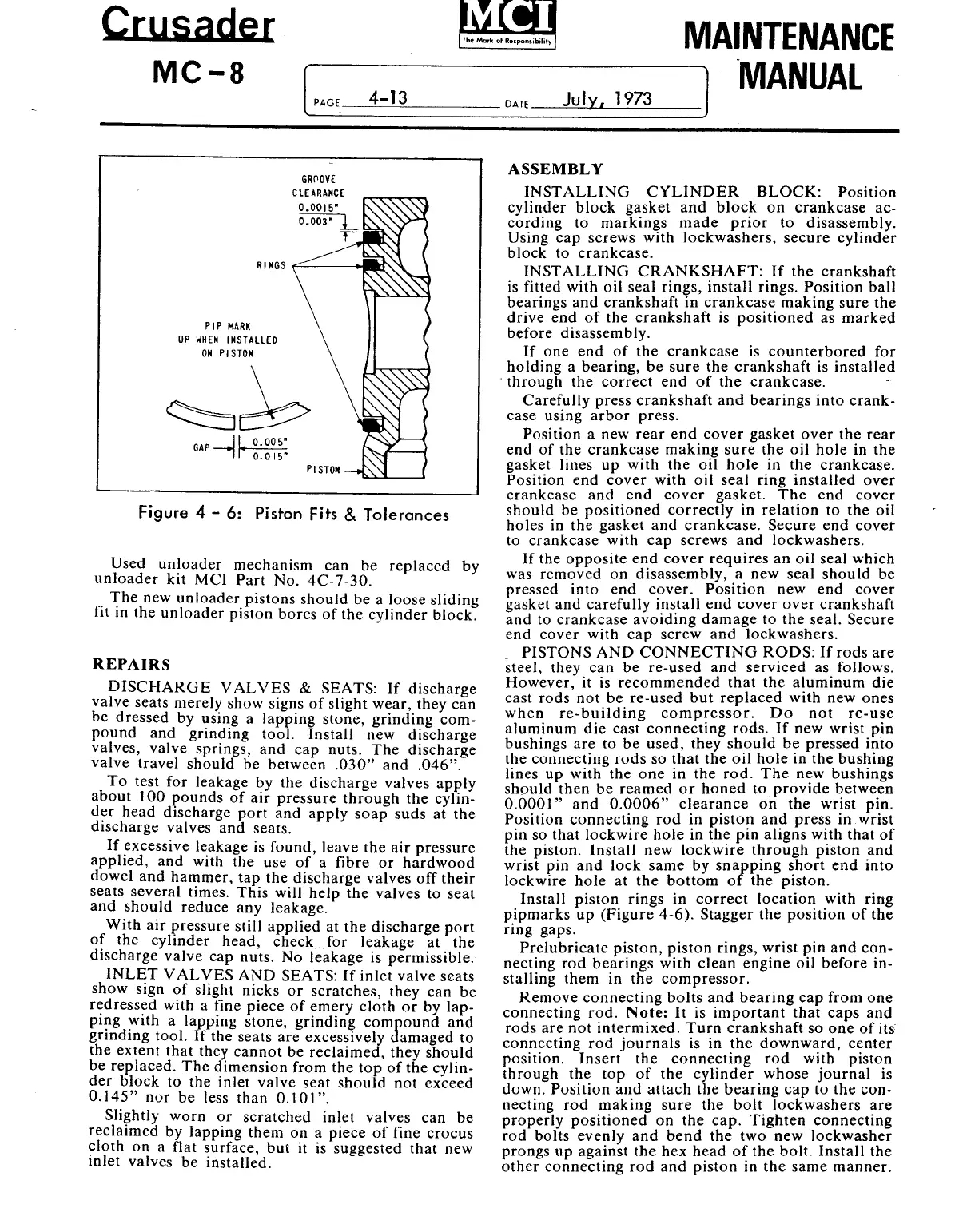
PIP
HARK
UP
WHEN
INSTALLED
ON
PISTON
GAP
II
0.005"
-,~
GRPOVE
Figure 4 - 6: Piston Fits & Tolerances
Used
unloader
mechanism
can be
replaced
by
unloader
kit
MCI
Part
No.
4C-
7-30.
The
new
unloader
pistons
should
be
a
loose
sliding
fit in
the
unloader
piston
bores
of
the
cylinder
block.
REPAIRS
DISCHARGE
VALVES
& SEATS:
If
discharge
valve
seats merely show signs
of
slight
wear,
they
can
be
dressed
by using a
lapping
stone,
grinding
com-
pound
and
grinding
tool.
Install
new
discharge
valves, valve springs,
and
cap
nuts.
The
discharge
valve
travel
should
be
between
.030"
and
.046"
To
test
for
leakage
by
the
discharge
valves
apply
about
I
00
pounds
of
air
pressure
through
the
cylin-
der
head
discharge
port
and
apply
soap
suds
at
the
discharge
valves
and
seats.
If
excessive leakage is
found,
leave
the
air
pressure
applied,
and
with the
use
of
a
fibre
or
hardwood
dowel
and
hammer,
tap the
discharge
valves
off
their
seats
several
times.
This
will
help
the
valves to
seat
and
should
reduce
any leakage.
With
air
pressure
still
applied
at
the
discharge
port
of
the
cylinder
head,
check
..
for
leakage
at
the
discharge
valve
cap
nuts.
No
leakage
is
permissible.
INLET
VAL
YES
AND
SEA
TS:
If
inlet
valve seats
show
sign
of
slight nicks
or
scratches,
they
can
be
redressed
with a fine
piece
of
emery
cloth
or
by lap-
ping
with
a lapping
stone,
grinding
compound
and
grinding
tool.
If
the seats
are
excessively
damaged
to
the
extent
that
they
cannot
be
reclaimed,
they
should
be
replaced.
The
dimension
from
the
top
of
the
cylin-
der
block
to the
inlet
valve
seat
should
not
exceed
0.145"
nor
be
less
than
0.101 ".
Slightly
worn
or
scratched
inlet valves
can
be
reclaimed
by
lapping
them
on
a
piece
of
fine
crocus
cloth
on
a flat surface,
but
it
is
suggested
that
new
inlet
valves be installed.
ASSEMBLY
INST
ALLING
CYLINDER
BLOCK:
Position
cylinder
block
gasket
and
bloc~
on
cra!1kcase ac-
cording
to
markings
made
pnor
to
d1sasse'!1bly.
Using
cap
screws
with
lockwashers,
secure
cylinder
block
to
crankcase.
INST
ALLING
CRANKSHAFT:
If
the
crankshaft
is
fitted with
oil
seal
rings,
install
rings.
Position
ball
bearings
and
crankshaft
in cr~nkca~~
making
sure
the
drive
end
of
the
crankshaft
1s
pos1t10ned as
marked
before
disassembly.
If
one
end
of
the
crankcase
is
counterbored
for
holding
a
bearing,
be
sure
the
crankshaft
is
installed
·
through
the
correct
end
of
the
crankcase.
-
Carefully
press
crankshaft
and
bearings
into
crank-
case using
arbor
press.
Position
a new
rear
end
cover
gasket
over
the
rear
end
of
the
crankcase
making
sure
the
oil
hole
in
the
gasket
lines
up
with
~he
~ii
hole
_in
t~e
crankcase.
Position
end
cover
with
011
seal
nng
mstalled
over
crankcase
and
end
cover
gasket.
The
end
cover
should
be
positioned
correctly
in
relation
to
the
oil
holes in
the
gasket
and
crankcase.
Secure
end
covet
to
crankcase
with
cap
screws
and
lockwashers.
If
the
opposite
end
cover
requires
an
oil
seal
which
was
removed
on
disassembly,
a
new
seal
should
be
pressed
into
end
cover.
Position
new
end
cover
gasket
and
carefully
install
end
cover
over
crankshaft
and
to
crankcase
avoiding
damage
to
the
seal.
Secure
end
cover
with
cap
screw
and
lockwashers.
PISTONS
AND
CONNECTING
RODS:
If
rods
are
steel,
they
can
be
re-used
and
serviced
as_
follow~.
However
it
is
recommended
that
the
alummum
die
cast
rods'
not
be
re-used
but
replaced
with
new
ones
when
re-building
compressor.
Do
not
~e-u~e
aluminum
die
cast
connecting
rods.
If
new
wnst
pm
bushings
are
to
be
used,
they sh_ould b~
pressed
i~to
the
connecting
rods
so
that
the
011
hole
m
the
bus~mg
lines
up
with
the
one
in
the
rod.
The
new
bushmgs
should
then
be
reamed
or
honed
to
provide
between
0.0001"
and
0.0006"
clearance
on
the
wrist
pin.
Position
connecting
rod
in
piston
and
press
in
wrist
pin
so
that
lockwire
hole
in th~
pin
aligns
wi_th
that
of
the
piston.
Install
new
lockw1re
t~rough
piston
_and
wrist
pin
and
lock
same
by
snappmg
~hort
end
mto
lockwire
hole
at
the
bottom
of
the
piston.
Install
piston
rings
in
correct
locatio~
_with
ring
pipmarks
up
(Figure
4-6).
Stagger
the
pos1t10n
of
the
ring
gaps.
Prelubricate
piston,
piston
rings,
~rist
I?in
and
c~n-
necting
rod
bearings
with
clean
engme
011
before
m-
stalling
them
in
the
compressor.
Remove
connecting
bolts
and
bearing
cap
from
one
connecting
rod.
Note:
It
is
important
that
caps
a~d
rods
are
not
intermixed.
Turn
crankshaft
so
one
of
its
connecting
rod
journals
is in ~he
downw~rd,
c~nter
position.
Insert
the
connectmg
rod
with
piston
through
the
top
of
the
cylinder.
whose
journal
is
down.
Position
and
attach
the
beanng
cap
to
the
con-
necting
rod
making
sure
the
bolt_
lockwashers
~re
properly
positioned
on
the
cap.
Tighten
connectmg
rod
bolts
evenly
and
bend
the
two
new
lockwasher
prongs
up
against
the
hex
h~ad
o~
the
bolt.
Install
the
other
connecting
rod
and
piston
m
the
same
manner.