46
Using setting circles requires a developed technique. When using the circles for the first time,
try hopping from one bright star (the calibration star) to another bright star of known coordi-
nates. Practice moving the telescope from one easy-to-find object to another. In this way, the
precision required for accurate object location becomes evident.
NOTE: You may also enter an object's R.A. and Dec coordinates using the "User:
Objects" option of Autostar's Object menu. Autostar then automatically slews the
telescope to the entered coordinates.
Locating the Celestial Pole
To get basic bearings at an observing location, take note of where the Sun rises (East) and
sets (West) each day. After the site is dark, face North by pointing your left shoulder toward
where the Sun set. To precisely point at the pole, find the North Star (Polaris) by using the Big
Dipper as a guide (Fig. 25).
For precise tracking of astronomical objects, your
telescope should be Polar aligned.
IMPORTANT NOTE: For almost all astro-
nomical observing requirements, approxi-
mate settings of the telescope’s latitude
and Polar axis are acceptable. Do not
allow undue attention to precise Polar
Alignment of the telescope to interfere with
your basic enjoyment of the instrument.
Autostar Polar Alignment
Autostar provides three different methods for Polar Alignment: Easy, One-Star and Two-Star.
In each method, the telescope is pointed at Polaris, which Autostar uses the star as a refer-
ence.
Easy Polar Alignment
Polaris and two alignment stars are chosen by Autostar based on the date, time, and location
entered. First, choose "Polar" from the "Setup: Telescope" menu. The rest of the procedure is
identical to the (Alt/Az) "EASY ALIGN," page 19, except that Autostar prompts you to point the
telescope at Polaris and center it in the telescope eyepiece.
One-Star Polar Alignment
Polar Two-Star Alignment requires some knowledge of the night sky. Autostar provides a data-
base of bright stars and one star from this database is chosen by the observer for alignment.
Polaris is chosen by Autostar. First, choose "Polar" from the "Setup: Telescope" menu. The rest
of the procedure is almost identical to the (Alt/Az) "ONE STAR ALT/AZ ALIGNMENT," page 37,
except that Autostar you to point the telescope at Polaris and center it in the telescope eye-
piece.
Two-Star Polar Alignment
Polar Two-Star Alignment requires some knowledge of the night sky. Autostar provides a data-
base of bright stars and two stars from this database are chosen by the observer for alignment.
Polaris is chosen by Autostar. The rest of the procedure is almost identical to the (Alt/Az) "TWO
STAR ALT/AZ ALIGNMENT," page 37, except that Autostar prompts you to point the telescope
at Polaris and center it in the telescope eyepiece.
Setting Circles
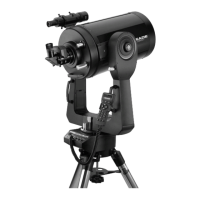
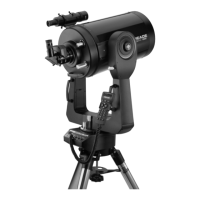
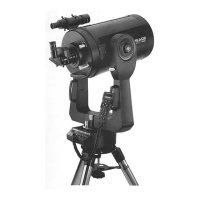
Setting circles included with the LX90 permit the location of faint celestial objects not easily
found by direct visual observation. R.A. circle is located on the top surface of the telescope’s
drive base. Declination circles (8, Fig. 1) are located at the top of each fork tine. With the tel-
escope pointed at the North Celestial Pole, the Dec circle should read 90° (understood to mean
+90°). Objects located below the 0-0 line of the Dec circle carry minus Declination coordinates.
Each division of the Dec circle represents a 1° increment. The R.A. circle runs from 0
hr
to (but
not including) 24
hr
, and reads in increments of 5
min
.


 To Next Page