47
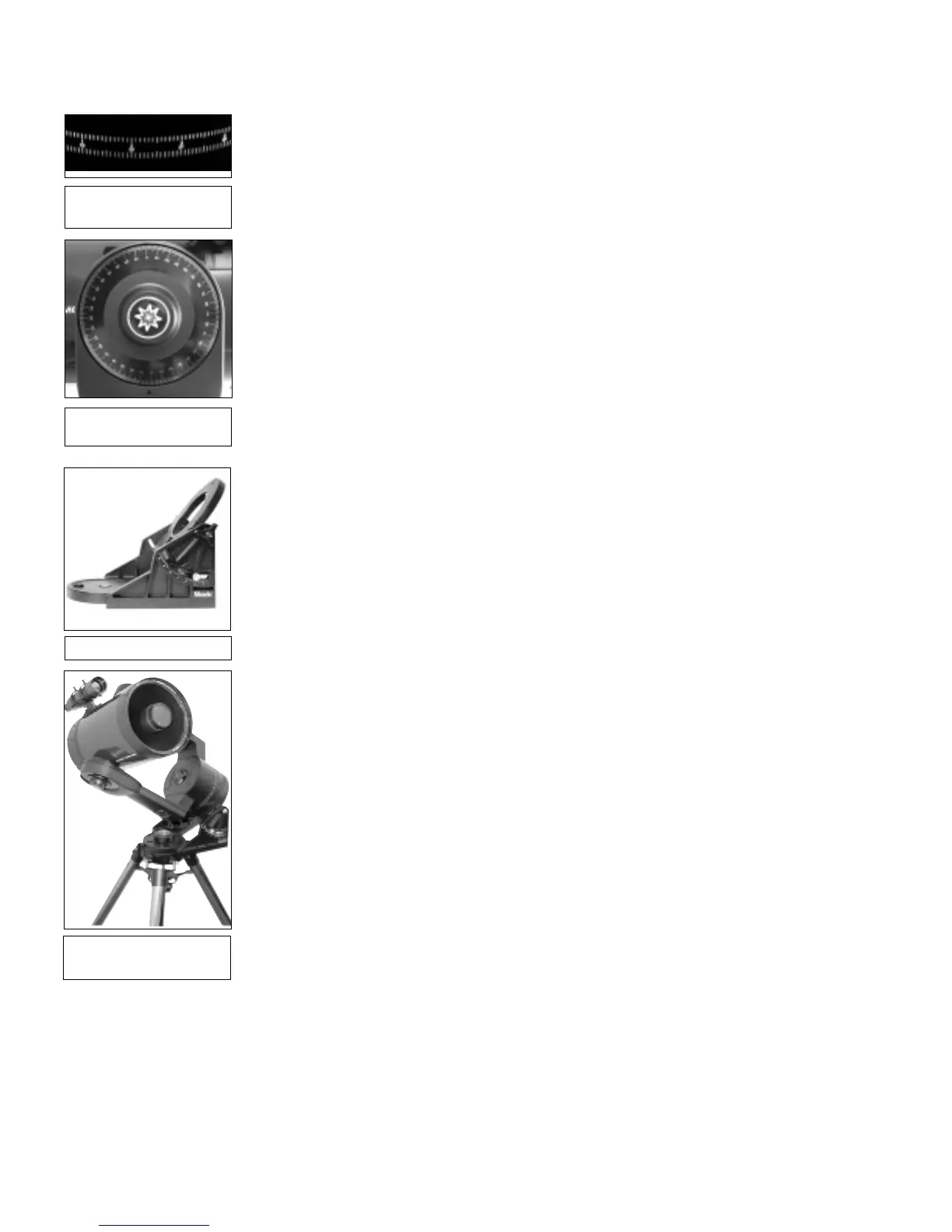
Note that the R.A. circle is double-indexed (i.e., there are two series of numbers running in
opposite directions around the circumference of the R.A. circle). The upper series of numbers
(increasing counterclockwise) applies to observers located in the Earth’s Northern Hemisphere;
the lower series of numbers (increasing clockwise) applies to observers located in the Earth’s
Southern Hemisphere.
To use the setting circles to locate an object not easily found by direct visual observa-
tion:
With the telescope aligned to the Celestial Pole, first look up the celestial coordinates (R.A. and
Dec.) of the object in a star atlas. Then loosen the R.A. lock and turn the telescope to read the
correct R.A. of the desired object; lock the R.A. lock onto the object. Next, turn the telescope
in Declination to read the correct Declination of the object. If the procedure has been followed
carefully, and if the telescope was well-aligned with the pole, the desired object should now be
in the telescopic field of a low-power eyepiece.
If you do not immediately see the object you are seeking, try searching the adjacent sky area.
Keep in mind that, with the 26mm eyepiece, the field of view of the LX90 is about 0.5°. Because
of its much wider field, the viewfinder may be of significant assistance in locating and center-
ing objects, after the setting circles have been used to locate the approximate position of the
object.
Pinpoint application of the setting circles requires that the telescope be precisely aligned with
the pole See "LOCATING THE CELESTIAL POLE," page 46.
EQUATORIAL WEDGE
An optional equatorial wedge allows a more precise Polar alignment. Polar alignment allows
you to take longer exposure photographs with your LX90.
The LX90 requires an adapter to attach the equatorial wedge to the tripod. See the instruction
sheet supplied with the wedge for installation.
Equatorial Wedge
The equatorial wedge permits use in an astronomical, or “equatorial,” mode. The wedge fits
onto the field tripod.
NOTE: The Meade equatorial wedge is designed solely for use in conjunction with
the Meade field tripod. The wedge should never be used without the field tripod
(e.g., by placing the wedge alone on a table top and then mounting the telescope
on the wedge – the wedge may become seriously imbalanced, to the point where
the telescope may actually tip over.
Included features:
• Attachment of the wedge to the field tripod by means of only one manual knob.
• Quick azimuth adjustment by loosening the manual knob as described above.
• Bubble level for rapid tripod/wedge leveling.
• Etched latitude scale for fast adjustment of the latitude angle.
Figure 27: Section of Right
Ascension Setting Circle.
Figure 28: Section of
Declination Setting Circle.
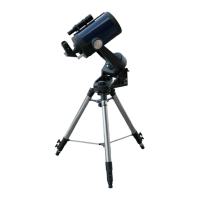
Fig. 29: Equatorial Wedge.
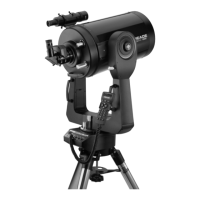
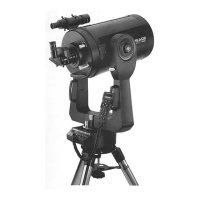
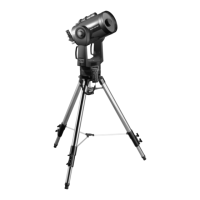
Fig. 30: LX90 mounted on
an equatorial wedge.


 To Next Page