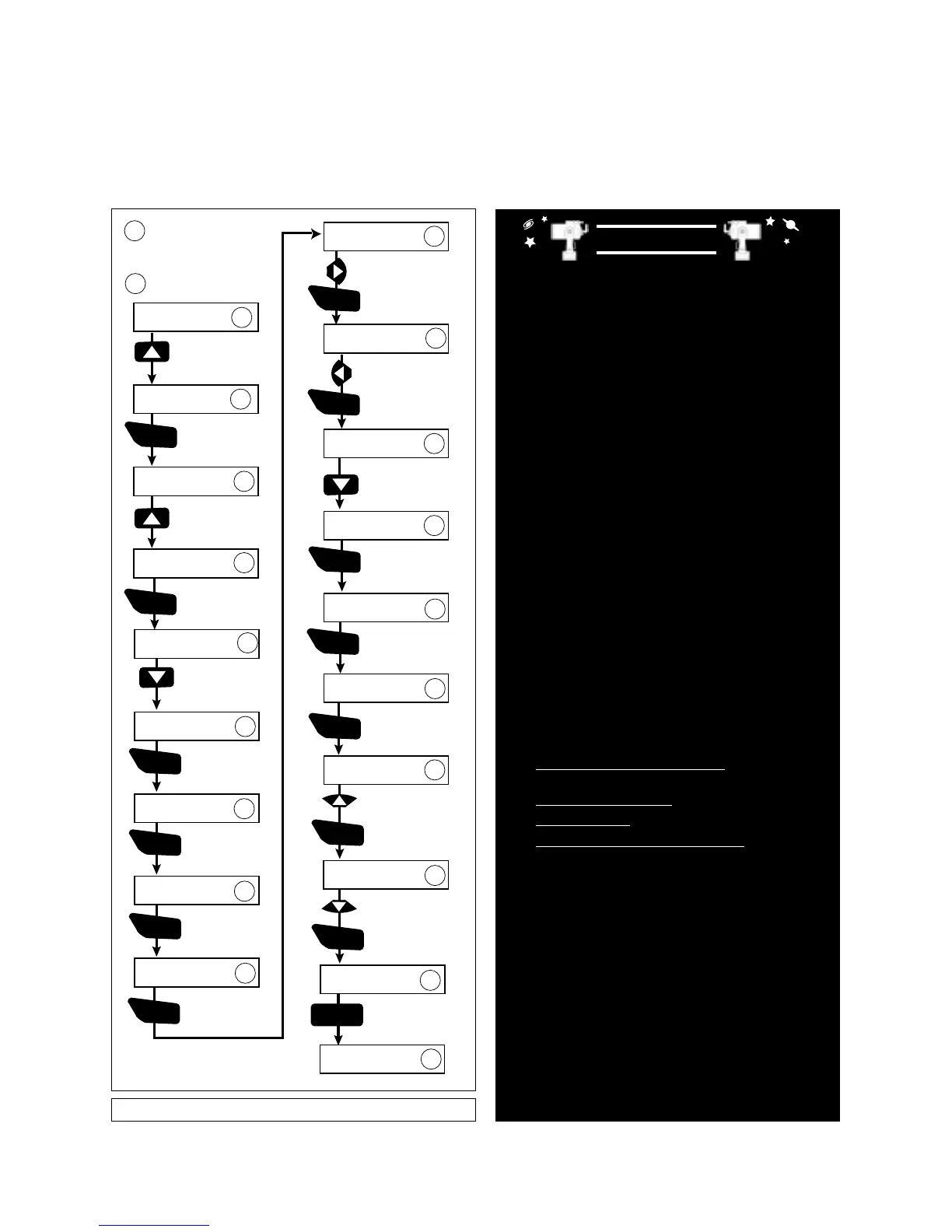
Az. Train
Alt. Train
Scope slews left.
Scope slews right.
Az. training.
training.
target.
Az. Train
keys.
Scope slews down.
Multiple presses.
menu.
Multiple presses.
Az. Train
object.
Multiple presses.
Drive option.
training.
target.
keys.
complete.
Further Study....
This manual gives only the briefest introduction to astron-
omy. If you are interested in pursuing further studies in
astronomy, a few topics are suggested below that are
worth reading up on. Try looking up some of these topics
in Autostar’s glossary.
Also included below is a small sampling of books, maga-
zines, and organizations that you might find helpful.
Topics
1. How is a star born? How does a solar system form?
2. How is the distance to a star measured? What is a
light year?
3. What is red shift and blue shift?
4. How are the craters on our Moon formed? How old
are the Moon and Earth? How old is the Sun?
5.
What is a black hole? A quasar? A neutron star?
6. What are stars made of? Why are stars different col-
ors? What is a white dwarf? A red giant?
7. What is a nova? A supernova?
8. What are comets? Asteroids? Meteors? Meteor
showers? Where do they come from?
9. What is a planetary nebula? A globular cluster?
10. What is the Big Bang? Is the universe expanding or
contracting, or does it always remain the same?
Books
1. The Guide to
Amateur Astronomy by Jack Newton
and Philip Teece
2. The Sky:
A User’s Guide by David Levy
3.
Turn Left at Orion by Guy Consolmagno & Dan Davis
4. Astrophotography for the Amateur by Michael
Covington
Magazines
1. Sky & Telescope
Box 9111, Belmont, MA 02178
2. Astronomy
Box 1612, Waukesha, WI 53187
Organizations:
1. Astronomical League
Executive Secretary
5675 Real del Norte, Las Cruces, NM 88012
2. The Astronomical Society of the Pacific
390 Ashton Ave, San Francisco, CA 94112
3. The Planetary Society
65 North Catalina Ave, Pasadena, CA 91106
APPENDIX C:TRAINING THE DRIVE


 To Next Page