10 EN
Troubleshooting
IX
If there is low Make sure
or no suction • the breastshield forms a complete seal around the breast.
• all connections of the kit and breastpump are secure.
• the white valve membrane is laying flat against the yellow valve
head. Check that the valve head and membrane are clean and
not damaged. See «Assembly Instructions».
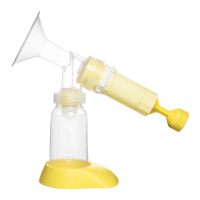
• the rubber seal is correctly attached onto piston.
• the piston/cylinder is correctly attached onto breastshield.
Storing and thawing Breastmilk
VIII
Storage
Storage guidelines for freshly expressed breastmilk (for healthy terms babies)
Room Temperature Refrigerator Freezer Thawed breastmilk
4–6 hours at 19 to 26 °C
(66 to 78 °F)
3–8 days at 4 °C (39 °F)
or lower
6–12 months –18 to
–20 °C (0 to 4 °F)
In refrigerator for 10h
max. Do not refreeze!
• Do not store breastmilk in the door of the refrigerator. Instead choose the coldest part
of the refrigerator (this is at the back of the glass shelf above the vegetable compart-
ment).
Freezing
• You can freeze expressed breastmilk in milk bottles or „Pump & Save“* bags. Do not
fill the bottles or bags more than 3/4 full to allow space for possible expansion.
• Label the bottles or „Pump & Save“ bags with the date of expression.
Thawing
Warning
Do not thaw frozen breastmilk or do not warm breastmilk in a microwave or a pan of
boiling water to avoid loss of vitamins, minerals and other important components and to
prevent burns.
• ln order to preserve the components of the breastmilk, thaw the milk in the refrigerator
overnight. Alternatively, you can hold the bottle or „Pump & Save“ bag under warm
water (max. 37 °C).
• Gently swirl the bottle or „Pump & Save“ bag to mix any fat that has separated. Avoid
shaking or stirring the milk.





 To Next Page