ENGLISH
41
OPERATION
Preparation
Always check before using the tool that all its parts are correctly fitted and working properly. Do not
use the tool if it is not working properly.
Secure the workpiece so that it cannot move or bend during the work. Mark out the sawing line on
the workpiece in a suitable manner.
Hold the tool firmly in the handles (3) and (13) with both hands.
Move the tool forwards, never backwards.
Place the tool with the front part of the base (4) towards the workpiece. Only move the tool against
the workpiece during the work.
Do not force the tool forwards too quickly, this can cause overheating or melting of the workpiece.
Use
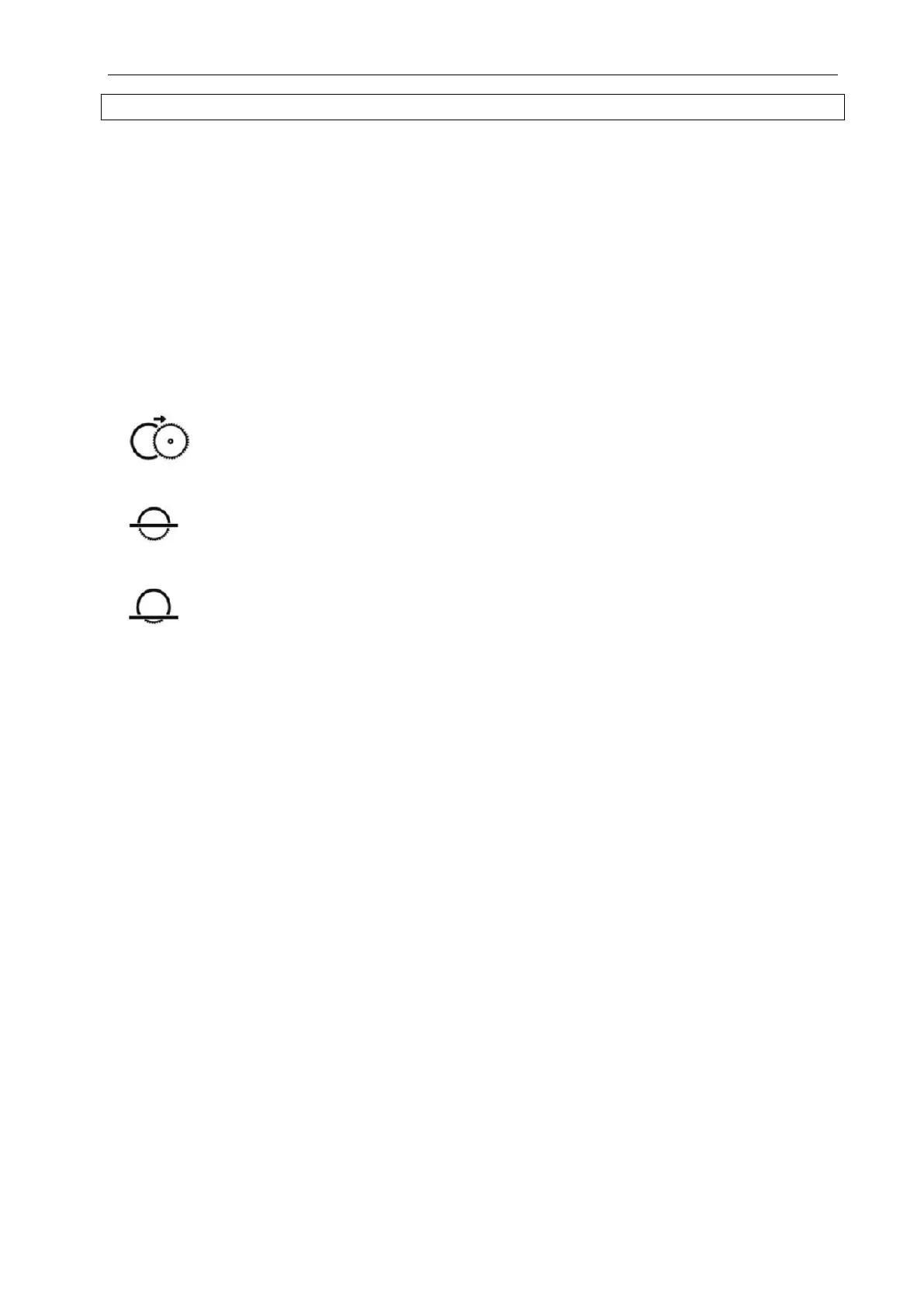
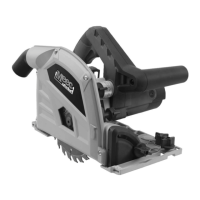
The plunge saw uses electronic control for the following functions. Use the selector (18) to set the
required power mode.
Sawing along the sawing line
NOTE: Only use blades that can withstand at least 5500 rpm.
Starting/Stopping
1. Press the lock button (1) for the power switch and then the power switch (2) to start the tool.
2. Release the power switch (2) to switch off the tool.
NOTE: When the lock button (1) for the power switch is pressed in this also releases the plunge
mechanism, so that the motor can be moved down. The blade comes out from the cover. When the tool is
lifted, the motor returns to the original position.
Adjusting the sawing depth
1. The sawing depth can be set from 0 to 54 mm according to the instructions below.
2. Release the knob for the depth setting and move it to the required depth on the depth scale.
3. Tighten the knob for the depth setting. The motor/blade can then be moved down to the set sawing
depth.
4. For clean, safe sawing the sawing depth should be set so that only one tooth extrudes below the
workpiece. NOTE: The depth scale only applies for sawing at 90°.
IMPORTANT:
If the tool is used without the guide rail the lever to compensate for the thickness of the rail must be lifted
up. If the tool is used with the guide rail the lever to compensate for the thickness of the rail must be used.
Using the guide rail = lever to compensate for thickness of rail down.
Guide rail not used = lever to compensate for thickness of rail lifted up.


 To Next Page