This document is a Service Guide for the MEG Trident Series Personal Computer, specifically the Trident B922 model. It is designed for MSI-authorized dealers or service centers and provides in-depth illustrations for disassembling and assembling the system. The guide emphasizes the importance of reading it from cover to cover first, although users may then directly access specific topics that meet their immediate needs.
Function Description
The MEG Trident Series Personal Computer is a personal computing device that allows users to perform various tasks, from everyday computing to more demanding applications like gaming or content creation. The service guide focuses on the internal components and their removal/installation, indicating a modular design that allows for upgrades, repairs, and maintenance. The system includes core components such as a CPU, CPU cooler, motherboard, memory, M.2 SSD, graphics card, and 3.5" HDD, all of which are covered in the disassembly and reassembly procedures.
Usage Features
While this guide primarily details service procedures, it implicitly highlights the upgradability and maintainability aspects of the MEG Trident Series. Users, or authorized service personnel, can:
- Upgrade and Replace Components: The guide provides instructions for removing and installing key components like the CPU, memory, M.2 SSD, graphics card, and 3.5" HDD. This indicates that the system is designed to allow for component upgrades to enhance performance or replace faulty parts.
- Access Internal Components: The initial steps involve removing side covers, which grants access to the internal layout of the PC. This is crucial for any internal maintenance or modification.
- Modular Design: The detailed steps for removing individual components suggest a modular design, where parts can be independently serviced or replaced without necessarily affecting other major components.
- Optional Storage Expansion: The inclusion of "Removing M.2 SSD (Optional)" and "Installing 3.5" HDD (Optional)" sections indicates that the system supports flexible storage configurations, allowing users to add or change storage devices based on their needs.
Maintenance Features
The Service Guide is a comprehensive resource for maintaining the MEG Trident Series Personal Computer. It covers essential aspects of safe and effective maintenance:
- Necessary Tools: The guide explicitly lists and illustrates the necessary tools for servicing the device: a screwdriver, pliers, tweezers, and anti-static gloves. This ensures that technicians are properly equipped before beginning any work.
- Safety Instructions: A dedicated section on "Safety Instructions" outlines critical precautions to prevent damage to the product or injury to the technician. These include:
- Referring servicing to qualified personnel only.
- Disconnecting all power sources and placing the product on a steady surface before disassembly/reassembly.
- Holding the connector part of the power cord when unplugging, never pulling the cord directly.
- Avoiding specific environmental conditions (mist, smoke, vibration, excessive dust, salty or greasy air, corrosive gases and fumes).
- Using an anti-static wrist strap and working in static-free areas to prevent electrostatic discharge when handling components.
- Handling components with care, avoiding touching pins or contacts.
- Placing components on a grounded anti-static pad or the bed they came with.
- Not performing maintenance with wet hands.
- Preventing foreign substances (water, other liquids, chemicals) from entering the product during disassembly/reassembly.
- Ensuring all screws are replaced and no stray screws remain after reassembly.
- Using only MSI-provided AC adapters if the product comes with one.
- Detailed Disassembly/Assembly Steps: The guide provides step-by-step instructions with accompanying images for removing and, by extension, installing various components. This includes:
- Removing Side Covers: Essential for initial access to the internal components.
- Right Side View and Left Side View: Provides an overview of the component layout, aiding in identification.
- Removing CPU Cooler Set: Involves unscrewing and flipping the cooler to access the motherboard.
- Removing CPU: Details the process of unscrewing the cooler, opening the load lever, and gently removing the CPU.
- Removing Memory: Explains how to release slot clips and remove memory modules.
- Removing M.2 SSD (Optional): Guides through locating the SSD, removing its screw, and gently pulling it from the slot.
- Removing Wireless Card: Describes removing the card clip, disconnecting antenna cables, removing the securing screw, and finally removing the card from its slot.
- Removing Graphics Card: Involves unscrewing the system bracket, flipping it outwards, removing screws from the graphics card bracket, disconnecting power connectors, and pressing the PCIE slot clip to release the card.
- Installing 3.5" HDD (Optional): Provides instructions for locating the HDD cage, inserting the HDD until it locks, and connecting power and signal cables.
- Important Notices: Throughout the guide, "Important" notes highlight critical information, such as warnings about electrostatic discharge, proper handling of components, and specific instructions for power connections (e.g., avoiding power splitters for GPU and ensuring full insertion of power cables).
- Upgrade and Warranty Information: The guide advises users to refer to the User Guide for upgrade limitations and to contact authorized dealers or service centers for upgrade or replacement services. This emphasizes the importance of professional assistance for complex procedures to maintain warranty validity and ensure proper functioning.
- Acquisition of Replaceable Parts: Information is provided on how to acquire replaceable parts, directing users to the MSI support website for detailed information, especially regarding parts availability within a specified timeframe after product discontinuation.
- Visual Aids: The inclusion of numerous images for each step significantly enhances the clarity and ease of understanding for technicians performing maintenance tasks. The images show the exact locations of screws, clips, and connectors, minimizing ambiguity.
- Reference Image Disclaimer: The guide notes that system photos are for demonstration only and that the internal view may vary by model, and graphics card appearance will vary. This manages expectations regarding visual discrepancies.

 Need help?
 General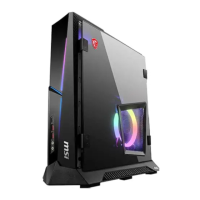

 To Next Page