6
OPERATION
Table 2 Installation methods
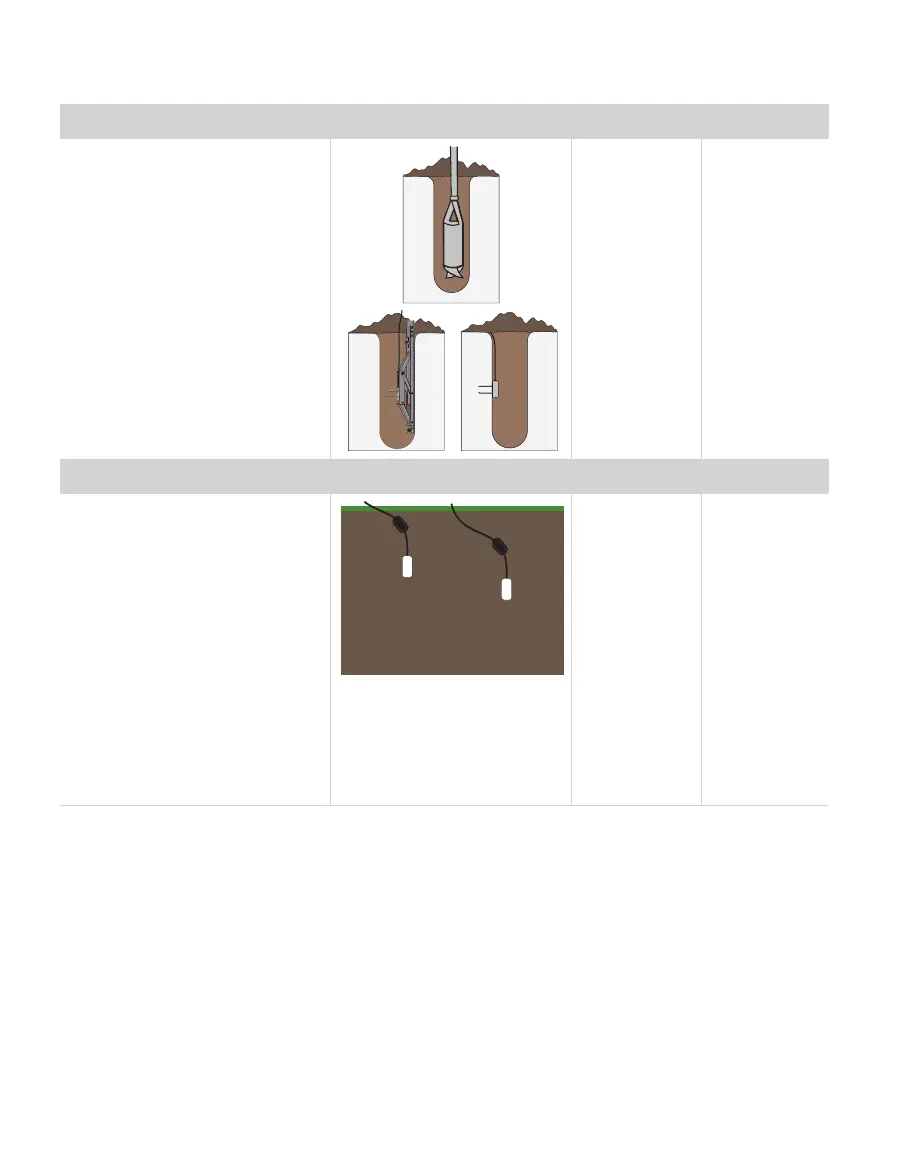
Borehole
This method uses the TEROS
Borehole Installation Tool
(Table1) that allows a prole
of soil moisture sensors to be
installed at different depths
within a single augered borehole.
A 10-cm (4-in) borehole is
augered vertically at the
measurement location. The
Borehole Installation Tool is then
used to install the sensors in the
sidewall of the borehole.
NOTE: The borehole method
Advantage
Minimizes soil
disturbance at
measurement
site.
Disadvantage
Requires a
specialized
installation
tool that can
be rented from
METER.
Trench
This method is best for shallow
installations (less than 40 cm).
This requires digging a trench
with a shovel, excavator, etc. The
trench needs to be dug to the
depth of the deepest installed
sensor. For deep installations, this
may require a large trench.
The sensor is installed carefully
by hand into the undisturbed soil
of the trench sidewall. The trench
is then carefully backlled to
preserve the bulk density of the
soil and to avoid dislodging the
installed sensor by accidentally
snagging the ferrite core.
Advantage
Does not
require
specialized
equipment.
Disadvantage
Large soil
disturbance at
measurement
site.
Potentially
large
excavation
effort.


 To Next Page